Voices of Work
3 min read
Voices of Work: Alexandra Aileru on Identity Translation and Modern Career Fit
Synopsis
Career coach Alexandra Aileru explains why modern resumes require identity translation for non-linear careers, and how job seekers can translate their experience into clear signals of value employers recognize.
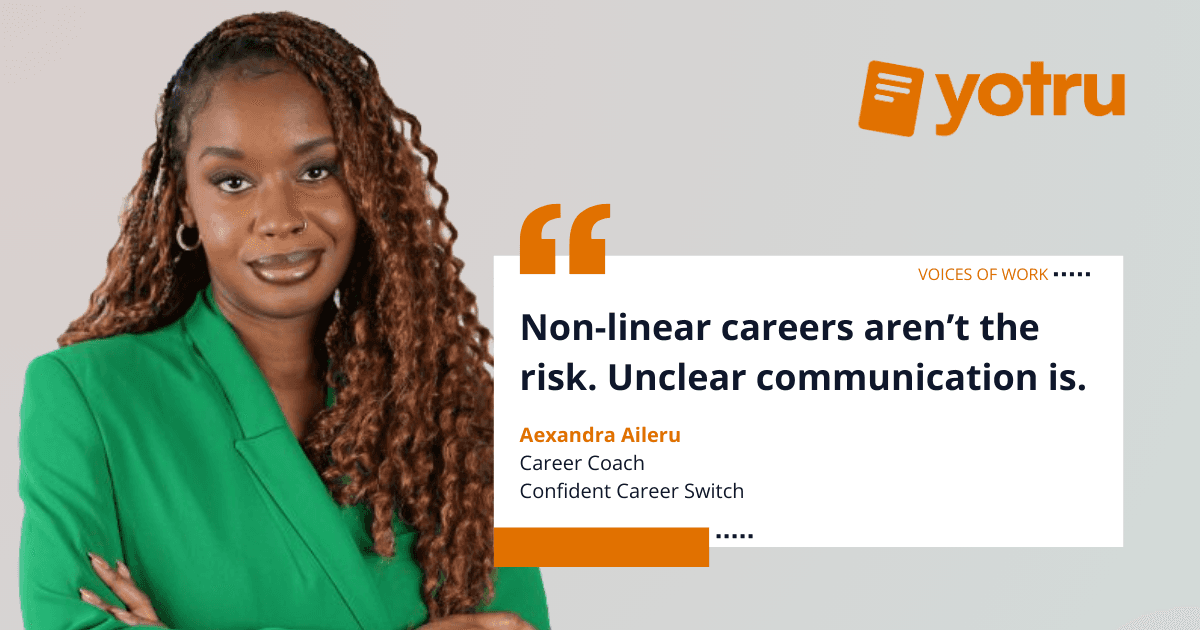
At Yotru, Voices of Work features people who are shaping how we hire, learn, and build sustainable careers. In this edition, we spoke with Alexandra Aileru, Career Rebranding Coach and Founder of Confident Career Switch.
Her perspective reflects a broader shift in career services: employers are no longer looking for better-formatted resumes, but clearer signals of value. Increasingly, the challenge is translating non-linear careers on a resume in a way that shows relevance, capability, and readiness, rather than job titles alone.
When Job Titles Stop Working
“For years, people were taught to treat job titles as identity markers,” Alexandra told us. “Today, titles are weak signals.”
Roles evolve faster than titles can keep up. What endures are transferable skills, patterns of contribution, and values. Alexandra sees many capable professionals struggle not because they lack experience, but because they lack language to explain their value beyond a past role.
“When people understand who they are, what they do well, and how they prefer to contribute, they can target roles where they will actually thrive,” she said. “Without that clarity, job searching becomes reactive and misaligned.”
The Translation Gap: Non-Linear Careers on a Resume
Traditional hiring systems still favor linear experience. That efficiency often works against career changers and professionals with non-traditional paths. Many career changers struggle to translate non-linear careers on a resume into the skills-first language employers now use in screening.
“The issue isn’t the experience itself,” Alexandra explained. “It’s the lack of translation.”
Career services teams are increasingly focused on helping people interpret their experience, surface impact, and communicate it in ways employers can trust. This work goes beyond rewriting bullets. It is about making value legible across contexts.
Skills Need Proof, Not Just Claims
As skills-based hiring expands, behavioral and cognitive skills such as communication, problem-solving, and adaptability matter more across roles. But Alexandra stresses that skills only count when they are demonstrated.
One practical approach she recommends is achievement-based storytelling: what was done, what changed, and how the work was delivered. This helps employers assess capability rather than background.
At Yotru, this is where structure matters. Identity translation is conceptually deep, but it does not need to be time-consuming. The thinking remains sophisticated, but the experience is intentionally simple. Many users move from reflection to a credible resume in minutes because the system handles the consistency and evidence requirements.
Better Fit Leads to Better Outcomes
For Alexandra, identity translation is not just about landing a role. It is about long-term fit.
“When identity, skills, and values align, hiring decisions improve on both sides,” she said. “People land in roles that fit, and organizations see stronger engagement and retention.”
In 2026, the resume is no longer the work. It is the output of clearer thinking, supported by better systems.
About the Contributor
Alexandra Aileru is a Career Rebranding Coach, Speaker, and Talent Consultant, and the Founder of Confident Career Switch. She helps professionals pivot into fulfilling roles without starting over and advises organizations on hiring and retaining career changers.
Editors Note: This article is part of Yotru's Voices of Work series, highlighting leaders who are redefining how people learn, lead, and get hired. To get featured, please contact us.
About the Author

Team Yotru
Employability Systems
Team Yotru
Employability Systems
We build practical career tools for training providers and workforce programs, combining labor market insights with real employment outcomes. Follow us on LinkedIn.
Frequently Asked Questions
Identity translation is the process of turning your skills, values, and experience into clear, employer-ready language that shows how you fit a role, especially with a non-linear career.
Audience Context
This article is for career practitioners, training providers, and job seekers navigating a labour market where job titles and linear paths no longer clearly signal value. It offers applied insight into how identity, skills, and evidence are translated in modern hiring, drawing on real-world practitioner experience.
Disclaimer
This content is provided for informational purposes only. It does not constitute career, hiring, or employment advice. Outcomes vary by role, employer, industry, and region, and readers should apply these insights within their own context.
Recommended Reading
Outcomes and CV signals
- Traits All Great Resumes Possess — Core traits hiring managers scan for
- What Methods Show Impact — Structure bullets around outcomes
- What Hiring Managers Notice First — Signals that stand out in seconds
- What Hundreds of Resumes Taught — Lessons from real CV reviews
- Resume Length: One or Two Pages — Scope and focus for 2026 CVs
Skills-first, not CV-first
- Skills in Resume for Freshers — Highlight skills, not just titles
- Why It Feels Hard to Get a Job — Market shift toward skills-first
- Why Interviews Feel Harder — Process vs real capability
- Job Search Strategies That Work — Strategies aligned with new filters
- How to Target Job Keywords — Matching skills to JD language
Character, values, and fit
- Emily Demirdonder on Character — Character over credentials
- Nicole Fougere on Trust — Trust, tools, and proof
- Gloria Espina on Suitability — Suitability beyond CV labels
- Green Flags in Interviews — Behavioural signals of fit
- What Really Matters in Interviews — How managers test for fit
Voices of Work and hiring trends
- Alex Kovalenko on Tech Hiring — Tech recruiter’s view on signals
- Amanda Main on Gen Z Pivot — Changing paths and proof
- Robert Hourie on AI & Instinct — AI plus recruiter judgment
- Em Richards on Storytelling — Story as evidence of value
- Danielle Ayodele on Safe Learning — Coaching toward measurable impact
References
- Bersin, J. (2022, October 16). Career pathways: An innovation that could transform the economy. Josh Bersin. https://joshbersin.com/2022/10/career-pathways-the-innovation-that-could-transform-the-economy/
- Burning Glass Institute. (2024, February 13). Skills-based hiring: The long road from pronouncements to practice. Burning Glass Institute. https://www.burningglassinstitute.org/research/skills-based-hiring-2024
- Courtois, C., Bertolotti, F., & Tagliaventi, M. R. (2025). Spotlight on identity construction among professionals transitioning to emerging occupations. Journal of Professions and Organization, 12(1), joae016. https://doi.org/10.1093/jpo/joae016
- Gouda-Vossos, A., Brooks, S., O'Sullivan, A. J., & Jovanovic, J. (2023). An evidence-based approach to employability curricula design: Closing the gap between graduate skills and employer expectations. Journal of University Teaching & Learning Practice, 20(4), Article 4. https://doi.org/10.53761/1.20.4.04
- Gunnels, C. W., IV, Groth, M., & Hund, A. (2025). Undergraduate research experiences grow career-ready transferable skills: A focus on communication and teamwork. Council on Undergraduate Research Quarterly, 45(4), 18–25.
- McKinsey Global Institute. (2023). Generative AI and the future of work in America. McKinsey & Company. https://www.mckinsey.com/mgi/our-research/generative-ai-and-the-future-of-work-in-america
- Murphy, C., & Kreiner, G. E. (2020). Occupational boundary strategies and the construction of professional identity. Academy of Management Journal, 63(3), 878–908. https://doi.org/10.5465/amj.2017.0701
- Shephard, N. (2022). The professional identity formation of career change teachers [Doctoral dissertation, Aston University]. Aston Publications Explorer. https://publications.aston.ac.uk/id/eprint/45614/
- Sullivan, S. E., & Al Ariss, A. (2021). Making sense of different perspectives on career transitions: A review and agenda for future research. Human Resource Management Review, 31(1), 100727. https://doi.org/10.1016/j.hrmr.2019.100727
- Tushar, H., Bharadwaj, S., & Shipley, A. (2023). Global employability skills in the 21st century workplace: A systematic literature review. Sustainability, 15(20), 15087. https://doi.org/10.3390/su152015087
Maintained by: Workforce Practice Group at Yotru
Review cycle: Regularly reviewed to reflect real-world practice
Last updated: February 10, 2026
Questions or Need Support?
If you are working on employability programs, hiring strategy, career education, or workforce outcomes and want practical guidance, you are in the right place.
Yotru supports individuals and organizations navigating real hiring systems. That includes resumes and ATS screening, career readiness, program design, evidence collection, and alignment with employer expectations. We work across education, training, public sector, and industry to turn guidance into outcomes that actually hold up in practice.