Market
12 min read
Sweden Jobs 2026: Hiring Trends + Salary Guide
Synopsis
Sweden enters 2026 with unemployment at 8.2% and recovering economic growth of 2.6-3.0%, creating a selective job market with strong opportunities in healthcare, IT, and green energy.
Whether you're a Swedish worker, a recent graduate, or an international professional considering opportunities in Sweden, understanding the structural labor constraints and skills premium dynamics is essential for making informed career decisions.
But the job market remains uneven. Youth unemployment tops 23%, while employers in healthcare, IT, engineering, and green energy struggle to fill specialized roles. Skills gaps are widening even as hiring demand rises. This guide highlights where opportunities are strongest — and how to tailor your resume with Yotru’s resume builder to stand out in Sweden’s shifting job landscape.
| Sweden 2026: labor market at a glance | ||
|---|---|---|
| Indicator | 2026 estimate | Job Outlook |
| Unemployment rate | 8.2% (Nov 2025); seasonally adjusted ~9%; youth unemployment 23.8% | Medium |
| Job vacancy level | 2.1% vacancy rate (Eurostat June 2025); one-third of employers struggle to find qualified workers | High |
| Top shortage sectors | Healthcare (aging population, rural gaps), IT/cybersecurity (30K+ shortage), green energy, construction trades | High |
| Real wage trend | ~3% nominal wage growth; real wage gains modest as inflation converges to 2% | Medium |
| Strongest profiles | IT specialists (AI, cybersecurity, software), registered nurses, engineers (electrical, building), renewable energy technicians | High |
Sources: Statistics Sweden (SCB), European Commission Economic Forecast, Swedish Public Employment Service, Eurostat
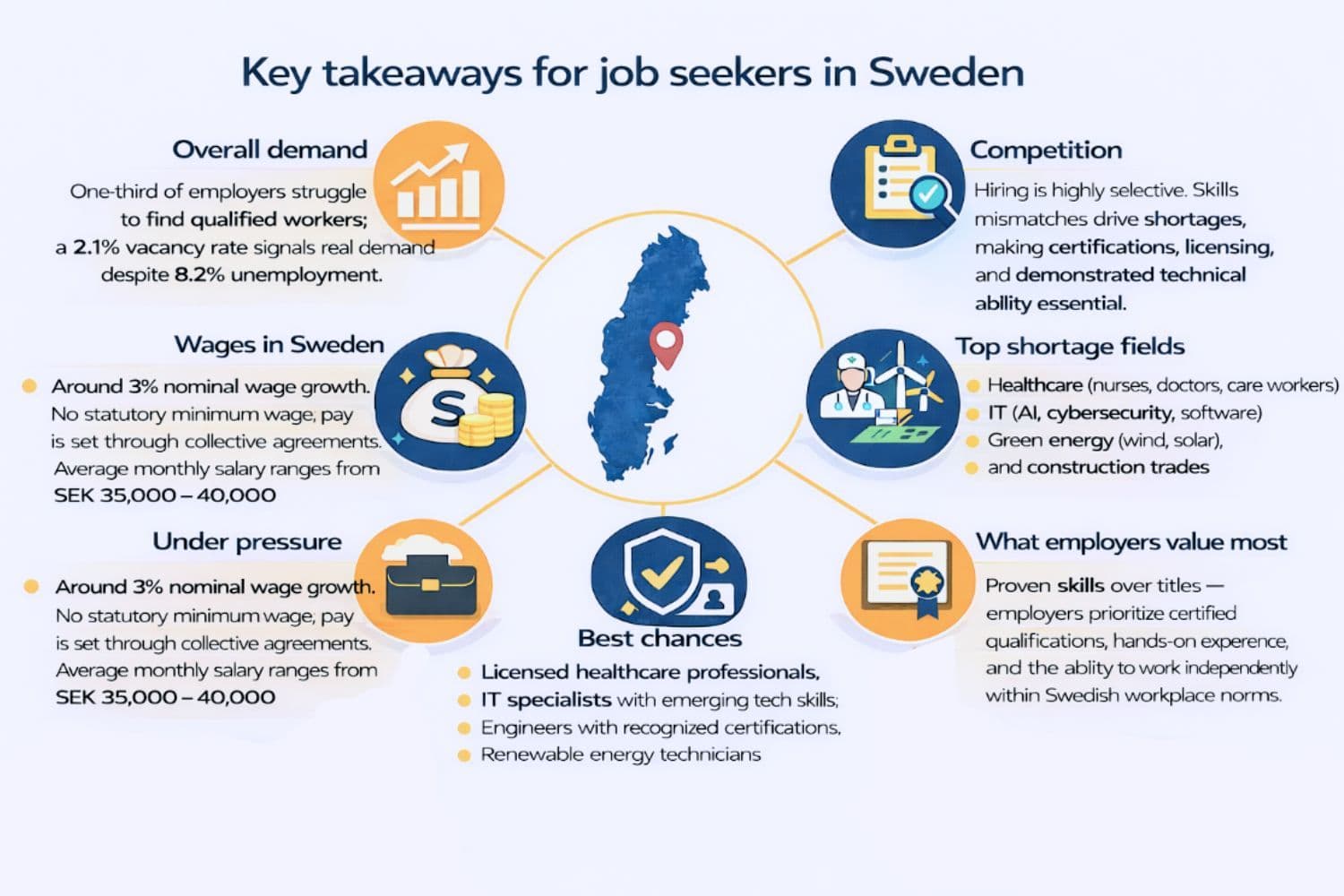
Key takeaways for job seekers in Sweden
- Overall demand: One-third of employers struggle to find qualified workers; vacancy rate 2.1% signals real demand despite 8.2% unemployment
- Competition: Hiring highly selective; skills mismatch drives shortages—certification, licensing, and demonstrated technical capability decisive
- Top shortage fields: Healthcare (nurses, doctors, care workers), IT (AI, cybersecurity, software), green energy (wind, solar), construction trades
- Under pressure: Administrative/clerical roles face automation; generalist roles without specialized credentials face stronger competition
- Wages in Sweden: ~3% nominal wage growth; no statutory minimum—rates set by collective agreements; average salary SEK 35,000–40,000 monthly
- Best chances: Licensed healthcare professionals, IT specialists with emerging tech skills, engineers with certification, renewable energy technicians
Jobs in Sweden by sector
Healthcare and nursing jobs in Sweden
Sweden faces severe healthcare shortages driven by an aging population, retiring professionals, and growing demand for complex care. Nurse shortage particularly acute; 80% of employers report recruitment difficulties. Rural areas face critical staffing gaps.
Salary in Sweden:
- Registered nurses (entry-level): SEK 37,000–42,000 monthly (SEK 444,000–504,000 annually)
- Registered nurses (experienced): SEK 42,000–50,000 monthly (SEK 504,000–600,000 annually)
- Specialist nurses (ICU, geriatrics, psychiatric): SEK 45,000–55,000 monthly (SEK 540,000–660,000 annually)
- General practitioners: SEK 70,000 monthly (SEK 840,000 annually)
- Specialist physicians: SEK 80,000–100,000 monthly (SEK 960,000–1,200,000 annually)
- Medical technologists: SEK 35,000 monthly (SEK 420,000 annually)
- Strongest demand: Rural regions, geriatric care, psychiatric nursing, primary care
Who's hiring:
- Public hospitals (Karolinska, Sahlgrenska, regional hospitals) — Largest employers; structured salary scales; strong benefits
- Regional healthcare authorities (21 regions) — Primary care; community healthcare; elderly care
- Private clinics and specialized care — Higher earning potential; growing sector
- Elder care facilities (äldreboende) — Critical shortages; expanding rapidly with aging population
- Rural healthcare facilities — Highest need; relocation support sometimes available
What you need:
- Swedish nursing license (legitimation): Required; international credentials must be recognized by Socialstyrelsen (National Board of Health and Welfare)
- Swedish language: B2-C1 level essential for patient safety and licensure
- Specialized certifications: ICU, geriatrics, psychiatric care, emergency care highly valued
- Cultural competence: Understanding Swedish healthcare system and patient rights essential
Job posting signals: "legitimerad sjuksköterska" (licensed nurse), "specialist sjuksköterska" (specialist nurse), "tillsvidareanställning" (permanent position), "bristyrke" (shortage occupation)
Hint
Public sector offers structured career progression and strong benefits (generous parental leave, pension, work-life balance) but competitive pay. Private sector may offer higher base salaries. Rural placements often include relocation support. Specialist nurse education (1-2 years) significantly boosts earning potential and career mobility.
If you're applying from abroad:
- Non-EU nurses must obtain credential recognition from Socialstyrelsen—process typically 6-12 months
- Swedish language proficiency (B2-C1) required for license and patient safety
- Some regions offer integration programs with language training for foreign-trained nurses
- EU Blue Card available for highly qualified healthcare professionals
- Focus resume on specialized skills, patient outcomes, and evidence-based practice
How Yotru helps: Yotru's resume builder helps healthcare professionals highlight specialized certifications, clinical experience, and Swedish language proficiency in formats that match Swedish employer expectations and pass ATS systems.
Technology and IT jobs in Sweden
Sweden faces massive tech talent shortage: estimated 30,000+ cybersecurity professionals needed, chronic shortage of software developers, AI specialists, and ICT practitioners. Tech sector anchored by Spotify, Ericsson, Klarna, King, and thriving startup ecosystem.
Salary in Sweden:
- Software developers (entry-level): SEK 30,000–50,000 monthly (SEK 360,000–600,000 annually)
- Software engineers (mid-level): SEK 45,000–60,000 monthly (SEK 540,000–720,000 annually)
- Senior software engineers: SEK 50,000–75,000 monthly (SEK 600,000–900,000+ annually)
- AI/machine learning specialists: SEK 55,000–80,000 monthly (SEK 660,000–960,000 annually)
- Cybersecurity specialists: SEK 50,000–75,000 monthly (SEK 600,000–900,000 annually)
- Data engineers/scientists: SEK 50,000–70,000 monthly (SEK 600,000–840,000 annually)
- IT architects/systems specialists: SEK 55,000–80,000 monthly (SEK 660,000–960,000 annually)
- Strongest demand: Stockholm, Gothenburg, Malmö; remote work increasingly common
Who's hiring:
- Tech giants (Spotify, Ericsson, Klarna, King) — Competitive pay; cutting-edge projects; equity compensation
- Startups and scale-ups — Fast growth; equity opportunities; innovation focus
- Financial services (banks, fintech) — Strong IT demand; regulatory compliance needs
- Consulting firms (Accenture, Deloitte, KPMG) — Client-facing roles; diverse projects
- Gaming industry — Strong Swedish presence; global reach
- Public sector digitalization — Government agencies modernizing systems; stable employment
What you need:
- Technical proficiency: Modern languages (Python, JavaScript, Java, C++, TypeScript), frameworks, cloud platforms (AWS, Azure, GCP)
- Specialized skills: AI/ML frameworks (TensorFlow, PyTorch), cybersecurity certifications (CISSP, CEH), DevOps tools
- Portfolio/GitHub: Demonstrated projects critical; degree less important than proven capability
- English fluency: Swedish not always required; English standard in tech sector
- Continuous learning: Field evolves rapidly; commitment to upskilling essential
Job posting signals: "systemutvecklare" (software developer), "mjukvaruingenjör" (software engineer), "cybersäkerhet" (cybersecurity), "AI/ML," "distansarbete möjligt" (remote work possible)
Hint
Stockholm tech salaries highest but cost of living also elevated. Gothenburg and Malmö offer strong tech scenes with lower living costs. Many companies offer flexible/remote work. Equity compensation common at startups. Collective agreements strong—even non-unionized tech workers benefit from sector standards. Top-tier companies (Spotify) pay SEK 1M+ total compensation for senior engineers.
If you're applying from abroad:
- EU Blue Card available for highly qualified tech professionals (salary threshold ~SEK 30,000 monthly)
- English-speaking roles abundant; Swedish not always required
- Portfolio and demonstrable skills matter more than formal credentials
- Remote work arrangements increasingly common—some companies hire internationally
- Focus resume on projects, impact, technical stack, and measurable outcomes
How Yotru helps: Yotru's resume builder helps IT professionals showcase technical skills, project impact, and relevant certifications in clean, ATS-friendly formats that tech recruiters and hiring managers expect.

Green energy and sustainability jobs in Sweden
Sweden committed to 100% renewable energy and carbon neutrality by 2045. Renewable energy sector experiencing skills shortage—wind, solar, battery storage, green hydrogen demand outpacing workforce supply. Green transition creating thousands of jobs.
Salary in Sweden:
- Renewable energy technicians: SEK 32,000–45,000 monthly (SEK 384,000–540,000 annually)
- Wind turbine technicians: SEK 35,000–50,000 monthly (SEK 420,000–600,000 annually)
- Solar installation specialists: SEK 30,000–45,000 monthly (SEK 360,000–540,000 annually)
- Environmental engineers: SEK 45,000–65,000 monthly (SEK 540,000–780,000 annually)
- Energy efficiency consultants: SEK 40,000–60,000 monthly (SEK 480,000–720,000 annually)
- Battery/storage specialists: SEK 45,000–70,000 monthly (SEK 540,000–840,000 annually)
- Strongest demand: Northern Sweden (wind), southern regions (solar), major cities (consulting)
Who's hiring:
- Energy companies (Vattenfall, E.ON, Statkraft) — Large-scale renewable projects; stable employers
- Installation and maintenance firms — Wind/solar deployment; growing rapidly
- Manufacturing (Northvolt, battery sector) — Green technology production; major investment
- Consulting firms — Sustainability advisory; corporate green transition support
- Public sector — Government agencies; climate policy implementation
- Startups — Clean tech innovation; venture-backed growth
What you need:
- Technical training: Renewable energy certifications, electrical/mechanical engineering background
- Safety certifications: Working at heights (wind turbines), electrical safety standards
- Problem-solving skills: Remote locations; troubleshooting critical
- Physical fitness: Demanding work environment; outdoor conditions
- Swedish language helpful: Especially for technician roles; English common in engineering
Job posting signals: "förnybar energi" (renewable energy), "vindkraftstekniker" (wind turbine technician), "solcellsinstallatör" (solar installer), "hållbarhet" (sustainability), "grön omställning" (green transition)
Hint
Northern Sweden (Norrbotten, Västerbotten) experiencing major industrial expansion driven by green steel, battery production, and renewable energy. Housing challenges emerging as workers relocate. Remote work not option for technician roles but engineers/consultants may have flexibility. Sector growing faster than training capacity—employers increasingly offering apprenticeships and on-the-job training.
If you're applying from abroad:
- Specialized renewable energy training/certifications valued globally
- Safety standards may require Swedish certification—verify requirements
- Remote locations may require Swedish language for daily life
- Some companies offer relocation packages for critical roles
- Focus resume on technical certifications, safety training, and hands-on experience
How Yotru helps: Yotru's resume builder helps green energy professionals highlight technical certifications, safety training, and project experience in formats that match Swedish employer expectations for skilled technical roles.
Construction and skilled trades jobs in Sweden
Construction sector recovering from housing downturn. Demand for skilled trades persistent—electricians, plumbers, carpenters, welders in short supply. Public infrastructure investment (defense, transport) boosting demand. Certification and licensing critical.
Salary in Sweden:
- Electricians (certified): SEK 35,000–50,000 monthly (SEK 420,000–600,000 annually)
- Plumbers (certified): SEK 32,000–48,000 monthly (SEK 384,000–576,000 annually)
- Carpenters: SEK 30,000–45,000 monthly (SEK 360,000–540,000 annually)
- Welders (certified): SEK 32,000–50,000 monthly (SEK 384,000–600,000 annually)
- Construction project managers: SEK 45,000–65,000 monthly (SEK 540,000–780,000 annually)
- HVAC technicians: SEK 33,000–48,000 monthly (SEK 396,000–576,000 annually)
- Strongest demand: Major cities (Stockholm, Gothenburg, Malmö), infrastructure projects
Who's hiring:
- Construction firms (Skanska, NCC, Peab) — Large-scale projects; structured employment
- Electrical/plumbing contractors — Smaller firms; residential and commercial
- Public infrastructure projects — Government-funded; defense installations
- Real estate companies — Property management; renovations
- Industrial facilities — Manufacturing plants; maintenance roles
- Self-employment/consulting — Skilled trades often work independently
What you need:
- Swedish certifications: Authorized electrician (auktoriserad elinstallatör), certified plumber, etc. required for many roles
- Vocational training: Swedish system emphasizes apprenticeships and practical training
- Safety training: Construction site safety, working at heights, confined spaces
- Driver's license: Often required for mobility between job sites
- Swedish language: Essential for safety, teamwork, customer interaction
Job posting signals: "behörig elektriker" (authorized electrician), "legitimerad rörmokare" (certified plumber), "byggnadsarbetare" (construction worker), "hantverksyrke" (craft profession), "yrkesbevis" (professional certificate)
Hint
Swedish construction follows strict certification requirements—international credentials may not transfer directly. Authorization process can take time. Collective agreements set wage floors and benefits—sector well-organized. Self-employment common for experienced trades; requires business registration (F-skatt). Rural areas sometimes offer faster authorization paths than urban centers.
If you're applying from abroad:
- EU Blue Card typically not route for trades—work permits require job offers
- Swedish certification requirements stringent—research recognition process early
- Swedish language essential—safety and client communication critical
- Some employers sponsor certification process for experienced tradespeople
- Focus resume on certifications, safety training, specialized skills (e.g., green building)
How Yotru helps: Yotru's resume builder helps construction and skilled trades professionals highlight certifications, safety training, and specialized technical skills in formats that meet Swedish employer expectations and ATS requirements.

Market changes shaping Sweden's job market in 2026
Economic recovery and fiscal stimulus
After prolonged economic weakness (2022-2024), Sweden experiencing recovery: GDP growth accelerating from 1.5% (2025) to 2.6-3.0% (2026). Government implementing expansionary fiscal policy—tax cuts, defense spending, infrastructure investment totaling ~1% of GDP. Household real wages recovering as inflation converges to 2% target. Riksbank rate cuts (policy rate 1.75% expected) reducing mortgage costs, boosting consumption. Recovery consumption-led initially; business investment following with lag.
Impact on hiring: Recovery gradual but strengthening. Public sector investment creating jobs in defense, infrastructure, education. Consumer-facing sectors (retail, hospitality) stabilizing. Manufacturing export-dependent—global uncertainty still weighs. Hiring selective—productivity focus persists. Skills-specific shortages remain despite elevated unemployment.
Skills mismatch and structural unemployment
Sweden faces structural paradox: 8.2% unemployment coexists with one-third of employers unable to find qualified workers. Skills mismatch particularly severe for:
- Youth (23.8% unemployment) lacking work experience and vocational training
- Migrants (particularly non-EU) with credential recognition challenges and language barriers
- Long-term unemployed whose skills degraded or became obsolete
- Lower-skilled workers displaced by automation and digitalization
Meanwhile acute shortages persist in:
- Healthcare (licensed nurses, specialist physicians)
- IT (software developers, cybersecurity, AI specialists)
- Engineering (electrical, building services, chemical)
- Skilled trades (electricians, plumbers requiring Swedish certification)
- Green energy (renewable technicians, environmental engineers)
Impact on hiring: Certification, licensing, demonstrated technical capability decisive. Generalist and administrative roles face automation pressure. Adult education, upskilling programs expanding. Labor market training, internships, subsidized employment growing. Matching problems challenge—workforce system adapting slowly. Candidates with specialized credentials face strong demand despite high headline unemployment.
Demographic shifts and aging workforce
Sweden's population aging rapidly. Workforce demographics challenging:
- Large cohort retiring (born 1950s-1960s)
- Healthcare demand surging as over-65 population grows
- Pension system strain creating labor force participation incentives
- Birth rates low—domestic workforce growth limited
- Migration essential for workforce replenishment
Impact on hiring: Healthcare shortages intensifying—nurses, care workers critical need. Knowledge transfer challenges as experienced workers retire. Older worker retention strategies emerging (flexible arrangements, phased retirement). International recruitment expanding—particularly healthcare, IT, engineering. Immigration policy focus on skills-based pathways (EU Blue Card, shortage occupation lists).
Green transition and industrial transformation
Sweden committed to carbon neutrality by 2045. Green transition reshaping economy:
- Renewable energy (wind, solar) expanding rapidly
- Green steel production (LKAB, H2 Green Steel) creating thousands of jobs
- Battery manufacturing (Northvolt) major industrial investment
- Electrification (vehicles, industry) requiring new skills
- Northern Sweden (Norrbotten) experiencing industrial boom
Impact on hiring: New occupations emerging—renewable energy technicians, battery specialists, environmental engineers, sustainability consultants. Traditional industries adapting—auto sector shifting to EVs; manufacturing decarbonizing. Skills gap severe—training capacity lagging demand. Geographic disparities—northern regions booming; housing/infrastructure challenges. Green skills premium emerging across sectors.
Getting started: Job search in Sweden
Sweden's job market operates through unique channels combining formal application processes, collective agreements, networking, and structured hiring norms. Understanding how Swedish employers hire is essential.
Application basics
- Resume format: Swedish CV typically 2-3 pages; reverse chronological; clear structure. Personal details limited (no photo, age, marital status required). Focus on skills, achievements, measurable outcomes. English acceptable for international companies; Swedish required for most public sector and traditional employers.
- Cover letter: Called "personligt brev"—essential for most applications. Typically 1 page. Explain motivation, fit, relevant experience. Formal yet personable tone. Swedish language unless job posting in English.
- Application method: Online application systems dominant. Follow instructions precisely. Some companies use CV databases (LinkedIn profiles important). Public sector often uses structured application forms.
- Timeline: Swedish hiring processes can be lengthy (2-3 months not uncommon). Multiple interview rounds standard. Reference checks mandatory—prepare 2-3 professional references.
Job search channels
Arbetsförmedlingen (Public Employment Service): Government employment agency; job listings; services for job seekers including counseling, training programs. Not sole channel—many jobs not posted there.
Online job boards:
- Arbetsförmedlingen.se (public employment service)
- LinkedIn (widely used, especially tech sector)
- Indeed.se, Monster.se (general job boards)
- Stepstone.se, Academic Work (recruitment agencies)
- Company websites (direct applications)
Recruitment agencies: Common in Sweden—many companies outsource hiring. Agencies specialize by sector (tech, healthcare, finance, etc.). Register with relevant agencies.
Networking: Swedish job market relationship-driven. LinkedIn essential. Professional networks (alumni, industry groups) valuable. Informational interviews ("informationsintervju") culturally accepted.
Company applications: Direct applications ("spontanansökan") accepted—even without posted vacancies. Research target companies; tailor application.
Work permits for non-EU citizens
EU/EEA/Nordic citizens: No work permit required; freedom of movement applies.
Non-EU citizens: Work permit required before entering Sweden. Must have job offer before applying. Process:
- Employer posts job for 10+ days (EU/EEA applicants priority)
- Job offer secured with contract meeting Swedish standards (salary, insurance, conditions)
- Apply for work permit from outside Sweden
- Processing time: 4-12 months (varies)
- Permit tied to specific employer initially
EU Blue Card: Available for highly qualified professionals. Requirements:
- University degree or 5+ years specialized experience
- Job offer in skilled occupation
- Minimum salary threshold (varies by region—typically ~SEK 30,000 monthly)
- Faster processing; mobility within EU after 18 months
Self-employment: Possible but complex. Must demonstrate viability, financial resources. Often requires establishing company.
Important
Immigration rules changed 2024-2025—increased salary thresholds for work permits. Verify current requirements with Swedish Migration Agency (Migrationsverket).
Swedish workplace culture
- Consensus and collaboration: Swedish workplaces emphasize teamwork, flat hierarchies, consensus decision-making. Managers facilitate rather than dictate. Input from all levels valued.
- Work-life balance: Core Swedish value. 40-hour work week standard. 25 days minimum vacation (many get more). Parental leave generous (480 days shared). Overtime rare and compensated.
- Punctuality and planning: Meetings start on time. Schedules respected. Advance planning expected. Last-minute changes uncommon.
- Communication style: Direct but diplomatic. Honesty valued but delivered tactfully. Silence acceptable—Swedes comfortable with pauses. Small talk limited in professional settings.
- Equality and informality: First names used regardless of hierarchy. Gender equality strong. Disability accommodations standard. LGBTQ+ inclusion high.
- Fika: Coffee break tradition; social and professional bonding. Informal but important. Participate when invited.
Credentials and education
- Credential recognition: International degrees often recognized but verification required for regulated professions (healthcare, engineering, teaching, law). Contact Swedish Council for Higher Education (UHR) for evaluation.
- Regulated professions: Require Swedish authorization—healthcare professionals, teachers, lawyers, authorized electricians, etc. Process varies by profession—can take 6-12 months.
- Language requirements: Swedish language often required for professional authorization and public-facing roles. English sufficient in tech, international business, some academic positions.
- Continuous education: Lifelong learning culturally valued. Many employers support further education. Vocational training (yrkesutbildning) highly regarded—alternative to university degree.
Your job search game plan for Sweden
1. Target your search
Focus on shortage areas like healthcare, IT, green energy, or skilled trades. Check where demand is highest—major cities or regional areas. Make sure your qualifications are recognized in Sweden, understand any licensing requirements, and assess whether Swedish language skills are needed. Use tools like Statistics Sweden (SCB) to research realistic salary levels before applying.
2. Prepare your application materials
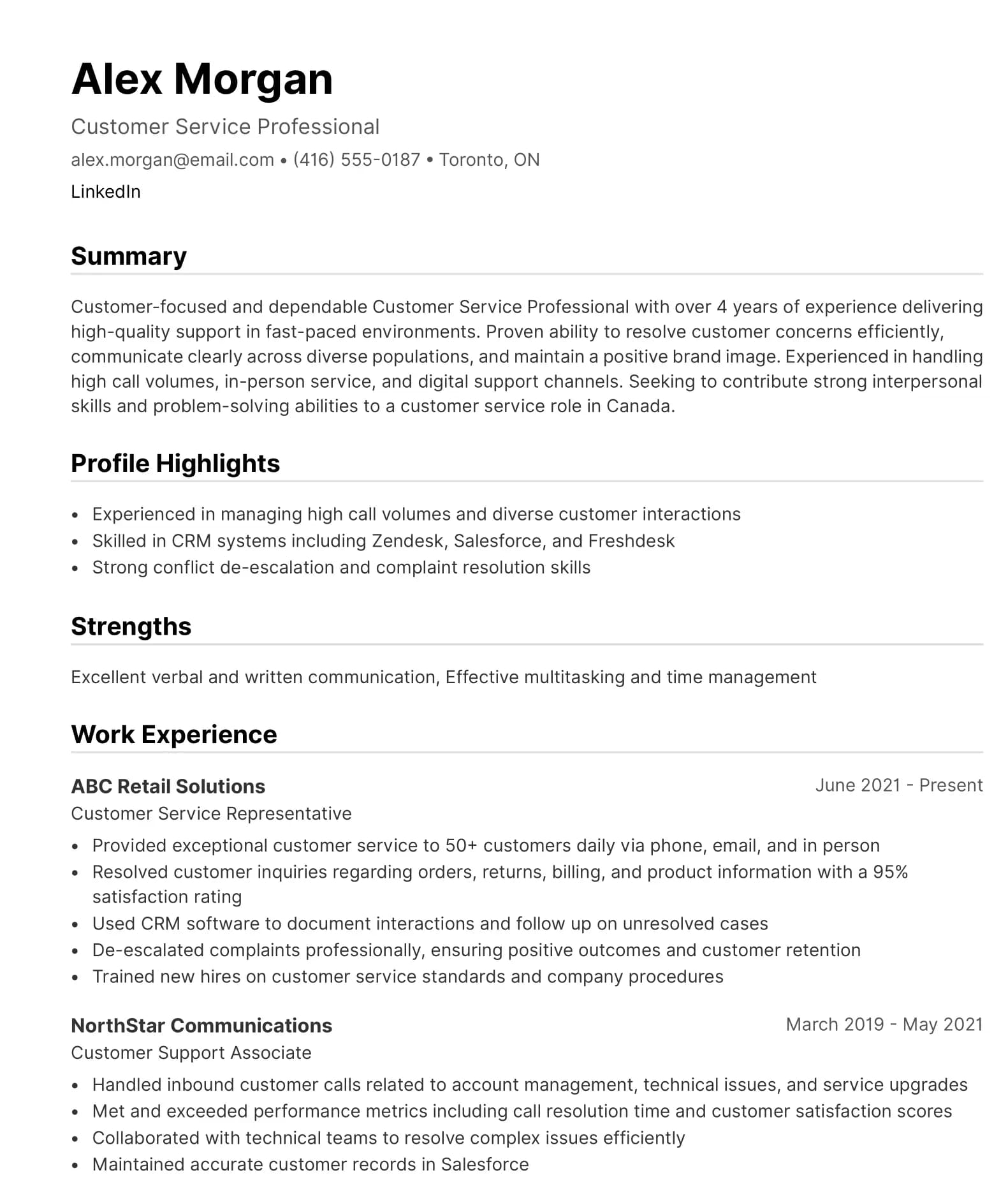
Resume (CV): Use Yotru's resume builder to create clean, ATS-friendly Swedish-format CV emphasizing:
- Measurable achievements and outcomes
- Relevant certifications and technical skills
- Language proficiency (specify levels: A1-C2)
- International experience (if applicable)
- No photo/age/personal details beyond contact information
Cover letter (personligt brev):
- Write in Swedish for Swedish-language job postings
- Explain motivation, cultural fit, specific interest in company/role
- 1 page maximum
- Formal yet warm tone
References:
- Prepare 2-3 professional references (Swedish format: name, title, company, contact info, relationship)
- Inform references in advance—Swedish employers always check
Credentials:
- Obtain credential evaluations early if needed (regulated professions)
- Gather certificates, diplomas, proof of work experience
- Translate key documents to Swedish if required
3. Apply strategically
Use multiple channels like Arbetsförmedlingen, LinkedIn, company websites, and recruiters. Tailor each application to the role—generic applications rarely work. Follow instructions carefully and apply directly to companies, even if no role is advertised. Networking matters, especially on LinkedIn.
4. Navigate the interview process
Prepare well by researching the company and role. Expect multiple interview stages. Be punctual, clear, and specific when discussing your experience. Use real examples. Ask thoughtful questions about the team and role, and send a short follow-up message after interviews.
5. Negotiate your offer
There is no minimum wage, so salaries depend on sector agreements. Research market rates before negotiating. Discuss benefits such as pension, vacation, remote work, and development support. Review contract terms carefully, including probation and notice periods.
6. For international applicants
You must secure a job offer before applying for a work permit. Processing can take several months. Some roles qualify for the EU Blue Card. Many employers offer relocation support. Learning Swedish helps long term, and registering for a personal ID number is essential for work, banking, and healthcare.
Pro Tip
Over 65,700 people participated in upskilling initiatives in 2025. Completing recognized programs (especially İŞKUR vocational training or university partnerships with employers) signals commitment and provides direct connections to hiring companies.
ATS-Optimized resumes That Meet Employer Standards
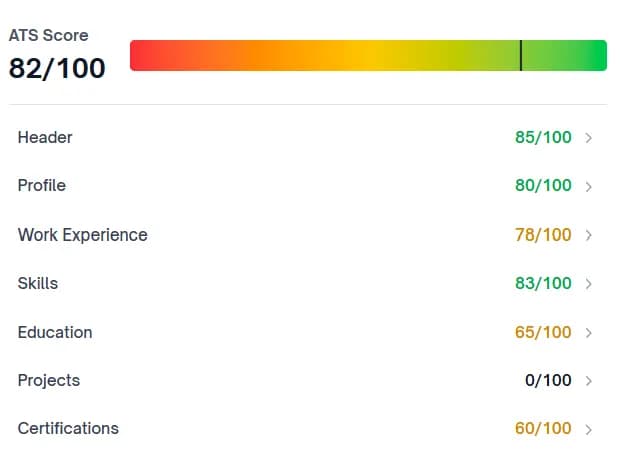
Our AI-powered scoring system helps organizations assess and standardize resume quality at scale. ATS-compliant templates support consistent formatting, keyword alignment, and interview readiness across cohorts.
Frequently asked questions
Sweden's job market in 2026 is characterized by elevated unemployment (8.2%) alongside persistent skills shortages—a structural mismatch challenge. Economic recovery strengthening (GDP growth 2.6-3.0%) driven by fiscal stimulus and recovering household consumption. Hiring selective but strong demand in healthcare (nurses, doctors), IT (software developers, cybersecurity, AI), green energy (renewable technicians), and skilled trades (electricians, plumbers). Youth unemployment high (23.8%); long-term unemployment persists. Skills, certification, and demonstrated capability decisive—credentials without specialization face competition.
About the Author

Team Yotru
Employability Systems
Team Yotru
Employability Systems
We build practical career tools for training providers and workforce programs, combining labor market insights with real employment outcomes. Follow us on LinkedIn.
Related Resources
Continue exploring related perspectives on career development, hiring trends, and workforce change.
Market and Research
- Hiring Trends in UK— UK job market outlook examining sectors hiring international workers, language requirements, and skilled migration pathways.
- Hiring Trends in Ireland— Ireland job market guide for international professionals, including tech sector demand and English-language opportunities.
- Hiring Trends in the United States— U.S. labor market conditions showing easing demand and persistent sectoral shortages.
- Hiring Trends in Canada — Canadian labor market outlook examining regional variations and skill requirements.
- Professional Networking Strategies— How to Build Connections That Lead to Career Opportunities
Resume Building and Optimization
- Make Your Resume ATS-Friendly in 5 Minutes— Simple, fast changes that help your resume pass applicant tracking systems without keyword stuffing.
Audience Context
This analysis draws on data from Statistics Sweden (SCB), the Swedish Public Employment Service (Arbetsförmedlingen), OECD economic surveys, European Commission forecasts, and Nordic banking sector reports. It integrates employment statistics, sector demand indicators, and economic projections to reflect current and emerging trends in Sweden's labor market.
References
- Bloomberg. (2025, December). Sweden's economic growth to almost double in 2026, Ministry says. Bloomberg News. https://www.bloomberg.com/
- CEDEFOP. (2021, October). Sweden: Mismatch priority occupations. European Centre for the Development of Vocational Training. https://www.cedefop.europa.eu/en/data-insights/sweden-mismatch-priority-occupations
- EURES. (2025). Labour market information: Sweden. European Employment Services. https://eures.europa.eu/living-and-working/labour-market-information/labour-market-information-sweden_en
- European Commission. (2025, November). Economic forecast for Sweden. European Commission. https://economy-finance.ec.europa.eu/economic-surveillance-eu-member-states/country-pages/sweden/economic-forecast-sweden_en
- Eurostat. (2025). Job vacancy statistics - Sweden. European Union. https://ec.europa.eu/eurostat
- Government of Sweden. (2025, November). Labour market policy and employment measures. Government Offices of Sweden. https://www.government.se/government-policy/labour-market/
- National Institute of Economic Research. (2025, December). Swedish economic outlook and forecast. Konjunkturinstitutet. https://www.konj.se/
- Nordea. (2025). Swedish economic outlook: Regaining confidence. Nordea Bank. https://www.nordea.com/
- OECD. (2025). OECD economic surveys: Sweden 2025 - Strengthening skills and labour market matching. OECD Publishing. https://www.oecd.org/en/publications/2025/06/oecd-economic-surveys-sweden-2025
- Skandinaviska Enskilda Banken. (2025, January). Nordic outlook: Stable growth despite challenges from all sides. SEB. https://sebgroup.com/
- Statistics Sweden. (2025). Labour force surveys (LFS). Statistiska Centralbyrån. https://www.scb.se/en/AM0401-en
- Swedbank. (2025, December). Swedish economic outlook: The recovery has begun. Swedbank Group. https://www.swedbank.com/
- Swedish Agency for Growth Policy Analysis. (2024). Labor and skills shortages: A knowledge overview. Tillväxtanalys. https://www.tillvaxtanalys.se/
- Swedish Migration Agency. (2025). Work permits and EU Blue Card - Sweden. Migrationsverket. https://www.migrationsverket.se/
- Swedish Public Employment Service. (2025). Labour market outlook and forecast 2026-2027. Arbetsförmedlingen. https://arbetsformedlingen.se/
Research Methodology
This analysis draws on publicly available data from Swedish government agencies (Statistics Sweden, Swedish Public Employment Service), European economic institutions (European Commission, Eurostat, OECD), and financial sector research (Swedbank, SEB, Nordea). It integrates employment statistics, sector-level demand indicators, skills gap analysis, and economic forecasts to reflect current and emerging trends in Sweden's 2026 job market.
Salary Data Normalization
Salary figures reflect estimated monthly and annual gross earnings in Swedish Krona (SEK) before taxes. Data is normalized using aggregated job postings, industry salary surveys, Statistics Sweden wage data, and employer-reported ranges to account for regional variation (Stockholm vs. smaller cities), role seniority, sector differences (public vs. private), and experience levels. Actual compensation varies based on experience, employer type, location, collective agreements, and negotiated terms. Swedish tax system is progressive (average ~30% but varies by income level).
Editorial Standards
Yotru provides factual labor market information to support informed career decisions. We do not guarantee employment outcomes. Information reflects conditions as of late 2025; verify current trends independently. We maintain editorial independence from employers, staffing agencies, and training providers..
Disclaimer
This content is for informational purposes only and does not constitute legal, financial, or professional advice. Labor market conditions change; verify information independently before making career decisions. Individual results vary by qualifications, experience, and circumstances.
Maintained by: Labor Intelligence Group at Yotru
Review cycle: Monitored as market conditions evolve
Last updated: December 31, 2025
Questions or Need Support?
If you are working on employability programs, hiring strategy, career education, or workforce outcomes and want practical guidance, you are in the right place.
Yotru supports individuals and organizations navigating real hiring systems. That includes resumes and ATS screening, career readiness, program design, evidence collection, and alignment with employer expectations. We work across education, training, public sector, and industry to turn guidance into outcomes that actually hold up in practice.