
Platform
6 min read
Career Platforms in Education: What Works and Why It Matters
Synopsis
A career platform for education helps UK schools, colleges, and training providers deliver personalised guidance at scale. Learn what features drive real student outcomes.
Career guidance in UK education has changed substantially over the past decade. The Gatsby Benchmarks established clear expectations, Ofsted sharpened its focus on careers provision, and digital tools became central to how institutions deliver support.
Key Insight
A career platform for education is not a replacement for qualified guidance. It is infrastructure that makes guidance more effective by handling administrative functions, freeing advisers to focus on strategic support.
Yet many careers leaders still struggle with fragmented systems. Spreadsheets track one thing, a separate website handles another, and evidence of impact requires hours of manual compilation.
A career platform for education consolidates these functions. It provides the technology infrastructure that enables personalised guidance at scale, systematic tracking, and the evidence that inspectors and funders require.
This guide examines how career platforms work in educational settings, what distinguishes effective solutions from ineffective ones, and how UK providers can evaluate options for their context. For guidance specifically focused on employability tools, see our companion article on employability platforms for education.
The Changing Landscape of Careers Provision
The Gatsby Charitable Foundation published its original benchmarks in 2014. Since then, achievement has risen significantly. The average number of benchmarks achieved by secondary schools and colleges increased from 1.8 out of eight in 2017 to 5.8 in 2024.
This progress reflects substantial effort by careers leaders, supported by infrastructure from The Careers & Enterprise Company and improved government guidance. Yet challenges remain.
The 2024 benchmark updates emphasised several themes that technology can address:
- Personalisation: Provision must be tailored to each learner's needs, not delivered uniformly.
- Inclusion: Particular attention to disadvantaged students and those with SEND.
- Evidence: Demonstrable impact, not just activity.
- Engagement: Meaningful encounters and experiences, not tick-box exercises.
Career platforms emerged partly in response to these demands. When you have 1,500 students and one careers leader, technology becomes essential for delivering personalised provision.
What a Career Platform Actually Does
The term "career platform" covers a range of tools with varying capabilities. At its core, a career platform for education should support three functions:
Learner-Facing Tools
These are the resources students use directly. They might include:
- Career exploration interfaces showing pathways and required qualifications
- Labour market information presenting local and national job data
- Self-assessment tools helping students understand their interests and strengths
- CV and personal statement builders
- Interview preparation resources
The quality of these tools matters enormously. Students form impressions of careers guidance based on what they interact with. Outdated interfaces, irrelevant content, or confusing navigation undermine engagement before guidance even begins.
Staff-Facing Administration
Behind the scenes, careers leaders need tools to manage provision:
- Tracking which students have engaged with careers activities
- Recording guidance meetings and action points
- Scheduling employer encounters and work experience
- Identifying students who need intervention
- Generating reports for governors, inspectors, and funders
Manual approaches to these tasks consume time that could be spent on direct student support.
Institutional Reporting
Schools and colleges must demonstrate that careers provision is effective. This requires data:
- Destination outcomes (employment, further study, apprenticeships)
- Engagement rates across different student groups
- Progress against Gatsby Benchmarks
- Impact of specific interventions
Career platforms should produce this reporting automatically, drawing on data already collected through normal use. For providers prioritising outcome measurement, our guide on education outcomes platforms examines this in detail..
Features That Matter Most
Not all career platforms deliver equal value. When evaluating options, it is important to focus on features that support real operational needs, learner outcomes, and reporting requirements, rather than surface-level functionality.
- Career exploration: Tools such as clear pathways, labour market information, and self-assessment help students make informed, realistic decisions about their next steps.
- Document creation: Practical CV builders and personal statement support ensure learners leave with usable, application-ready documents rather than unfinished drafts.
- Tracking: Engagement, meetings, and activity tracking provide evidence of provision while helping teams identify participation gaps across cohorts.
- Reporting: Alignment with frameworks such as the Gatsby Benchmarks and destination reporting supports inspection readiness and continuous improvement.
Labour Market Information Integration
Effective career guidance requires accurate labour market information. Students making decisions about A-level choices, apprenticeships, or university courses need to understand employment prospects, salary expectations, and skills demand.
Look for platforms that integrate current LMI data, ideally drawing from sources like the Office for National Statistics, sector skills councils, and regional labour market analyses.
Hint
The Careers & Enterprise Company publishes regional labour market information through its Career Hubs. Platforms that integrate or reference this data provide more relevant local context than those offering only national statistics.
Gatsby Benchmark Alignment
The updated Gatsby Benchmarks specify what good careers provision looks like. Career platforms should explicitly support benchmark achievement.
✔ Gatsby-aligned capabilities
- Built-in Gatsby Benchmark tracking
- Activity mapping to specific benchmarks
- Progress reporting by benchmark
- Evidence generation for inspections
✖ Not suitable
- Platforms designed for other education systems
- Tools without benchmark alignment features
- Systems requiring manual benchmark tracking
Accessibility and Inclusion
The updated benchmarks emphasise inclusion, with particular attention to students with SEND and those from disadvantaged backgrounds. Career platforms should support this through:
- Accessibility features meeting WCAG standards
- Content suitable for learners with varying literacy levels
- Customisation options for individual needs
- Monitoring to ensure all groups engage equitably
Integration with Existing Systems
Career platforms do not operate in isolation. They must work alongside other institutional systems including:
- Management Information Systems (MIS): Student data, attendance, and demographic information often resides in systems like SIMS, Arbor, or Bromcom. Platforms that integrate with MIS reduce duplicate data entry.
- Compass+: Many careers leaders use The Careers & Enterprise Company's Compass+ tool for self-evaluation. Career platforms should support or complement this.
- Virtual Learning Environments: If careers content is delivered through platforms like Google Classroom or Microsoft Teams, integration enables smoother student access.
Pro Tip
Before selecting a career platform, map your current systems and data flows. Identify where integration would save time and where standalone functionality is acceptable. This prevents purchasing solutions that create more work rather than less.
Implementation: Common Pitfalls
Technology implementation in education frequently fails not because the software is poor but because implementation is mishandled.
Underestimating Training Requirements
Staff need time to learn new systems. Budget for initial training sessions and ongoing support as staff encounter new situations. Assuming that intuitive interfaces require no training consistently proves wrong.
Neglecting Student Onboarding
Students will not use tools they do not understand or see value in. Structured introduction, ideally embedded in PSHE or tutorial time, builds engagement. Simply providing login details and hoping for the best produces minimal uptake.
Failing to Secure Leadership Buy-In
The updated Gatsby Benchmarks emphasise that careers provision is a whole-institution endeavour. Without senior leadership support, career platforms become marginalised as "the careers leader's thing" rather than integrated into institutional practice.
Ignoring Data Quality
Platforms produce valuable data only if that data is accurate. Establish clear protocols for data entry and regularly audit quality. Garbage in, garbage out applies to careers tracking as much as any other system.
For detailed implementation guidance, our article on choosing an education employability platform covers the full procurement and setup process.
Evaluating Impact
Career platforms represent an investment. Demonstrating return on that investment requires clear evaluation.
Process Measures
These track engagement and activity:
- Student login rates and time spent on platform
- CV completion rates
- Career exploration activity
- Participation in guided activities
Process measures indicate whether the platform is being used. They do not, by themselves, demonstrate impact.
Outcome Measures
These track destinations and satisfaction:
- NEET rates at post-16 and post-18
- Progression to intended destinations
- Student satisfaction with guidance received
- Quality of employment or study secured
Outcome measurement requires longer timescales. The HESA Graduate Outcomes survey, which contacts graduates 15 months after completion, provides a useful model. Students' situations immediately after leaving education often differ from their medium-term outcomes. For detailed guidance on outcome measurement methodology, see our article on measuring career outcomes in education.
Comparative Analysis
Where possible, compare outcomes before and after platform implementation, or between student groups with different levels of engagement. This helps isolate the platform's contribution from other factors affecting destinations.
Important
Establish baseline measurements before implementing a new platform. Without baseline data, you cannot demonstrate that the platform has improved outcomes, even if results are positive.
The Role of AI in Career Platforms
Artificial intelligence features increasingly appear in career platforms. These range from sophisticated to superficial.
Potentially valuable applications:
- Matching student profiles to relevant career pathways
- Generating CV content based on structured input
- Personalising labour market information to individual interests
- Identifying students who may need intervention based on engagement patterns
Applications requiring caution:
- Fully automated guidance without human oversight
- AI-generated career advice without quality assurance
- Predictive tools that may reinforce existing inequalities
The key question is whether AI features genuinely improve outcomes or simply provide marketing differentiation. Ask vendors for evidence of effectiveness, not just feature descriptions.
Getting Started
For careers leaders considering a career platform, a structured evaluation process helps identify the right solution.
- Define requirements: What specific problems does the platform need to solve? Which features are essential versus desirable?
- Involve stakeholders: Gather input from senior leadership, teaching staff, and students. Their needs differ, and all must be addressed.
- Request demonstrations: See platforms in action with realistic scenarios, not just polished demos.
- Check references: Speak with similar institutions already using the platform. Ask about implementation challenges, ongoing support, and actual outcomes.
- Pilot before committing: Where possible, trial platforms with a subset of students before institution-wide rollout.
Yotru's platform for educators provides AI-powered career tools designed specifically for UK educational settings. It combines student-facing resume building and career exploration with the institutional tracking and reporting features that careers leaders need.
About the Author

Team Yotru
Employability Systems
Team Yotru
Employability Systems
We build practical career tools for training providers and workforce programs, combining labor market insights with real employment outcomes. Follow us on LinkedIn.
Frequently Asked Questions
A career platform for education is software that supports careers provision in schools, colleges, and training providers. It typically combines student-facing tools like career exploration and CV building with staff-facing administration and reporting features.
Yotru Platform
Employer-Ready Resume Solutions Hub
- Career Development Platform— AI platform for compliant, employer-ready resumes.
- Employer Hiring Signals— Standardized resumes with clear pre-interview hiring signals
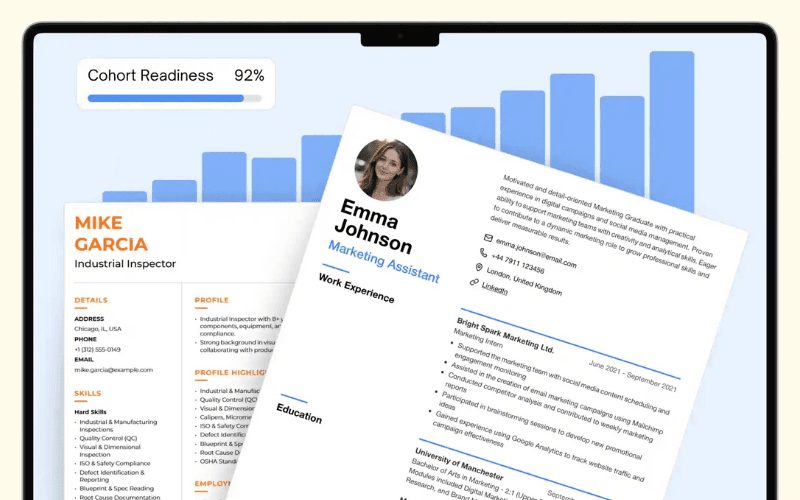
- Educator Resume Platform— Standardize learner resumes and track cohort readiness.
- Workforce Resume Builder— Employer-ready resumes for workforce clients with tracking.
- Outplacement Resume Support— Support transitions with standardized, employer-ready resumes.
- Recruitment Resume Signals— Role-aligned resumes plus readiness scores for recruiters.
Audience Context
This article is written for careers leaders, education administrators, and decision-makers evaluating career platform options for UK schools, colleges, and training providers. It addresses practical selection and implementation considerations.
Research Methodology
Analysis draws on published Gatsby Foundation research, Department for Education guidance, Ofsted inspection frameworks, and Careers & Enterprise Company resources. Platform functionality analysis reflects common features across the education technology sector.
Editorial Standards
Yotru maintains Editorial Policy standards requiring accuracy, neutrality, and regular review. Content is updated as guidance and technology evolve.
Disclaimer
This article provides general information about career platforms in education. Specific implementation decisions should consider individual institutional circumstances. Outcomes vary based on implementation quality, student engagement, and local labour market conditions.
Related Resources
Related Yotru Articles
- Career Platforms in Education: What Works and Why – Comprehensive guide to career technology selection for educational settings
- Choosing an Education Employability Platform – Practical procurement and implementation guidance for UK providers
- Building Effective Training Provider Employability – How ITPs deliver employability support under new Gatsby requirements
- Measuring Career Outcomes in Education – Understanding outcome measurement methodology and using data for improvement
- Education Outcomes Platforms: Connecting Support to Results – Technology that links employability provision to measurable destinations
Platform and Product Resources
- Yotru Platform Overview – Complete platform capabilities for education and workforce organisations
- Yotru for Educators – Tools designed for UK schools, colleges, and training providers
- Yotru for Workforce Development – Supporting regional skills and employment programmes
Additional Resources
- Applying Gatsby Benchmark 3 in Adult and Vocational Education – Personalising guidance in post-16 settings
- How Training Providers Can Evidence Gatsby Benchmarks Without Overloading Careers Teams – Practical approaches to compliance
- Why University Career Services Teams Are Loving Yotru's AI Resume Builder – Higher education applications
- Resume Outcomes for Training Providers – Measuring the impact of CV support
- Why Libraries Are Key to Career Building – Community partnerships in careers provision
References
- Gatsby Charitable Foundation. (2024). Good Career Guidance: The Next Ten Years. https://www.gatsby.org.uk/education/programmes/good-career-guidance
- Gatsby Benchmarks. (2025). A New Chapter for Careers Guidance. https://www.gatsbybenchmarks.org.uk/news/a-new-chapter-for-career-guidance-updated-gatsby-benchmarks-adopted-into-government-guidance-for-schools-colleges-and-itps/
- Department for Education. (2025, May). Careers guidance and access for education and training providers. GOV.UK. https://www.gov.uk/government/publications/careers-guidance-provision-for-young-people-in-schools
- Ofsted. (2023, September). Independent review of careers guidance in schools and further education and skills providers. GOV.UK. https://www.gov.uk/government/publications/independent-review-of-careers-guidance-in-schools-and-further-education-and-skills-providers
- The Careers & Enterprise Company. (2025). Updated Gatsby Benchmarks adopted into latest government guidance. https://www.careersandenterprise.co.uk/news/updated-gatsby-benchmarks-adopted-into-latest-government-guidance-for-schools-colleges-and-itps/
- Gatsby Benchmarks. (2025). Now it's time for ITPs to step up on careers advice. https://www.gatsbybenchmarks.org.uk/thought-leadership/now-its-time-for-itps-to-step-up-on-careers-advice/
- Career Development Institute. (2020). Framework for Careers, Employability and Enterprise Education. https://www.thecdi.net/CDI/media/Write/Documents/CDI-Framework-Jan2020-web.pdf
- Department for Education. (2024). Skills bootcamps starts, completions and outcomes, Financial year 2023-24. GOV.UK. https://explore-education-statistics.service.gov.uk/find-statistics/skills-bootcamps-starts-completions-and-outcomes/2023-24
- HESA. (2025). Graduate Outcomes 2022/23: Summary Statistics. https://www.hesa.ac.uk/news/17-07-2025/sb272-higher-education-graduate-outcomes-statistics
- Luminate. (2025). What do graduates do? 2025/26. https://luminate.prospects.ac.uk/what-do-graduates-do
Maintained by: Platform & Systems Group at Yotru
Review cycle: Reviewed periodically to reflect evolving hiring trends
Last updated: February 2, 2026
Questions or Need Support?
If you are working on employability programs, hiring strategy, career education, or workforce outcomes and want practical guidance, you are in the right place.
Yotru supports individuals and organizations navigating real hiring systems. That includes resumes and ATS screening, career readiness, program design, evidence collection, and alignment with employer expectations. We work across education, training, public sector, and industry to turn guidance into outcomes that actually hold up in practice.