Research
6 min read
Measuring Career Outcomes in Education: What Matters and How to Track It
Synopsis
Career outcomes data shapes funding, inspection results, and institutional reputation. This guide explains how UK education providers measure, track, and improve learner destinations.
When 82% of 2022/23 UK graduates reported being in employment or unpaid work 15 months after graduation, that figure shaped decisions across the education sector. Universities used it to demonstrate value. Policymakers assessed higher education policy effectiveness. Prospective students weighed investment against likely returns.
Career outcomes in education have moved from peripheral interest to central concern. Funding increasingly ties to employment metrics. Ofsted examines destinations as evidence of education quality. Parents and learners choose providers partly based on outcome data.
Yet measuring career outcomes effectively presents substantial challenges. What counts as a "good" outcome? When should measurement occur? How do we attribute outcomes to education versus other factors?
This guide examines how UK education providers can approach career outcomes measurement thoughtfully, using data to improve provision rather than just satisfy compliance requirements. For providers looking to strengthen the employability support that drives these outcomes, our guide to choosing an education employability platform addresses the technology infrastructure that enables systematic tracking.
Key Insight
Career outcomes in education measurement serves multiple purposes: accountability, improvement, and learner support. Effective approaches balance all three rather than optimising for any single use.
Why Career Outcomes Measurement Matters
Interest in career outcomes stems from several converging pressures.
Accountability Requirements
Education providers at all levels face outcome-focused accountability:
- Schools and colleges: Ofsted examines destinations data as part of personal development judgements. The Gatsby Benchmarks require evidence that careers provision produces measurable impact. An effective career platform for education can automate much of this evidence collection.
- Higher education: The Office for Students uses outcome data in its regulatory approach. Graduate Outcomes survey results influence institutional rankings and public perception.
- Training providers: Skills Bootcamps, apprenticeships, and funded programmes increasingly tie payment to employment outcomes. Our guide on training provider employability examines how ITPs can build provision that delivers strong outcomes.
Improvement Evidence
Beyond compliance, outcome data enables genuine improvement:
- Identifying which programmes produce strong destinations
- Spotting learner groups with worse outcomes who need additional support
- Evaluating whether interventions actually work
- Making evidence-based decisions about provision development
Learner Information
Prospective learners deserve accurate information about likely outcomes from different educational pathways. Outcome data, properly presented, supports informed decision-making.
Defining "Good" Outcomes
Before measuring, define what constitutes success. This is less straightforward than it appears.
Employment as Outcome
Employment is the most common outcome measure. But not all employment is equivalent:
- Full-time vs part-time: Is part-time employment a positive outcome? It depends on whether the learner wanted full-time work.
- Skill level: Is employment in a role requiring degree-level qualifications different from employment that does not?
- Relevance: Does employment relate to the field of study? Should it?
- Quality: Is the employment secure, fairly paid, and offering progression prospects?
The HESA Graduate Outcomes survey captures some of this nuance, distinguishing full-time from part-time employment and assessing whether graduates feel their role fits their future plans.
Further Study as Outcome
Progression to further study is typically counted as a positive outcome. But context matters:
- Planned progression to postgraduate study represents success
- Further study taken reluctantly due to poor employment prospects is different
- Further study that delays rather than enhances career entry may not benefit learners
Other Positive Outcomes
Some outcomes do not fit employment or study categories but still represent success:
- Entrepreneurship and self-employment
- Caring responsibilities chosen positively
- Gap years with defined purpose
- Portfolio working combining multiple activities
Outcome frameworks that recognise only employment or study miss learners whose paths are equally valid but structurally different.
Hint
The Graduate Outcomes survey asks whether activity is "meaningful" and "fits with future plans". These questions capture outcome quality beyond simple employment status.
Timing of Measurement
When outcomes are measured has a major impact on how reliable and meaningful the results are. Measuring immediately after completion is easy because learners are still reachable, but results often reflect unstable early-career activity. Measuring at 3–6 months provides more settled outcomes, though some learners are still transitioning.
By 12–15 months, outcomes are more representative of sustained employment or study, but response rates decline as graduates become harder to contact. Measuring 3–5 years later shows long-term career trajectories, although it becomes much harder to attribute outcomes directly to the education or programme.
The HESA Graduate Outcomes survey measures at 15 months post-graduation, striking a balance between stability and contactability. For providers measuring outcomes internally, using multiple touchpoints rather than a single snapshot is more effective. Contact at 3, 12, and 24 months allows providers to track progression over time instead of relying on one-off results.
Pro Tip
Build outcome tracking into programme design from the start. Collect contact details with explicit consent for follow-up. Maintain engagement through alumni networks or newsletters. Response rates depend heavily on maintaining relationships after learners complete
Data Collection Methods
Outcome data comes from several sources with different strengths and limitations.
Surveys
Direct surveys ask learners about their activities. The Graduate Outcomes survey contacts over 900,000 graduates annually.
Strengths:
- Captures learner perspective
- Can assess subjective measures (satisfaction, meaning)
- Relatively rich data per respondent
Limitations:
- Response rates vary (51% for UK graduates in 2022/23)
- Self-reported data may contain errors
- Non-response bias can skew results
Administrative Data Linkage
Linking education records with HMRC employment data or benefits records provides population-level outcome information.
Strengths:
- No response rate issues
- Objective employment and earnings data
- Long-term tracking possible
Limitations:
- Limited to what administrative systems capture
- Cannot assess subjective outcomes
- Privacy and data protection complexity
Destination Measures
Schools and colleges track destinations through local data collection, often supported by local authority processes.
Strengths:
- Direct provider control
- Can capture local context
- Enables immediate follow-up with unknown outcomes
Limitations:
- Consistency varies between providers
- Resource-intensive to conduct well
- May miss learners who move away
Interpreting Outcome Data
Raw outcome data requires careful interpretation to generate useful insight.
Contextual Factors
Outcomes reflect more than education quality:
- Labour market conditions: Recession years produce worse outcomes regardless of provision quality.
- Geographic factors: Regional employment opportunities vary substantially.
- Learner characteristics: Prior attainment, socioeconomic background, and other factors influence outcomes independent of provision.
Meaningful comparison requires controlling for, or at least acknowledging, these contextual factors.
Compositional Effects
Providers with different learner populations will produce different outcomes even with identical provision quality. Comparing a selective university's graduate outcomes with those of a provider serving disadvantaged communities without adjustment is misleading.
Value-added approaches attempt to measure the provider contribution beyond what learner characteristics alone would predict. These are methodologically complex but conceptually important.
Survivor Bias
Outcome measures typically capture those who complete programmes successfully. They may miss:
- Learners who dropped out before completion
- Those who completed but had such poor outcomes they could not be contacted
- Learners who left due to problems that also affected later employment
Understanding non-completion rates alongside completer outcomes provides fuller picture.
Using Outcome Data for Improvement
The most valuable use of outcome data is driving genuine improvement, not just satisfying accountability requirements.
Identifying Gaps
Disaggregate outcome data by:
- Learner characteristics: Do some groups have systematically worse outcomes? This might indicate provision not meeting their needs.
- Programme area: Do some courses produce better outcomes than others? What explains the differences?
- Support accessed: Do learners who engaged with careers support have better outcomes? This helps evaluate intervention effectiveness. An employability platform for education can track this engagement automatically.
Targeted Intervention
When data identifies groups with worse outcomes, targeted intervention becomes possible:
- Additional careers support for groups with lower employment rates
- Programme modifications for courses with poor destination relevance
- Early intervention when patterns suggest emerging problems
Closing the Loop
Connect outcome data back to current provision:
- Share outcome information with learners to inform their decisions
- Use alumni experiences to enrich current career guidance
- Involve employers who hired graduates in curriculum development
Important
Outcome improvement requires acting on data, not just collecting it. Build processes to review outcome data regularly and make changes based on findings. Data collection without action wastes resources.
Challenges and Limitations
Honest outcome measurement acknowledges inherent limitations.
Attribution Problem
Education is one of many factors affecting career outcomes. Separating provider contribution from:
- Learner ability and effort
- Family connections and social capital
- Labour market conditions
- Luck and timing
remains methodologically challenging. Outcome data reflects all these factors combined, not provider effectiveness alone.
Gaming Risks
When outcomes affect funding or reputation, incentives to game measures emerge:
- Encouraging less-employable learners not to complete
- Focusing resources on learners likely to respond to surveys
- Defining outcomes in ways that inflate positive rates
Accountability systems must balance measurement rigour against perverse incentive creation.
Burden and Cost
Effective outcome tracking requires sustained investment:
- Survey administration and follow-up
- Data management systems
- Analysis capacity
- Action implementation
Smaller providers may lack resources for sophisticated tracking, creating measurement inequality across the sector.
Technology and Platforms
Technology can reduce the burden of outcome tracking while improving data quality. An education outcomes platform combines the tracking infrastructure needed for measurement with the employability tools that improve outcomes in the first place.
Tracking Systems
Platforms that track learner progress during programmes can extend to post-completion follow-up:
- Maintaining contact details and consent
- Automating survey distribution
- Aggregating responses for analysis
- Generating compliance reports
Data Visualisation
Making outcome data accessible to staff and leaders supports its use for improvement:
- Dashboards showing key metrics over time
- Comparison views across programmes and learner groups
- Drill-down capability to investigate patterns
Integration
Outcome tracking works best when integrated with:
- Current learner management systems
- Career and employability support platforms
- Alumni engagement systems
Yotru's platform supports this integrated approach, combining learner-facing employability tools with institutional tracking that extends beyond programme completion to capture outcome data.
About the Author

Team Yotru
Employability Systems
Team Yotru
Employability Systems
We build practical career tools for training providers and workforce programs, combining labor market insights with real employment outcomes. Follow us on LinkedIn.
Frequently Asked Questions
Career outcomes in education refer to the employment, further study, or other activities learners progress to after completing educational programmes. Measuring these outcomes helps assess whether education effectively prepares learners for their next steps.
Yotru Platform
Employer-Ready Resume Solutions Hub
- Career Development Platform— AI platform for compliant, employer-ready resumes.
- Employer Hiring Signals— Standardized resumes with clear pre-interview hiring signals
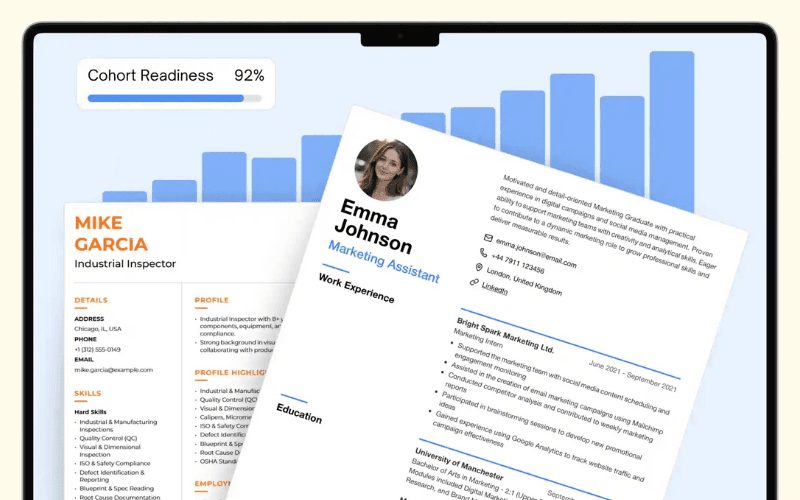
- Educator Resume Platform— Standardize learner resumes and track cohort readiness.
- Workforce Resume Builder— Employer-ready resumes for workforce clients with tracking.
- Outplacement Resume Support— Support transitions with standardized, employer-ready resumes.
- Recruitment Resume Signals— Role-aligned resumes plus readiness scores for recruiters.
Audience Context
This article is written for UK education professionals responsible for measuring, reporting, or improving learner career outcomes. It addresses practical challenges in outcome tracking while acknowledging methodological limitations.
Research Methodology
Analysis draws on published HESA Graduate Outcomes survey methodology and findings, Department for Education destination measures guidance, and academic literature on education outcome measurement. Recommendations reflect established practice in the education sector.
Editorial Standards
Yotru maintains Editorial Policy standards requiring accuracy, neutrality, and regular review. Content is updated as methodology and reporting requirements evolve.
Disclaimer
This article provides general information about career outcomes measurement in education. Specific approaches should consider individual institutional circumstances and regulatory requirements. Outcomes reflect multiple factors beyond provider control.
Related Resources
Further Insights
Related Yotru Articles
- How Employability Platforms Transform Education Outcomes – Understanding platform capabilities for tracking and improving learner destinations
- Career Platforms in Education: What Works and Why – Comprehensive guide to selecting career technology for educational settings
- Choosing an Education Employability Platform – Practical procurement and implementation guidance
- Building Effective Training Provider Employability – How ITPs deliver employability support that produces strong outcomes
- Education Outcomes Platforms: Connecting Support to Results – Technology that links employability provision to measurable destinations
Platform and Product Resources
- Yotru Platform Overview – Complete platform capabilities for education and workforce organisations
- Yotru for Educators – Tools designed for UK schools, colleges, and training providers
- Yotru for Workforce Development – Supporting regional skills and employment programmes
Additional Resources
- Applying Gatsby Benchmark 3 in Adult and Vocational Education – Personalising guidance in post-16 settings
- How Training Providers Can Evidence Gatsby Benchmarks Without Overloading Careers Teams – Practical approaches to compliance
- Why University Career Services Teams Are Loving Yotru's AI Resume Builder – Higher education applications
- Resume Outcomes for Training Providers – Measuring the impact of CV support
- Why Libraries Are Key to Career Building – Community partnerships in careers provision
References
- HESA. (2025, July). Graduate Outcomes 2022/23: Summary Statistics. https://www.hesa.ac.uk/news/17-07-2025/sb272-higher-education-graduate-outcomes-statistics
- Universities UK. (2025). Graduate outcomes: What the latest data reveals about employment, pay and job quality. https://www.universitiesuk.ac.uk/latest/insights-and-analysis/graduate-outcomes-what-latest-data
- Department for Education. (2024). Graduate labour market statistics, Calendar year 2024. GOV.UK. https://explore-education-statistics.service.gov.uk/find-statistics/graduate-labour-markets/2024
- Gatsby Charitable Foundation. (2024). Good Career Guidance: The Next Ten Years. https://www.gatsby.org.uk/education/programmes/good-career-guidance
- Department for Education. (2025, May). Careers guidance and access for education and training providers. GOV.UK. https://www.gov.uk/government/publications/careers-guidance-provision-for-young-people-in-schools
- Ofsted. (2023). Independent review of careers guidance in schools and further education and skills providers. GOV.UK. https://www.gov.uk/government/publications/independent-review-of-careers-guidance-in-schools-and-further-education-and-skills-providers
- HESA. (2025). Graduate Outcomes open data repository. https://www.hesa.ac.uk/data-and-analysis/graduates/releases
- Luminate. (2025). What do graduates do? 2025/26. https://luminate.prospects.ac.uk/what-do-graduates-do
- Department for Education. (2024). Skills bootcamps starts, completions and outcomes. GOV.UK. https://explore-education-statistics.service.gov.uk/find-statistics/skills-bootcamps-starts-completions-and-outcomes/2023-24
- The Careers & Enterprise Company. (2025). Updated Gatsby Benchmarks adopted into latest government guidance. https://www.careersandenterprise.co.uk/news/updated-gatsby-benchmarks-adopted-into-latest-government-guidance-for-schools-colleges-and-itps/
Maintained by: Workforce Practice Group at Yotru
Review cycle: Reviewed periodically to reflect evolving hiring trends
Last updated: February 2, 2026
Questions or Need Support?
If you are working on employability programs, hiring strategy, career education, or workforce outcomes and want practical guidance, you are in the right place.
Yotru supports individuals and organizations navigating real hiring systems. That includes resumes and ATS screening, career readiness, program design, evidence collection, and alignment with employer expectations. We work across education, training, public sector, and industry to turn guidance into outcomes that actually hold up in practice.