
Practice
4 min read
How Training Providers Can Evidence Gatsby Benchmarks
Synopsis
For careers leaders and training providers. Learn how to evidence Gatsby Benchmarks clearly and credibly without adding admin burden or turning guidance work into a compliance checklist.
The Gatsby Benchmarks set clear expectations for high quality careers education. They also bring a familiar pressure with them. Evidence is required. Inspection frameworks expect consistency. Outcomes need to be visible.
At the same time, careers work is deeply human. It is built on trust, listening, judgement, and long term relationships with learners. Most careers teams are already stretched across multiple cohorts, priorities, and reporting demands.
This tension sits at the heart of Gatsby delivery, particularly in further education, adult learning, and vocational training. Careers teams are not struggling because they are not doing the work. They are struggling because much of that work is difficult to evidence without adding administrative burden.
This challenge is explored in more detail in our earlier article, What the Gatsby Benchmarks Look Like in Practice for Careers Teams, which looks at how Gatsby operates on the ground rather than on paper. That context matters when thinking about evidence.
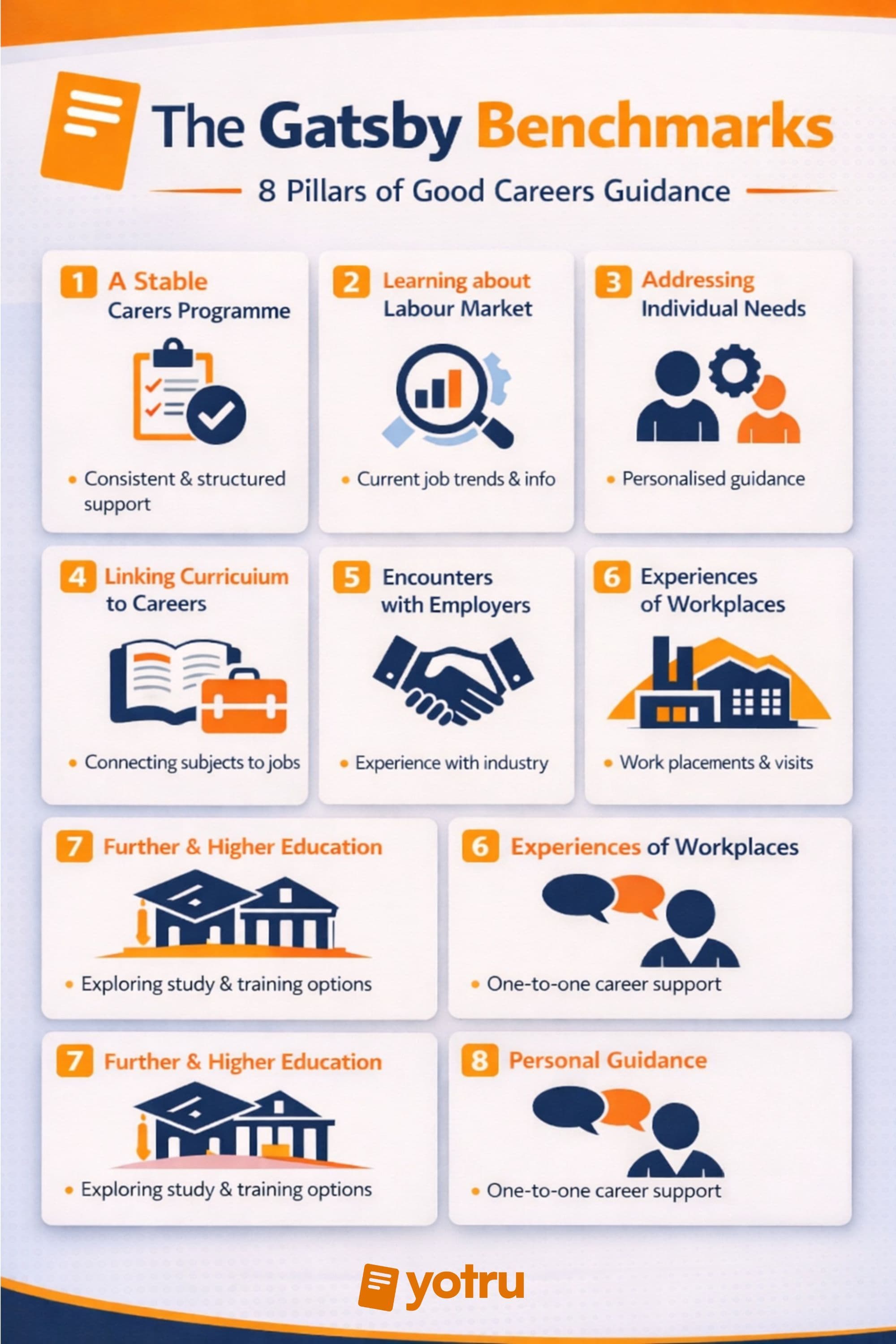
What “evidence” actually means in Gatsby and Ofsted contexts
One of the most common misconceptions about Gatsby evidence is that more is better. In practice, this is rarely the case.
Inspectors and quality reviewers are not looking for volume. They are looking for intent, consistency, and outcomes. They want to understand whether careers provision is planned, embedded, and making a difference to learners.
Much of the strongest evidence already exists within everyday careers activity. It does not usually require special reporting exercises or parallel systems. The challenge is making that work visible in a clear and coherent way.
Common evidence sources inspectors recognise
Careers teams often already generate evidence through their normal work, including:
- Learner progression over time rather than one off outcomes
- Guidance records that show continuity and follow up
- CV development that reflects clearer job targeting
- Employer engagement outcomes that link to realistic pathways
- Consistency in how support is delivered across cohorts
These sources help demonstrate that careers provision is structured, purposeful, and learner focused.
Why evidence becomes a burden for careers teams
For many training providers, the difficulty is not understanding what counts as evidence. It is managing how that evidence is captured and maintained alongside core guidance work.
Fragmented systems and manual tracking
Careers teams are often expected to pull evidence together from multiple places, including:
- Spreadsheets maintained alongside other systems
- Screenshots saved for future reference
- Email trails used to demonstrate engagement
- Records that vary between staff or learner groups
Over time, this fragmentation creates duplication and inconsistency. It also increases the risk that meaningful work is not reflected accurately when it matters most.
The emotional labour that never gets documented
Some of the most important aspects of careers guidance rarely appear in reports.
This includes rebuilding confidence after redundancy, managing uncertainty during career transitions, and supporting learners through setbacks or indecision. These moments are central to Benchmark 8 and to effective guidance more broadly.
They are also difficult to capture without adding further pressure to already busy teams.

Evidencing Gatsby without changing how guidance is delivered
Strong Gatsby evidence does not require careers teams to work differently with learners. It requires a shift in how that work is supported and surfaced.
Treat evidence as a by-product, not a task
Evidence should emerge naturally from existing workflows. It should not require careers practitioners to repeat work or maintain separate records purely for compliance.
When evidence is treated as a by-product of good practice, it becomes more accurate and more sustainable over time.
Focus on repeatable structure, not rigid processes
Careers work is not linear, but it benefits from light structure. Repeatable touchpoints, clear learner journeys, and consistent ways of recording progress help create continuity without reducing flexibility.
This approach allows teams to maintain professional judgement while ensuring that work can be understood and reviewed when needed.
What good Gatsby evidence looks like in adult and vocational settings
In adult and vocational education, evidence often reflects progression rather than immediate outcomes.
Examples include iterative CV development that shows increasing clarity, job targeting that becomes more realistic over time, and documented guidance touchpoints that demonstrate ongoing support.
Employer aligned outcomes, such as applications, interviews, or realistic next steps, help show that guidance is connected to labour market realities.
None of this requires additional reporting if systems are aligned with how careers teams already work.

Supporting careers teams without reducing guidance to a checklist
There is a risk that evidencing Gatsby becomes a box ticking exercise. This undermines the very work the benchmarks are designed to support.
Why tools should support judgement, not replace it
Careers guidance relies on professional judgement. No framework or system can capture every nuance of a learner’s situation.
The most effective support respects this expertise while providing structure and traceability. Systems should reflect the complexity of careers work, not flatten it.
At Yotru, our work with careers teams is shaped by this principle. Structure exists to support people, not to constrain them.
As we move Forward
Gatsby evidence does not need to overwhelm careers teams. Much of what inspectors and funders want to see already exists within everyday guidance work.
When systems support people effectively, evidence follows naturally. Careers teams are freed to focus on what matters most, supporting learners to move forward with confidence and clarity.
Many careers teams are already doing the work Gatsby expects. The challenge is ensuring that work is visible without increasing pressure on the people delivering it.
About the Author

Team Yotru
Employability Systems
Team Yotru
Employability Systems
We build practical career tools for training providers and workforce programs, combining labor market insights with real employment outcomes. Follow us on LinkedIn.
Questions or Need Support?
If you are working on employability programs, hiring strategy, career education, or workforce outcomes and want practical guidance, you are in the right place.
Yotru supports individuals and organizations navigating real hiring systems. That includes resumes and ATS screening, career readiness, program design, evidence collection, and alignment with employer expectations. We work across education, training, public sector, and industry to turn guidance into outcomes that actually hold up in practice.
Continue Reading
More insights from our research team

AI in Career Services: Practical Use Cases That Don't Replace Advisors
AI in career services isn't about replacing advisors. It's about handling baseline tasks so career professionals can focus on coaching and relationship building.
7 min read

Resume Builder for Laid Off Workers: Turning Job Loss Into a Fresh Start
For laid-off workers, getting back to work starts with a strong resume. This guide explains how a resume builder for laid-off workers helps you handle employment gaps, highlight transferable skills, and create an ATS-ready document that gets you in front of employers.
2 min read
What “Job-Ready” Actually Means for Early-Career Candidates
Job-ready isn’t about grades anymore. What actually gets early-career candidates hired is real-world experience, initiative, and proof you can deliver from day one.
4 min read

Applying Gatsby Benchmark 3 in Adult and Vocational Education: Personal Guidance at Scale
For careers teams in adult and vocational education. A practical look at applying Gatsby Benchmark 3, delivering personalised guidance at scale without overwhelming staff.
3 min read