Voices of Work
4 min read
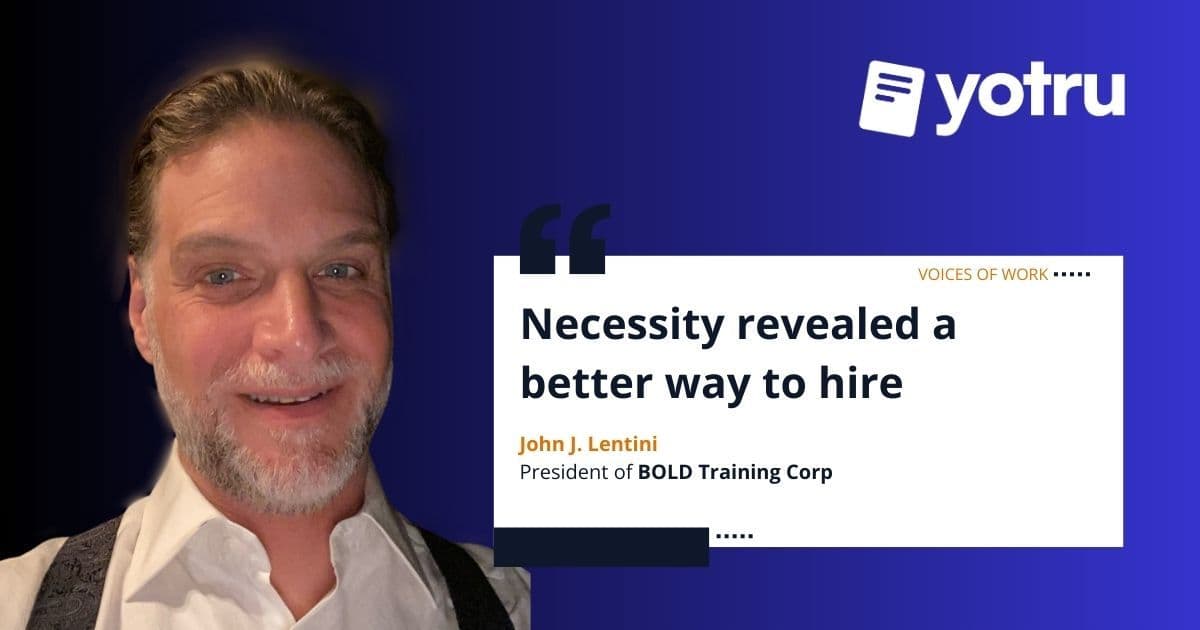
How Hiring Volume Forced John Lentini to Rethink Resume Requirements
Synopsis
When hiring at scale broke traditional resume filters, one banking executive rebuilt screening around competencies instead of credentials.
Key Insight
When you need to hire over 100 people within six months in a market where the ideal candidate doesn’t yet exist, your typical resume screening practices will most likely fall flat.
This was the reality John J. Lentini faced in 2013 as a senior banking executive establishing a new operation in Poland. There were no comparable firms to recruit from, no pool of local investment banking professionals, and no convenient opportunities for lateral hires.
In John’s case, “rethinking resume requirements” meant moving away from filtering candidates based solely on their educational background. Instead, he evaluated them based on their performance potential.
In a recent exchange, John shared several insights from his experience leading global banking operations. Here are just a few.
When Traditional Resume Screens Fail
At most companies, resume screening relies on pattern recognition, focusing on familiar companies, recognizable titles, direct industry experience, and credentials that indicate low risk.
But for John, those patterns were irrelevant.
“The traditional resume screen, where you look for direct industry experience, specific credentials, and a familiar career trajectory, was useless to me.”
The talent pool simply did not fit the mold John had in mind. If he had insisted on only hiring candidates with prior investment banking experience, his operation would never have launched on time.
The pressure of increased hiring volume revealed a deeper truth to John: resume requirements are often based on habit more than necessity.
When the demand for hires increases and timelines shorten, overly relying on narrow criteria can become a liability.
From Experience to Core Competencies
Instead of focusing on industry experience, John restructured his hiring process around core competencies: problem-solving ability, adaptability, communication skills, and cultural fit.
While resumes still mattered, his evaluation criteria changed.
“I stopped looking for job titles and industry keywords and started looking for evidence of learning agility, resilience, and transferable skills.”
A candidate with no banking experience who could quickly navigate complex environments was more attractive than someone with a polished, industry-specific resume.
Notably, he still hired experienced managers and financial controllers, but no one with direct investment banking or trading experience. The organization built its workforce from adjacent talent pools, rather than poaching competitors.
At Yotru, we see similar patterns across institutions scaling hiring under pressure: when hiring volumes increase, competencies become more predictive of success than credentials.
Widening the Funnel Without Lowering the Bar
High-volume hiring creates tension for employers, as it is assumed that widening the funnel will sacrifice quality.
While John simplified the application requirements to avoid filtering out capable candidates due to formatting issues or credential gaps, he also adopted a more structured approach.
In practice, that meant using ATS‑friendly structure to make screening more consistent, while shifting the real decision‑making weight toward demonstrated competencies rather than pedigree.
He replaced technical knowledge checks with behavioral and situational interviews. Instead of asking what candidates already knew, his interviewers focused on how the candidates approached ambiguity and solved unfamiliar problems.
Hiring for potential required disciplined onboarding, so training protocols became organized and were strictly enforced. This shift applied even up to VP-level positions. The goal was to achieve consistency in evaluations rather than relying on improvisation.
Of course, there were mistakes along the way. John was candid about that. Rapid hiring always brings some level of remediation. But the overall outcome was success. Within two years, the Poland operation was performing comparably to established global hubs in New York, London, and Singapore.
Why He Never Went Back
What surprised John the most was what happened afterward.
Even after returning to established talent markets, he did not revert to traditional resume filters.
“The experience proved to me that hiring for attitude and training for skill produces stronger, more adaptable teams.”
He also noted the cost dynamic: paying a premium for experienced competitors does not always guarantee better performance, especially if those candidates bring rigid assumptions or are disengaged because of previous roles.
The team in Poland built its culture from scratch. Without inherited habits, they could intentionally design processes rather than replicate legacy norms.
“Volume forced me to rethink resume requirements out of necessity. What I discovered is that the necessity revealed a better way to hire.”
John’s hiring volume did not lower the team’s standards; it clarified them.
For workforce leaders and employers, the lesson is not to ignore experience but to define what truly predicts performance before writing the job description. When resume requirements are too closely tied to past roles, organizations limit their access to capable people.
About John J. Lentini
John J. Lentini is the President of BOLD Training Corp and an authorized licensee of Crestcom International. He has over 20 years of executive experience, having previously led global banking operations across the Americas, Asia-Pacific, and Europe. Lentini is also the author of the upcoming book, Engineering Character: Six Dials to Build Better Leaders, set to be published by Forefront Books / Simon & Schuster in August 2026.
Pro Tip
This article is part of Yotru's Voices of Work series, highlighting leaders who are redefining how people learn, lead, and get hired. To get featured, please contact us.
About the Author

Hannah Verkler
Media Relations Lead
Hannah Verkler
Media Relations Lead
Hannah leads media relations and external communications at Yotru, helping share the company’s work with journalists, partners, and the workforce community.
Frequently Asked Questions
When hiring volume increases, strict resume filters often break down. Employers cannot rely solely on direct industry experience because the ideal candidate pool may be too small. This forces organizations to reconsider which requirements truly predict performance and which are merely outdated preferences.
About This Article
This article is designed for workforce leaders, hiring managers, and training providers navigating high-volume recruitment environments. It draws on executive experience from global banking operations where scale, speed, and cultural build-out were central challenges.
Research Methodology
This piece synthesizes firsthand written reflections from John J. Lentini regarding his executive hiring experience building a greenfield banking operation. The article relies on qualitative insights rather than external statistical data.
Editorial Standards
Voices of Work features are source-driven and grounded in practitioner experience. Verbatim quotes are drawn directly from provided material, and interpretations remain closely aligned to the expert’s documented perspective.
Disclaimer
The views expressed reflect the professional experience of John J. Lentini in a specific executive context. Outcomes may vary by industry, geography, and organizational structure. This article is for informational purposes only.
Related Readings
Voices of Work
- Why qualified candidates fail resume screening — A Leadership and hiring perspective
- What Employers Really Mean by Job‑Ready — Employer ROI, hidden skills, and motivational fit in job readiness
Fallon Chase on Fractional HR and the Future of People Operations — Fractional leadership and scaling people ops - Nicole Fougere on Trust, Tools, and the Future of Hiring — Building trust into hiring systems
- Robert Hourie on AI, Instinct, and the Future of Recruitment — Balancing AI with recruiter judgment
- Gloria Espina on Suitability, Systems, and Human-First Hiring — Suitability over credentials
Platform and Solutions
- Yotru for Workforce Development — Tools for workforce organizations
- Yotru for Employers — Hiring and talent solutions
- Yotru for Outplacement — Supporting workforce transitions
- Yotru for Educators — Career services for education providers
People Strategy and Hiring
- Why Yotru Is Built for Real Hiring, Not Just Resume Writing — Systems built for real hiring outcomes
- Why HR Departments Are Using Yotru to Support Laid-Off Workers — Humane layoff support tools
- How Yotru Helps Regions Identify Upskilling and Retraining Opportunities — Regional workforce strategy
- What Is a Risk-Free Hiring Pilot Program — Testing hiring systems safely
Job Market and Interview Insights
- Why It Feels So Hard to Get a Job Right Now — Market pressures and constraints
- Why Interviews Feel Harder Than the Actual Job — Where process and work diverge
- Green Flags in Interviews — Signs of healthy hiring cultures
- What Hiring Managers Really Notice in the First 5 Minutes — Signals that matter early
References
- Chamorro-Premuzic, T., & Frankiewicz, B. (2019). Rethinking the role of the resume in hiring. Harvard Business Review. https://hbr.org
- LinkedIn. (2024). Global talent trends 2024: Skills-first hiring in a changing world. LinkedIn Corporation. https://www.linkedin.com
- National Bureau of Economic Research. (2020). The labor market effects of hiring through employee referrals (Working Paper No. 27774). https://www.nber.org
- World Economic Forum. (2023). Future of jobs report 2023. World Economic Forum. https://www.weforum.org
Maintained by: Workforce Practice Group at Yotru
Review cycle: Reviewed periodically to reflect evolving hiring trends
Last updated: February 20, 2026
Questions or Need Support?
If you are working on employability programs, hiring strategy, career education, or workforce outcomes and want practical guidance, you are in the right place.
Yotru supports individuals and organizations navigating real hiring systems. That includes resumes and ATS screening, career readiness, program design, evidence collection, and alignment with employer expectations. We work across education, training, public sector, and industry to turn guidance into outcomes that actually hold up in practice.