Voices of Work
3 min read
What Employers Really Mean When They Say “Job-Ready”
Synopsis
Global learning leader Kelly Cassaro explains how employers actually define job readiness and why ROI, behavior, and fit matter more than credentials alone.
Key Insight
Job-ready is one of the most common phrases in hiring, and one of the most misunderstood.
To many candidates, it sounds like a checklist of skills or certifications. For employers, however, it is something far more pragmatic. It is a question of risk, contribution, and return on investment.
In a recent exchange, Kelly Cassaro shared several observations drawn from years of global workforce research, employer interviews, and hands-on work across education systems. As Chief of Learning at Generation, Kelly has spent decades watching where expectations quietly diverge between job seekers and hiring managers, and identifying factors that help bridge that gap.
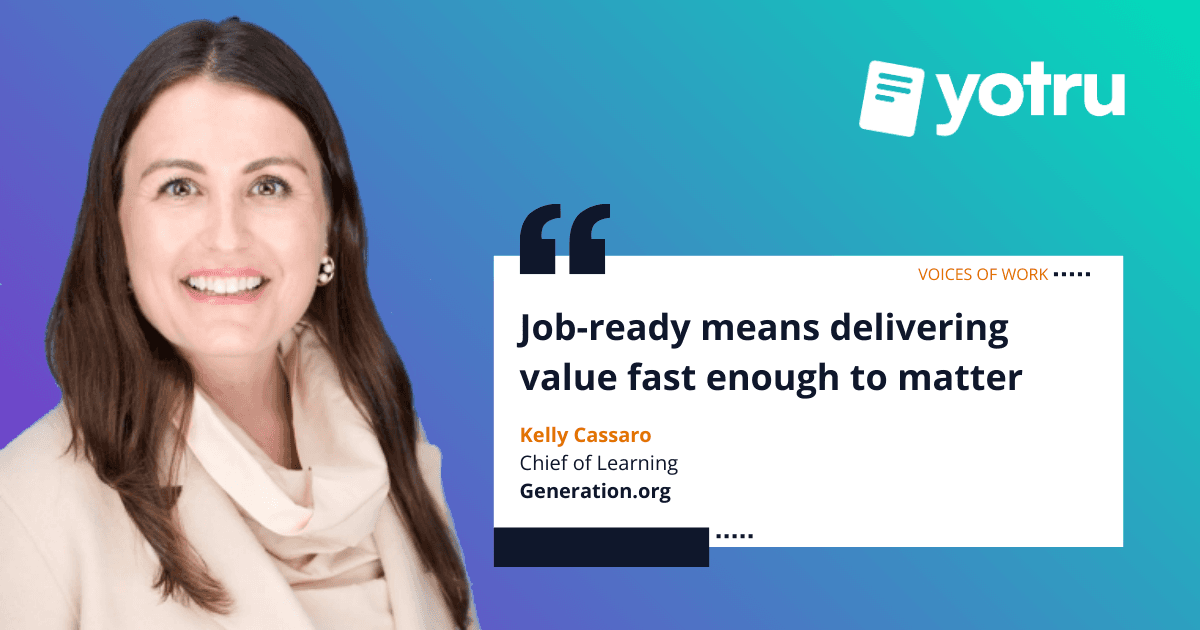
Job-Ready Starts With Employer ROI
In practice, “job-ready” means one thing first: will this hire deliver value quickly enough to justify the investment?
Kelly is direct about this framing, even when it feels uncomfortable for job seekers.
“Job-ready actually means, ‘Will my return on investment make this hire worth it?’”
Employers evaluate every hire through the lens of time, money, and team impact. Training, onboarding, and supervision all carry real costs. A candidate who can signal early contribution reduces that risk.
This is where many candidates unintentionally misalign. When interviews center on what the company can provide rather than what the candidate can contribute, employers hear uncertainty rather than readiness. Kelly notes that shifting this orientation alone often changes outcomes.
Technical Skills Are Necessary, But Rarely Sufficient
Across industries, Kelly sees the same pattern repeat. Technical skills get candidates into the conversation. Behavioral skills determine whether they succeed.
“Employers are not only looking for technical skills. They also want people with strong, role-aligned behavioral skills and mindsets.”
Communication, reliability, problem-solving, and a willingness to learn are not “soft” traits in practice. They are how work actually gets done, especially under pressure.
At Yotru, we see similar signals when analyzing screening outcomes. Candidates who can illustrate their experiences through demonstrated behaviors consistently outshine those who simply list skills without context. Emphasizing these qualities will undoubtedly set you apart.
The Hidden Skills Tied to Specific Roles
One of Kelly’s key insights is that behavioral skills are not generic. They are role-specific.
For example, a cybersecurity analyst may need empathy to understand user behavior and anticipate mistakes. In contrast, a software developer is often evaluated on attention to detail and pattern recognition. Project managers are assessed in stressful situations, where emotional steadiness matters more than enthusiasm. Healthcare workers must compartmentalize effectively to function in high-stakes environments.
Researching these unspoken expectations and demonstrating them in concrete ways signals an understanding of the real, day-to-day challenges of the role.
“When candidates can demonstrate these ‘hidden’ skills, they show hiring managers they can navigate the breakdown moments common to the role.”
Motivational Fit Is About Staying Power
Many candidates approach interviews with the mindset that any job will do. Employers notice.
What is often referred to as “motivational fit” is essentially about alignment. Why this role? Why this team? Why this organization?
Kelly emphasizes that employers listen for evidence that a candidate’s internal motivations align with the day-to-day realities of the job. This alignment can predict both performance and retention, linking back to ROI for the employer.
“When candidates can explain how their internal drivers align with the day-to-day work, team, and culture, they are more likely to perform well and stay longer.”
Redefining Readiness for a Changing Workforce
Kelly’s perspective invites a rethinking of readiness, challenging education systems and job seekers alike. Readiness is not a static credential. It is contextual, behavioral, and closely tied to employer economics.
Her work sits at the intersection of education, employment, and human skills, highlighting the importance of preparing people for real-world work experiences rather than just for assessments.
About Kelly Cassaro
Kelly Cassaro is a global learning leader, author, and workforce development executive. She serves as Chief of Learning at Generation, where she leads curriculum and instruction across programs supporting learners in more than 18 countries. She is the author of Shift Teaching Forward and a former Women in AI Fellow, with over 20 years of experience spanning PreK through adult education.
Pro Tip
This article is part of Yotru's Voices of Work series, highlighting leaders who are redefining how people learn, lead, and get hired. To get featured, please contact us.
About the Author

Hannah Verkler
Media Relations Lead
Hannah Verkler
Media Relations Lead
Hannah leads media relations and external communications at Yotru, helping share the company’s work with journalists, partners, and the workforce community.
Frequently Asked Questions
Employers typically mean that a candidate needs to contribute value quickly with minimal risk. This includes not only technical competence, but also role-specific behavioral skills, reliability, and alignment with the day-to-day demands of the job.
Audience Context
This article is written for workforce leaders, educators, employers, and advanced job seekers seeking a clearer understanding of how hiring decisions are made beyond resumes and credentials.
Disclaimer
Views shared reflect personal experience only. Not official advice. Hiring practices vary by company and region. Use for general guidance, not as professional or legal advice.
Editorial Standards
Voices of Work articles synthesize verified expert perspectives into narrative editorials. No insights, quotes, or examples are fabricated or inferred beyond the provided source material.
Research Methodology
Insights are drawn from direct source material provided by the featured expert, informed by global employer interviews and workforce development practice across multiple industries.
Related Readings
Voices of Work: Leadership and Hiring Perspectives
- Fallon Chase on Fractional HR and the Future of People Operations — Fractional leadership and scaling people ops
- Nicole Fougere on Trust, Tools, and the Future of Hiring — Building trust into hiring systems
- Tina Schust Robinson on Gremlins, Trust, and Leadership Habits — Sustainable leadership practices
- Robert Hourie on AI, Instinct, and the Future of Recruitment — Balancing AI with recruiter judgment
- Gloria Espina on Suitability, Systems, and Human-First Hiring — Suitability over credentials
Platform and Solutions
- Yotru for Workforce Development — Tools for workforce organizations
- Yotru for Employers — Hiring and talent solutions
- Yotru for Outplacement — Supporting workforce transitions
- Yotru for Educators — Career services for education providers
People Strategy and Hiring
- Why Yotru Is Built for Real Hiring, Not Just Resume Writing — Systems built for real hiring outcomes
- Why HR Departments Are Using Yotru to Support Laid-Off Workers — Humane layoff support tools
- How Yotru Helps Regions Identify Upskilling and Retraining Opportunities — Regional workforce strategy
- What Is a Risk-Free Hiring Pilot Program — Testing hiring systems safely
Job Market and Interview Insights
- Why It Feels So Hard to Get a Job Right Now — Market pressures and constraints
- Why Interviews Feel Harder Than the Actual Job — Where process and work diverge
- Green Flags in Interviews — Signs of healthy hiring cultures
- What Hiring Managers Really Notice in the First 5 Minutes — Signals that matter early
References
- Cassaro, K., & Lee, D. (2024). Shift teaching forward: Advancing career skills to prepare tomorrow’s workforce. Wiley. https://www.barnesandnoble.com/w/shift-teaching-forward-kelly-cassaro/1143742611
- Generation. (2022, May 27). Strategic skills-based hiring: How smart employers build competitive advantage through talent access. Generation Global. https://www.generation.org/news/strategic-skills-based-hiring-how-smart-employers-build-competitive-advantage-through-talent-access
- National Association of Colleges and Employers. (2024, December 31). Career readiness defined. NACE. https://www.naceweb.org/career-readiness/competencies/career-readiness-defined
- Deel. (2024, February 21). What is job readiness? A comprehensive guide for HR and people leaders. https://www.deel.com/blog/job-readiness
- Paradigm Education Solutions. (n.d.). Work readiness inventory guide. Paradigm Education. https://www.paradigmeducation.com/sites/default/files/facilitator%20resources/assessments/work-readiness-inventory-administrator
- National Coalition for Homeless Veterans. (2023, May 10). Employment readiness: Strategies and assessments. NCHV. https://www.nchv.org/images/uploads/Employment_Readiness_Strategies_and_Assessments.pdf
Maintained by: Workforce Practice Group at Yotru
Review cycle: Regularly reviewed to reflect real-world practice
Last updated: January 30, 2026
Questions or Need Support?
If you are working on employability programs, hiring strategy, career education, or workforce outcomes and want practical guidance, you are in the right place.
Yotru supports individuals and organizations navigating real hiring systems. That includes resumes and ATS screening, career readiness, program design, evidence collection, and alignment with employer expectations. We work across education, training, public sector, and industry to turn guidance into outcomes that actually hold up in practice.