Platform
7 min read
Resume Builder vs Career Platform: When to Move Beyond a Standalone Resume Builder
Synopsis
Generic resume builders work for individuals. But when programs serve hundreds of learners, the limits show. Here's when to upgrade to a career development platform.
Most training programs start with simple tools. Advisors show learners how to use Word or Google Docs. Maybe there's a Canva template floating around. Eventually, someone discovers a free resume builder online and it becomes the default recommendation.
This works fine when you're serving a handful of learners. But as programs scale, the limitations become obvious. There's no consistency. No visibility. No way to know which learners are actually ready for the job market.
The transition from point tools to platforms isn't about chasing the newest technology. It's about recognizing when your current approach can't keep up with your program's needs.
This article explains the signals that indicate it's time to move beyond a standalone resume builder for programs to a governed career development platform.
Key Insight
A generic resume builder serves one person at a time. A career development platform serves programs at scale, with consistency, visibility, and governance that point tools can't provide.
What Point Tools Can and Can't Do
Let's be clear about what standalone resume builders are good at. They help individuals create documents. A learner can log in, enter their information, pick a template, and download a formatted resume. That's genuinely useful.
But point tools are designed for consumers, not institutions. They're optimized for individual use, not program management. Here's what they typically lack:
- No cohort visibility: You can't see which learners have completed their resumes, which are still in progress, or which need intervention. Each learner is an isolated user. There's no aggregate view.
- No quality standards enforcement: The tool might flag some issues, but you can't configure it for your program's specific requirements. A nursing program and a construction program have different resume needs. Generic tools treat them the same.
- No administrative controls: Advisors can't access learner resumes for review unless the learner shares them manually. There's no role-based access, no audit trail, no institutional governance.
- No branding: Learners use a third-party tool with the vendor's branding. The experience is disconnected from your institution.
- No integration: The resume builder doesn't connect to your student information system, LMS, or reporting tools. Data has to be tracked manually.
For programs serving dozens or hundreds of learners, these gaps create real problems.
Important
Generic resume builders can't tell you which learners are job-ready. Without cohort-level visibility, you're relying on advisor anecdotes and learner self-reports, which are unreliable at scale.
Signals That You've Outgrown Point Tools
How do you know when it's time to upgrade? Look for these patterns:
Advisors are overwhelmed with resume reviews
If your team spends significant hours each week reviewing resumes for basic issues, that's capacity being consumed by work that could be automated. A platform with AI-powered quality checks handles the baseline, freeing advisors for coaching.
Quality is inconsistent across cohorts
When you compare resumes from different learners, advisors, or cohorts, do you see significant variation in quality? That variation reflects the inconsistency of manual processes. Platforms enforce standards automatically.
You can't report on readiness
When funders or accreditors ask how many learners are employer-ready, can you answer confidently? If you're cobbling together data from spreadsheets and advisor estimates, you don't have the visibility you need.
Learners are using multiple tools
Some learners use the tool you recommend. Others use whatever they find online. Some just ask ChatGPT. This fragmentation makes it impossible to maintain standards or provide consistent support.
Employer feedback is negative
If employers or placement partners comment on resume quality, formatting inconsistencies, or lack of professionalism, that's a signal that your current approach isn't producing employer-ready documents.
Your program is growing
What works for 50 learners breaks down at 200. What works for 200 breaks down at 500. If your program is scaling, your tools need to scale with it.
If you recognize three or more of these signals, it's probably time to evaluate platforms.
Hint
Start documenting the time your team spends on resume-related tasks. This data helps justify platform investment and provides a baseline for measuring improvement after implementation.
What a Career Development Platform Adds
The transition from point tools to platforms isn't just about better resume building. It's about adding capabilities that point tools fundamentally can't provide.
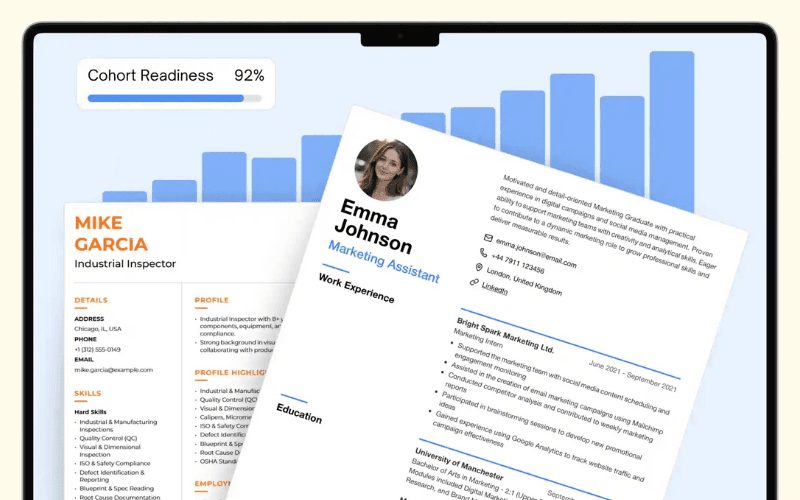
- Cohort-level management: Platforms designed for institutions let you see all learners in a program, track their progress, and identify who needs support. This visibility is essential for program management and reporting.
- AI-powered quality checks: Instead of advisors catching typos and formatting issues, the platform handles baseline quality. Every learner gets consistent feedback, and advisors focus on higher-value work.
- Program-aware guidance: The platform can be configured for your specific learner population. A nursing student gets different guidance than a welding apprentice. A re-entry program gets different guidance than a tech bootcamp.
- Administrative controls: Role-based access means advisors see what they need, administrators see what they need, and learners only see their own work. Audit trails provide accountability.
- Institutional branding: The platform can carry your institution's identity, making the experience feel connected to your program rather than a random third-party tool.
- Integration capabilities: Good platforms connect to your existing systems, reducing duplicate data entry and enabling automated reporting.
A career development platform isn't just a better resume builder. It's a different category of tool designed for institutional use.
Comparing Resume Builders and Career Platforms
Here's how the two approaches differ across key dimensions:
- Who it serves: Resume builders serve individuals. Career platforms serve programs with multiple learners, cohorts, and administrators.
- Quality control: Resume builders offer generic suggestions. Career platforms enforce program-specific standards and provide cohort-level quality data.
- Visibility: Resume builders show nothing beyond individual documents. Career platforms provide dashboards showing progress, readiness, and intervention needs.
- Administration: Resume builders have no administrative layer. Career platforms support role-based access, governance, and audit trails.
- Scalability: Resume builders don't scale. Using them at volume requires manual coordination. Career platforms are designed for programs serving hundreds or thousands of learners.
- Integration: Resume builders are standalone. Career platforms connect to student information systems, LMS platforms, and reporting tools.
- Branding: Resume builders carry vendor branding. Career platforms can be white-labeled to reflect institutional identity.
The right choice depends on your context. If you're a small program with hands-on advisor capacity, point tools might be sufficient. If you're scaling, need visibility, or have reporting requirements, platforms become necessary.
Pro Tip
When evaluating platforms, ask for a demo that shows the administrator view, not just the learner experience. Program managers need to see the cohort dashboard, not just how individual resumes get built.
Making the Transition
Moving from point tools to a platform doesn't have to be disruptive. Here's a practical approach:
Step 1: Document current pain points
Before evaluating platforms, be clear about what problems you're solving. Is it advisor workload? Quality consistency? Reporting gaps? Learner fragmentation? Knowing your priorities helps you evaluate vendors against your actual needs.
Step 2: Assess your technical environment
What systems does the platform need to connect to? Do you require single sign-on? What are your data privacy requirements? Understanding your constraints narrows the field of viable options.
Step 3: Involve stakeholders
Advisors, administrators, and IT should all have input. Advisors understand the day-to-day workflow. Administrators understand reporting needs. IT understands integration and security requirements.
Step 4: Pilot before full rollout
Test the platform with a single cohort before committing to program-wide implementation. This identifies configuration issues, builds advisor confidence, and provides data on actual impact.
Step 5: Plan for change management
Any tool transition requires adjustment. Communicate clearly about why the change is happening, what benefits to expect, and how workflows will change. Provide training and ongoing support.
Step 6: Measure and refine
Track your key metrics before and after implementation. Are advisors spending less time on baseline reviews? Are resumes meeting quality standards at higher rates? Are learners completing their resumes faster? Use data to refine your configuration.
Individual Resume Building Still Matters
Platforms serve institutions. But many learners also need self-service options for building resumes on their own time, outside program structures.
Yotru serves both needs. The Yotru Platform provides institutional capabilities for training providers, workforce programs, and employers. The AI-powered resume builder serves individual job seekers with the same quality guidance in a self-service format.
For programs, this means learners who need additional practice or want to update their resumes after program completion can continue using Yotru without requiring program resources. The quality standards carry forward.
For learners who also need cover letters, Yotru offers a cover letter builder that maintains the same approach to quality and ATS optimization.
Questions to Ask Platform Vendors
When evaluating career development platforms, use these questions to assess fit:
About program support:
- How do you handle different learner populations within a single institution?
- Can we configure quality standards for specific programs?
- What does the cohort dashboard show?
About AI capabilities:
- How is the AI trained and governed?
- Can we customize AI behavior for our context?
- What guardrails prevent inappropriate content?
About administration:
- What role-based access controls are available?
- How are audit trails maintained?
- What reporting options exist?
About integration:
- Can you integrate with our student information system?
- Do you support single sign-on?
- How does data flow between systems?
About implementation:
- What does the implementation timeline look like?
- What training is provided?
- What ongoing support is available?
About pricing:
- What's included in the base price?
- Are there per-learner fees?
- What does total cost of ownership look like over 3 years?
The answers to these questions reveal whether a platform is designed for institutional use or just a consumer tool with some administrative features bolted on.
Next Steps
If your program has outgrown generic resume builders, explore what a career development platform can offer.
The Yotru Platform is designed for training providers, workforce programs, and organizations that need consistent, employer-ready resumes at scale. With AI-powered guidance, program-aware configuration, and cohort-level visibility, Yotru helps career services teams focus on coaching while the platform handles the baseline.
For learners building resumes independently, the Yotru resume builder provides the same quality guidance in a self-service format.
About the Author

Team Yotru
Employability Systems
Team Yotru
Employability Systems
We build practical career tools for training providers and workforce programs, combining labor market insights with real employment outcomes. Follow us on LinkedIn.
Frequently Asked Questions
Consider switching when advisors are overwhelmed with reviews, quality is inconsistent across cohorts, you can't report on readiness, learners are using multiple fragmented tools, or your program is scaling beyond what manual processes can handle.
Yotru Platform
Employer-Ready Resume Solutions Hub
- Career Development Platform— AI platform for compliant, employer-ready resumes.
- Employer Hiring Signals— Standardized resumes with clear pre-interview hiring signals
- Educator Resume Platform— Standardize learner resumes and track cohort readiness.
- Workforce Resume Builder— Employer-ready resumes for workforce clients with tracking.
- Outplacement Resume Support— Support transitions with standardized, employer-ready resumes.
- Recruitment Resume Signals— Role-aligned resumes plus readiness scores for recruiters.
Audience Context
This article is for program managers and career services leaders evaluating whether to upgrade from generic resume builders to career development platforms. It explains the signals that indicate it's time to transition and how to approach the evaluation process.
Research Methodology
This article draws on observed patterns in career services tool adoption, publicly available research on workforce program efficiency, and general best practices for institutional technology transitions.
Editorial Standards
Yotru content prioritizes accuracy, neutrality, and practical guidance. This article is maintained by the Platform & Systems Group and reviewed regularly to reflect current market conditions and platform capabilities.
Disclaimer
This article is for informational purposes only. Tool suitability varies by program context and constraints. Evaluate options based on your specific requirements.
Related Resources
Platform Hub
- Career development platforms explained
- How to standardize resume quality across cohorts
- Practical AI use cases for career services
- Why white-label career platforms matter
Tool Comparisons and Selection
- CV tools for training providers: Canva and Word alternatives - Comparison of common career services tools
- Best AI resume optimization tools - Review of AI-powered options
- The ultimate guide to resume builders in 2026 - Comprehensive tool overview
Platform Implementation
- How training providers can improve learner job outcomes with AI resume tools - Implementation guidance
- Resume platform for adult education providers - Adult learning context
- Yotru unveils enhanced platform for educators and workforce organizations - Platform capabilities
Resume Quality
- ATS-friendly resume builders: How to pass the bots and get hired - ATS optimization basics
- Traits all great resumes possess - Quality criteria overview
References
- Higher Education Quality Council of Ontario. (2024). Navigating the transition from school to work: The impact of career development activities and services on graduate labour market outcomes. HEQCO. Retrieved January 29, 2026, from https://heqco.ca/wp-content/uploads/2024/10/School-to-work-report-FINAL.pdf
- Alberta Education. (2023). Career Education Task Force: Final report. Government of Alberta. Retrieved January 29, 2026, from https://open.alberta.ca/dataset/3c2dc71d-5922-4b18-84c3-3dedb361ec85/resource/9655a771-9dfa-4057-9ae4-29131433a9d5/download
- Employment and Social Development Canada. (2021, May 18). Evaluation of Pathways to Education: Final report. Government of Canada. Retrieved January 29, 2026, from https://www.canada.ca/en/employment-social-development/corporate/reports/evaluations/pathways-education-report.html
- Bezanson, L., Hopkins, S., & Future Skills Centre. (2021). The career development profession in Canada and the emergence of a new ecosystem. Future Skills Centre. Retrieved January 29, 2026, from https://fsc-ccf.ca/wp-content/uploads/2021/11/FSC-RCP-Profession-EN.pdf
- Finnie, R., Mueller, R. E., & Sweetman, A. (2021). Improving the linkages between university and work: A report for the Public Policy Forum. Public Policy Forum. Retrieved January 29, 2026, from https://ppforum.ca/wp-content/uploads/2021/06/ImprovingTheLinkagesBetweenUniversityAndWork-PPF-June2021-EN.pdf
- Usher, A. (2020, December 30). Higher education for lifelong learners: A roadmap for Ontario post-secondary leaders and policymakers. Ontario 360. Retrieved January 29, 2026, from https://on360.ca/policy-papers/higher-education-for-lifelong-learners-a-roadmap-for-ontario-post-secondary-leaders-and-policymakers/
- Careers & Enterprise Company. (2024, November 21). Employer standards for careers education: One year on. Careers & Enterprise Company. Retrieved January 29, 2026, from https://www.careersandenterprise.co.uk/evidence-and-reports/employer-standards-for-careers-education-one-year-on/
- Department for Education. (2025, June 25). LEO graduate and postgraduate outcomes: Tax year 2022–23. UK Government. Retrieved January 29, 2026, from https://explore-education-statistics.service.gov.uk/find-statistics/leo-graduate-and-postgraduate-outcomes/2022-23
- Prospects Luminate. (2024). What do graduates do? 2025/26. Prospects. Retrieved January 29, 2026, from https://luminate.prospects.ac.uk/what-do-graduates-do
- Asia Pacific Career Development Association. (2025, November 22). Australia – country information and trends in career development. APCDA. Retrieved January 29, 2026, from https://asiapacificcda.org/australia-information/
- Catholic Schools New South Wales. (2025, June 5). 2024 National Survey of Australian Career Development Practitioners. Catholic Schools NSW. Retrieved January 29, 2026, from https://www.csnsw.catholic.edu.au/resources/national-survey-career-development-practitioners
- Organisation for Economic Co-operation and Development. (2022). Strengthening career guidance for mid-career adults in Australia. OECD. Retrieved January 29, 2026, from https://www.oecd.org/content/dam/oecd/en/publications/reports/2022/06/strengthening-career-guidance-for-mid-career-adults-in-australia.pdf
Maintained by: Labor Intelligence Group at Yotru
Review cycle: Monitored as market conditions evolve
Last updated: January 29, 2026
Questions or Need Support?
If you are working on employability programs, hiring strategy, career education, or workforce outcomes and want practical guidance, you are in the right place.
Yotru supports individuals and organizations navigating real hiring systems. That includes resumes and ATS screening, career readiness, program design, evidence collection, and alignment with employer expectations. We work across education, training, public sector, and industry to turn guidance into outcomes that actually hold up in practice.