Platform
5 min read
What Is a Career Development Platform? Benefits for Programs and Institutions
Synopsis
A career development platform helps training providers and workforce programs deliver consistent, employer-ready resumes across cohorts without burning out staff.
Most training programs and workforce organizations still rely on a patchwork of tools to help learners build resumes. Career advisors spend hours reviewing documents one by one. Feedback is inconsistent. And when funding reports are due, no one can say with confidence how many learners are actually job-ready.
A career development platform solves this by bringing resume creation, AI-powered guidance, and program-level insights into a single system designed for institutions, not individuals.
This article explains what a career development platform is, how it differs from consumer resume builders, and why training providers, workforce agencies, and nonprofits are adopting them to improve learner outcomes without adding staff workload.
Key Insight
A career development platform is built for institutions. It provides consistent, program-aware resume guidance across cohorts while giving administrators visibility into learner readiness.
What Makes a Career Development Platform Different from a Resume Builder
Resume builders are designed for individuals. They help one person create one document. That works fine for someone updating their own resume on a weekend, but it creates problems at scale.
When a workforce program serves 200 learners per cohort, a consumer resume builder offers no way to ensure consistency, track progress, or report outcomes. Each learner gets generic advice that may not reflect the program's goals or the industries they're targeting.
A career development platform is purpose-built for this context.
Key differences:
- Program-aware guidance: The platform understands what the learner is training for and tailors resume suggestions accordingly
- Consistency at scale: Every learner receives the same quality of feedback, regardless of which advisor is available
- Administrative visibility: Program managers can see cohort-level readiness, identify learners who need support, and generate reports without manual aggregation
- Institutional branding: Resumes and the platform itself reflect the organization, not a third-party tool
For training providers, workforce programs, and nonprofits, this shift from individual tools to institutional platforms is what allows them to serve more learners without proportionally increasing staff time.
Hint
If your career services team spends more time formatting resumes than coaching learners, you're using the wrong tools. A career development platform shifts the balance toward higher-value work.
Who Uses Career Development Platforms
Career development platforms serve any organization responsible for preparing people for employment. The specific use cases vary, but the underlying need is the same: consistent, employer-ready resumes at scale.
Training providers and educators
Colleges, bootcamps, and vocational programs use career platforms for educators to ensure graduates leave with resumes that meet employer expectations. This is especially important when learners have limited work history and need help translating coursework into marketable skills.
Workforce development agencies
Government-funded programs, community organizations, and regional workforce boards use employability platforms for workforce programs to standardize resume quality across service providers and demonstrate outcomes to funders.
Employers and outplacement services
Companies undergoing restructuring use outplacement platforms to support exiting employees with resume assistance that doesn't require hiring external coaches. HR teams also use these tools to help internal mobility candidates update their materials.
Recruiters and staffing agencies
Recruitment teams use career platforms to clean up candidate resumes before submission, ensuring formatting consistency and ATS compatibility without manual rework.
Each of these audiences has different priorities, but they share a common constraint: limited staff time and a need for consistent quality.
Core Capabilities of a Career Development Platform
Not all platforms offer the same features. When evaluating options, focus on capabilities that directly reduce staff workload and improve learner outcomes.
AI-powered resume guidance
The platform should offer real-time suggestions as learners build their resumes. This includes flagging vague language, suggesting stronger action verbs, and ensuring proper formatting. The AI should be program-aware, meaning it understands the learner's training context and industry targets.
ATS alignment
Applicant tracking systems are the first filter most resumes pass through. A career development platform should check for common ATS issues like improper formatting, missing sections, and overuse of graphics that don't parse correctly.
Cohort-level readiness insights
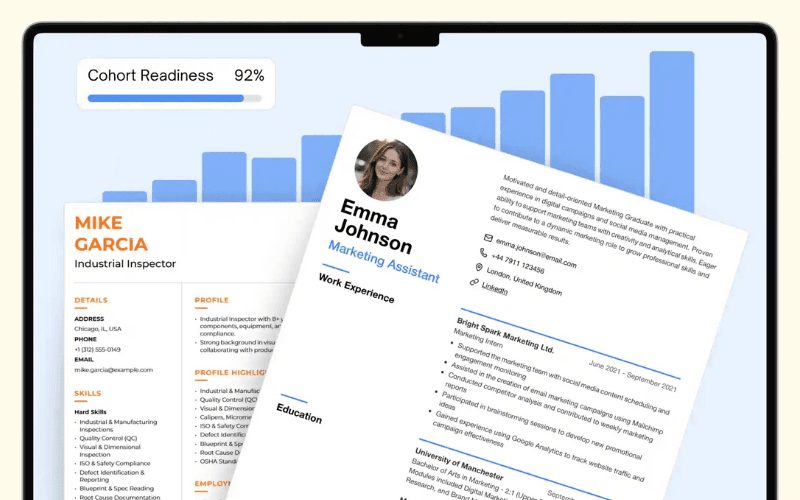
Administrators need to see which learners are on track and which need intervention. This means dashboards that show completion rates, quality scores, and flags for resumes that aren't employer-ready.
Institutional branding and governance
For many organizations, it matters that the tool reflects their brand, not a third party's. Look for platforms that support custom branding, role-based access controls, and the ability to set program-specific templates and standards.
Integration with existing systems
Career development platforms are more useful when they connect to your student information system, LMS, or case management software. This reduces duplicate data entry and makes reporting easier.
Pro Tip
Ask vendors how their AI handles learners with non-traditional backgrounds. Generic advice doesn't help someone translating military service, caregiving experience, or informal work into a resume.
Why Consistency Matters More Than You Think
When career advisors review resumes manually, feedback varies. One advisor might focus on formatting. Another might emphasize keywords. A third might have strong opinions about objectives versus summaries.
This inconsistency isn't a personal failing. It's a structural problem. Advisors are human, and their time is limited. When they're reviewing 30 resumes in an afternoon, they can't apply the same level of attention to each one.
A career development platform standardizes the baseline. Every learner gets the same quality checks. Every resume is evaluated against the same criteria. Advisors can then spend their time on the cases that actually require human judgment, like helping someone navigate a difficult employment gap or translate unusual experience.
This shift has real implications:
- Learners get faster, more consistent feedback
- Advisors can focus on coaching instead of copyediting
- Program managers can trust that quality standards are being met
For organizations serving diverse populations, including learners with limited English proficiency or unfamiliarity with resume conventions, this consistency is especially valuable.
How to Evaluate a Career Development Platform
If you're considering a career development platform for your organization, here's what to look for:
Does it understand your context?
The platform should allow you to configure it for your learner population. A platform that gives the same advice to nursing students and welding apprentices isn't doing its job.
Can it scale without adding staff?
The whole point of a platform is to serve more learners without proportionally increasing workload. Ask how the platform handles large cohorts and what the admin burden looks like.
Does it provide actionable data?
Reports should help you make decisions, not just check boxes. Look for platforms that surface insights about where learners are struggling and what interventions are working.
Is the AI governed?
AI that generates unpredictable or inappropriate content is a liability. Ask how the platform ensures consistency and what guardrails are in place.
Can you brand it?
For many institutions, it matters that learners see the organization's name and identity, not a third-party tool. White-label options allow this.
If you're currently relying on generic resume builders, Word templates, or manual advisor reviews, a career development platform may be the upgrade that lets you serve more learners at higher quality without burning out your team.
Getting Started
Yotru is a career development platform built for training providers, workforce programs, and institutions that need consistent, employer-ready resumes at scale.
With AI-powered guidance, program-aware templates, and cohort-level insights, Yotru helps career services teams focus on high-value coaching while the platform handles the baseline.
Explore the Yotru Platform to learn how it works, or see specific solutions for educators, workforce programs, and outplacement.
About the Author

Team Yotru
Employability Systems
Team Yotru
Employability Systems
We build practical career tools for training providers and workforce programs, combining labor market insights with real employment outcomes. Follow us on LinkedIn.
Frequently Asked Questions
A career development platform is a software system designed to help institutions like training providers, workforce agencies, and nonprofits deliver consistent resume guidance and employability support to learners at scale. Unlike consumer resume builders, these platforms offer administrative visibility, program-aware AI, and cohort-level reporting.
Yotru Platform
Employer-Ready Resume Solutions Hub
- Career Development Platform— AI platform for compliant, employer-ready resumes.
- Employer Hiring Signals— Standardized resumes with clear pre-interview hiring signals
- Educator Resume Platform— Standardize learner resumes and track cohort readiness.
- Workforce Resume Builder— Employer-ready resumes for workforce clients with tracking.
- Outplacement Resume Support— Support transitions with standardized, employer-ready resumes.
- Recruitment Resume Signals— Role-aligned resumes plus readiness scores for recruiters.
Audience Context
This article is for leaders of training providers, workforce programs, and nonprofits evaluating career development platforms. It explains what these platforms are, how they differ from consumer tools, and what to look for when making a decision.
Research Methodology
This article draws on publicly available information about career services technology, observed patterns in workforce program operations, and general best practices for institutional tool adoption. No proprietary data is claimed.
Editorial Standards
Yotru content prioritizes accuracy, neutrality, and evidence-based guidance. This article is maintained by the Platform & Systems Group and reviewed regularly to reflect current product capabilities and market trends.
Disclaimer
This article is for informational purposes only. Platform capabilities and suitability vary by organization. Evaluate tools based on your specific needs and constraints.
Related Resources
Platform Hub
- How to standardize resume quality across cohorts
- Practical AI use cases for career services
- Why white-label career platforms matter
- When to move beyond a resume builder
Career Services
- Yotru unveils enhanced platform for educators and workforce organizations - Overview of institutional platform capabilities
- How training providers can improve learner job outcomes with AI resume tools - Practical guidance for program implementation
- CV tools for training providers: Canva and Word alternatives - Comparison of common tools used in career services
- Resume platform for adult education providers - Specific considerations for adult learning contexts
AI and Resume Quality
- How AI resume tools can help and hurt your job application - Balanced perspective on AI in resume building
- Demystifying applicant tracking systems: What recruiters really do - Understanding the ATS context
References
- Higher Education Quality Council of Ontario. (2024). Navigating the transition from school to work: The impact of career development activities and services on graduate labour market outcomes. HEQCO. Retrieved January 29, 2026, from https://heqco.ca/wp-content/uploads/2024/10/School-to-work-report-FINAL.pdf
- Finnie, R., Mueller, R. E., & Sweetman, A. (2021). Improving the linkages between university and work: A report for the Public Policy Forum. Public Policy Forum. Retrieved January 29, 2026, from https://ppforum.ca/wp-content/uploads/2021/06/ImprovingTheLinkagesBetweenUniversityAndWork-PPF-June2021-EN.pdf
- Usher, A. (2020, December 30). Higher education for lifelong learners: A roadmap for Ontario post-secondary leaders and policymakers. Ontario 360. Retrieved January 29, 2026, from https://on360.ca/policy-papers/higher-education-for-lifelong-learners-a-roadmap-for-ontario-post-secondary-leaders-and-policymakers/
- Future Skills Council. (2020). A skilled, agile workforce ready to shape the future: Consultation report. Employment and Social Development Canada. Retrieved January 29, 2026, from https://www.canada.ca/en/employment-social-development/programs/future-skills/report-learning-nation.html
- Organisation for Economic Co-operation and Development. (2020). Workforce innovation to foster positive learning environments in Canada. OECD. Retrieved January 29, 2026, from https://www.oecd.org/content/dam/oecd/en/publications/reports/2020/04/workforce-innovation-to-foster-positive-learning-environments-in-canada.pdf
- Organisation for Economic Co-operation and Development. (2023). OECD employment outlook 2023: Artificial intelligence and the labour market. OECD. Retrieved January 29, 2026, from https://www.oecd.org/employment-outlook/2023/
- OECD, & International Centre for Career Development and Public Policy. (2025). Artificial intelligence, occupations, and career guidance: Connecting the dots in the labour market. ICCDPP. Retrieved January 29, 2026, from https://www.iccdpp.org/artificial-intelligence-occupations-and-career-guidance-connecting-the-dots-in-the-labour-market-oecd/
- National Association of Colleges and Employers. (2025, May 26). Using technology to amplify the impact of career services. NACE. Retrieved January 29, 2026, from https://www.naceweb.org/career-development/best-practices/using-technology-to-amplify-the-impact-of-career-services
- National Association of Colleges and Employers. (2025). NACE career readiness competencies: Technology. NACE. Retrieved January 29, 2026, from https://www.naceweb.org/career-readiness
- Khurumova, L. N. (2023). Online and computer-assisted career guidance. Frontiers in Psychology, 14, 1137718. https://doi.org/10.3389/fpsyg.2023.1137718
- Careers & Enterprise Company. (2024, November 21). Employer standards for careers education: One year on. Careers & Enterprise Company. Retrieved January 29, 2026, from https://www.careersandenterprise.co.uk/evidence-and-reports/employer-standards-for-careers-education-one-year-on/
- Department for Education. (2025, June 25). LEO graduate and postgraduate outcomes: Tax year 2022–23. UK Government. Retrieved January 29, 2026, from https://explore-education-statistics.service.gov.uk/find-statistics/leo-graduate-and-postgraduate-outcomes/2022-23
- Prospects Luminate. (2024). What do graduates do? 2025/26. Prospects. Retrieved January 29, 2026, from https://luminate.prospects.ac.uk/what-do-graduates-do
- Asia Pacific Career Development Association. (2025, November 22). Australia: Country information and trends in career development. APCDA. Retrieved January 29, 2026, from https://asiapacificcda.org/australia-information/
- Catholic Schools New South Wales. (2025, June 5). 2024 national survey of Australian career development practitioners. Catholic Schools NSW. Retrieved January 29, 2026, from https://www.csnsw.catholic.edu.au/resources/national-survey-career-development-practitioners
Maintained by: Labor Intelligence Group at Yotru
Review cycle: Monitored as market conditions evolve
Last updated: January 29, 2026
Questions or Need Support?
If you are working on employability programs, hiring strategy, career education, or workforce outcomes and want practical guidance, you are in the right place.
Yotru supports individuals and organizations navigating real hiring systems. That includes resumes and ATS screening, career readiness, program design, evidence collection, and alignment with employer expectations. We work across education, training, public sector, and industry to turn guidance into outcomes that actually hold up in practice.