Practice
6 min read
How to Standardize Resume Quality Across Multiple Cohorts Without Burning Out Staff
Synopsis
Manual resume reviews take 30+ minutes each and produce inconsistent results. Here's how to standardize resume quality across cohorts using AI-powered, program-aware guidance.
Career services teams know the problem well. You have 150 learners completing a training program this quarter. Each one needs a resume that's employer-ready. Your team of three advisors is already stretched thin with coaching appointments, employer outreach, and reporting.
So what happens? Resume reviews get rushed. Feedback varies depending on who's reviewing. Some learners get detailed guidance. Others get a quick scan and a stamp of approval. The resumes that go out to employers are inconsistent in quality, format, and readiness.
This isn't a failure of effort. It's a structural problem. Manual resume review at scale doesn't work. And the solution isn't hiring more staff. It's changing the approach.
This article explains how to standardize resume quality across cohorts using AI-powered guidance and program-aware templates, so your team can focus on coaching instead of copyediting.
Key Insight
Manual resume reviews take 30+ minutes per document and produce inconsistent results. To standardize resume quality at scale, you need tools that apply the same criteria to every learner automatically.
The Real Cost of Manual Resume Review
Let's put numbers to the problem.
A typical resume review, done properly, takes 20 to 40 minutes. That includes reading the document, identifying issues, writing feedback, and often following up with the learner. For a cohort of 100 learners, that's 33 to 66 hours of advisor time just on first-pass reviews.
But it doesn't stop there. Learners revise and resubmit. Some need two or three rounds of feedback. Multiply those hours by your annual cohort volume, and you're looking at a significant portion of your team's capacity consumed by a task that could be systematized.
The other cost is harder to measure: inconsistency.
When Advisor A reviews a resume, they might focus on keywords and ATS formatting. Advisor B might prioritize storytelling and impact statements. Advisor C might have strong opinions about objectives. None of them are wrong, but the learner experience varies wildly depending on who they happen to work with.
This inconsistency creates problems downstream. Employers notice when resumes from the same program look and read differently. Funders ask why placement rates vary across advisors. And learners get confused when they receive conflicting feedback.
Important
Inconsistent resume quality isn't just an internal problem. Employers and funders notice when resumes from the same program don't meet a consistent standard. Standardization protects your program's reputation.
What "Standardized Resume Quality" Actually Means
Standardization doesn't mean making every resume look identical. It means ensuring every resume meets a defined baseline of quality, regardless of who created it or who reviewed it.
That baseline should include:
Structural completeness
Every resume has the required sections: contact information, summary or objective (if appropriate), experience, education, skills. Nothing critical is missing.
ATS compatibility
The resume uses standard formatting that applicant tracking systems can parse. No graphics that break parsing. No unusual fonts. Proper use of headers.
Language quality
Sentences are clear. Action verbs are used appropriately. There are no obvious grammar or spelling errors. The tone is professional.
Relevance to target roles
The content aligns with what employers in the target industry expect to see. Skills are framed in industry terms. Experience is presented in a way that makes sense for the intended job.
Program-specific standards
For some programs, there are additional requirements. Nursing students might need to include clinical rotations in a specific format. Trades apprentices might need to list certifications prominently. Whatever your program requires, the standard should account for it.
When you define this baseline clearly, you can measure whether resumes meet it. And when you have a system that checks resumes against the baseline automatically, you've solved the consistency problem.
How AI-Powered Guidance Changes the Equation
The shift from manual review to AI-assisted review isn't about replacing advisors. It's about changing what advisors spend their time on.
Here's how it works in practice:
Real-time feedback during creation
Instead of waiting for an advisor to review a finished resume, learners receive guidance as they build. The system flags issues immediately: vague language, missing sections, formatting problems. By the time the resume is "complete," most common errors have already been addressed.
Consistent application of standards
The AI applies the same criteria to every resume. It doesn't get tired at the end of a long day. It doesn't have personal preferences about formatting. Every learner gets the same quality checks.
Prioritized advisor attention
When advisors do review resumes, the system has already flagged the documents that need human judgment. Maybe a learner has an unusual background that doesn't fit standard templates. Maybe there's a gap in employment that needs a thoughtful approach. Advisors focus on these cases instead of catching typos.
Cohort-level visibility
Program managers can see which learners are on track and which are struggling. Instead of asking advisors for anecdotal updates, you have data. This makes it easier to intervene early and allocate resources where they're needed.
A career development platform designed for institutions provides these capabilities in a way that consumer resume builders don't. The AI is configured for your program context, not generic job seekers.
Pro Tip
Configure your platform with program-specific templates before cohorts start. This reduces learner confusion and ensures resumes align with your standards from the beginning.
Implementing Standardized Resume Quality in Your Program
Moving from ad-hoc reviews to standardized quality doesn't happen overnight. Here's a practical approach:
Step 1: Define your baseline
Work with your team to articulate what a "good enough" resume looks like for your learner population. Be specific. Don't just say "professional." Define what professional means: font choices, section order, language standards, length guidelines.
Document this baseline and make sure all advisors understand it. This is your quality standard.
Step 2: Audit your current state
Review a sample of recent resumes against your defined baseline. How many meet the standard? Where are the common gaps? This audit gives you a benchmark and helps you identify what the platform needs to address.
Step 3: Select a platform that fits your context
Not all career platforms are built the same. Look for:
- Program-aware AI that understands your learner population
- Cohort management features that let you track progress at scale
- Customizable templates that reflect your standards
- Administrative dashboards that surface actionable data
The Yotru Platform is designed specifically for training providers and workforce programs, with features that support standardization across diverse learner populations.
Step 4: Train your team
Advisors need to understand how the platform fits into their workflow. They're not being replaced. They're being freed up to do higher-value work. Make sure they know how to read the platform's quality indicators and where to focus their attention.
Step 5: Monitor and adjust
Once implemented, track your metrics. Are resumes meeting the baseline at higher rates? Are advisors spending less time on basic reviews? Are learners progressing faster? Use this data to refine your standards and platform configuration.
Hint
Start with a single cohort as a pilot. This lets you work out configuration issues and build advisor confidence before rolling out program-wide.
What Advisors Actually Do When They're Not Copyediting
One of the concerns about automation is that it will eliminate jobs. In career services, the opposite tends to happen. When advisors aren't buried in resume formatting, they have time for work that actually moves the needle.
Deep coaching conversations
Instead of spending 30 minutes on a resume review, advisors can spend 30 minutes helping a learner think through their career goals, practice interview responses, or navigate a difficult job search decision.
Employer relationship building
Career services teams that have capacity can invest in employer partnerships. This means more job leads, better placement rates, and stronger outcomes for learners.
Proactive intervention
With cohort-level data, advisors can identify learners who are falling behind before they drop out. Early outreach prevents problems instead of reacting to them.
Program improvement
Advisors have front-line insight into what's working and what isn't. When they're not overwhelmed with task work, they can contribute to curriculum improvements and program design.
The goal of standardizing resume quality isn't just efficiency. It's freeing up human capacity for work that requires human judgment.
Common Objections and How to Address Them
Good AI-powered platforms are designed to support non-traditional learners, not just people with linear career paths. The platform handles the baseline checks. Advisors handle the cases that require nuance. This is actually more attention to unique backgrounds, not less.
Next Steps
If your program struggles with inconsistent resume quality, overworked advisors, or lack of visibility into learner progress, it's worth exploring how a career development platform can help.
Yotru is built for training providers and workforce programs that need to standardize resume quality without adding headcount. The platform provides AI-powered guidance, program-aware templates, and cohort-level insights that let career services teams focus on what matters most: helping learners succeed.
For individual learners looking to build their own resumes, Yotru also offers an AI-powered resume builder that applies the same quality standards in a self-service format.
About the Author

Team Yotru
Employability Systems
Team Yotru
Employability Systems
We build practical career tools for training providers and workforce programs, combining labor market insights with real employment outcomes. Follow us on LinkedIn.
Frequently Asked Questions
Most programs can implement a career development platform within a few weeks. The bigger investment is defining your quality standards and training advisors on the new workflow. Expect 1 to 3 months for full adoption.
Yotru Platform
Employer-Ready Resume Solutions Hub
- Career Development Platform— AI platform for compliant, employer-ready resumes.
- Employer Hiring Signals— Standardized resumes with clear pre-interview hiring signals
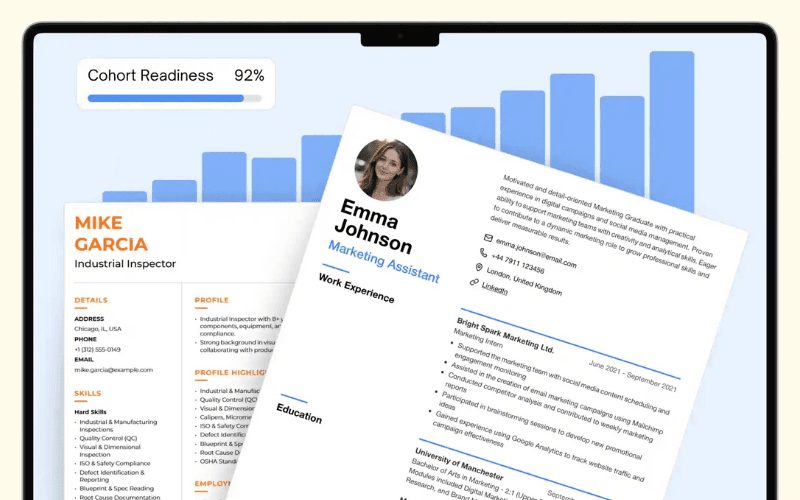
- Educator Resume Platform— Standardize learner resumes and track cohort readiness.
- Workforce Resume Builder— Employer-ready resumes for workforce clients with tracking.
- Outplacement Resume Support— Support transitions with standardized, employer-ready resumes.
- Recruitment Resume Signals— Role-aligned resumes plus readiness scores for recruiters.
Audience Context
This article is for program managers and career services leads responsible for resume quality across multiple cohorts. It provides practical guidance on moving from manual reviews to standardized, AI-assisted processes.
Research Methodology
This article draws on observed patterns in career services operations, publicly available research on workforce program efficiency, and general best practices for institutional process improvement.
Editorial Standards
Yotru content prioritizes accuracy, neutrality, and practical guidance. This article is maintained by the Workforce Practice Group and reviewed regularly to reflect current best practices.
Disclaimer
This article is for informational purposes only. Implementation timelines and outcomes vary by program. Evaluate approaches based on your specific context and constraints.
Related Resources
Platform Hub
- Career development platforms explained
- Practical AI use cases for career services
- Why white-label career platforms matter
- When to move beyond a resume builder
Career Services
- Yotru unveils enhanced platform for educators and workforce organizations - Overview of institutional platform capabilities
- How training providers can improve learner job outcomes with AI resume tools - Practical guidance for program implementation
- CV tools for training providers: Canva and Word alternatives - Comparison of common tools used in career services
- Resume platform for adult education providers - Specific considerations for adult learning contexts
AI and Resume Quality
- How AI resume tools can help and hurt your job application - Balanced perspective on AI in resume building
- Demystifying applicant tracking systems: What recruiters really do - Understanding the ATS context
References
- Higher Education Quality Council of Ontario. (2024). Navigating the transition from school to work: The impact of career development activities and services on graduate labour market outcomes. HEQCO. Retrieved January 29, 2026, from https://heqco.ca/wp-content/uploads/2024/10/School-to-work-report-FINAL.pdf
- Finnie, R., Mueller, R. E., & Sweetman, A. (2021). Improving the linkages between university and work: A report for the Public Policy Forum. Public Policy Forum. Retrieved January 29, 2026, from https://ppforum.ca/wp-content/uploads/2021/06/ImprovingTheLinkagesBetweenUniversityAndWork-PPF-June2021-EN.pdf
- Usher, A. (2020, December 30). Higher education for lifelong learners: A roadmap for Ontario post-secondary leaders and policymakers. Ontario 360. Retrieved January 29, 2026, from https://on360.ca/policy-papers/higher-education-for-lifelong-learners-a-roadmap-for-ontario-post-secondary-leaders-and-policymakers/
- Organisation for Economic Co-operation and Development. (2020). Workforce innovation to foster positive learning environments in Canada. OECD. Retrieved January 29, 2026, from https://www.oecd.org/content/dam/oecd/en/publications/reports/2020/04/workforce-innovation-to-foster-positive-learning-environments-in-canada.pdf
- National Association of Colleges and Employers. (2025, May 26). Using technology to amplify the impact of career services. NACE. Retrieved January 29, 2026, from https://www.naceweb.org/career-development/best-practices/using-technology-to-amplify-the-impact-of-career-services
- Khurumova, L. N. (2023). Online and computer-assisted career guidance. Frontiers in Psychology, 14, 1137718. https://doi.org/10.3389/fpsyg.2023.1137718
- Careers & Enterprise Company. (2024, November 21). Employer standards for careers education: One year on. Careers & Enterprise Company. Retrieved January 29, 2026, from https://www.careersandenterprise.co.uk/evidence-and-reports/employer-standards-for-careers-education-one-year-on/
- Department for Education. (2025, June 25). LEO graduate and postgraduate outcomes: Tax year 2022–23. UK Government. Retrieved January 29, 2026, from https://explore-education-statistics.service.gov.uk/find-statistics/leo-graduate-and-postgraduate-outcomes/2022-23
- Prospects Luminate. (2024). What do graduates do? 2025/26. Prospects. Retrieved January 29, 2026, from https://luminate.prospects.ac.uk/what-do-graduates-do
- Future Skills Council. (2020). A skilled, agile workforce ready to shape the future: Consultation report. Employment and Social Development Canada. Retrieved January 29, 2026, from https://www.canada.ca/en/employment-social-development/programs/future-skills/report-learning-nation.html
Maintained by: Workforce Practice Group at Yotru
Review cycle: Regularly reviewed to reflect real-world practice
Last updated: January 29, 2026
Questions or Need Support?
If you are working on employability programs, hiring strategy, career education, or workforce outcomes and want practical guidance, you are in the right place.
Yotru supports individuals and organizations navigating real hiring systems. That includes resumes and ATS screening, career readiness, program design, evidence collection, and alignment with employer expectations. We work across education, training, public sector, and industry to turn guidance into outcomes that actually hold up in practice.