Practice
7 min read
AI in Career Services: Practical Use Cases That Don't Replace Advisors
Synopsis
AI in career services isn't about replacing advisors. It's about handling baseline tasks so career professionals can focus on coaching and relationship building.
Every few months, another headline announces that AI will replace career counselors. The reality is more nuanced. AI in career services isn't about elimination. It's about augmentation.
Career advisors do work that AI can't replicate: building trust, navigating emotional complexity, understanding context that doesn't fit neatly into data fields. But advisors also spend significant time on tasks that AI handles better, like checking resume formatting, flagging missing sections, and applying consistent quality criteria across hundreds of documents.
The question isn't whether to use AI. It's how to use it in ways that make advisors more effective, not less relevant.
This article explores practical use cases for AI in career services that treat technology as a co-pilot, not a replacement.
Key Insight
AI in career services works best as a co-pilot. It handles baseline quality checks and surfaces insights, freeing advisors to focus on coaching, relationship building, and the cases that require human judgment.
Why Career Services Leaders Are Skeptical (And Why That's Reasonable)
Before diving into use cases, it's worth acknowledging the legitimate concerns about AI in career services.
Job displacement fears
If AI can review resumes, why pay advisors? This concern is understandable but misplaced. The value of career advisors isn't resume copyediting. It's coaching, motivation, and contextual guidance. AI doesn't do those things well.
Quality and accuracy concerns
Generative AI can produce confident-sounding nonsense. Career services leaders rightly worry about giving learners bad advice at scale. This concern is valid and requires careful platform selection. Not all AI tools are governed the same way.
Loss of human connection
Career development is personal. Learners facing job loss, career transitions, or workforce re-entry need empathy, not algorithms. Any AI implementation that undermines the human relationship is counterproductive.
Equity concerns
AI systems can perpetuate bias. If the training data reflects existing inequities, the AI will too. Career services leaders working with underserved populations need assurance that tools won't disadvantage their learners.
These concerns don't mean AI should be avoided. They mean it should be implemented thoughtfully, with clear boundaries about what the technology does and doesn't do.
Important
Not all AI tools are created equal. Look for platforms with governed AI that has guardrails, consistent behavior, and configuration options for your specific learner population. Generic consumer tools often lack these safeguards.
Use Case 1: Real-Time Resume Quality Checks
The most straightforward application of AI in career services is automated resume review.
The problem:
Advisors spend 20 to 40 minutes per resume on basic quality checks. They're looking for missing sections, formatting issues, vague language, and ATS compatibility problems. This work is necessary but repetitive, and it consumes time that could go toward coaching.
How AI helps:
AI-powered resume tools provide real-time feedback as learners build their resumes. The system flags issues immediately: missing contact information, sentences that start with "I," formatting that won't parse in applicant tracking systems. By the time a learner submits their resume for advisor review, the baseline problems are already addressed.
What advisors do instead:
Advisors focus on substance. Does the resume tell a coherent story? Are the learner's goals realistic? Is there a gap or unusual background that needs strategic positioning? These questions require human judgment.
A career development platform designed for institutions provides this capability at scale, with AI configured for program-specific requirements rather than generic job seekers.
Use Case 2: Program-Aware Content Suggestions
Generic AI resume tools give generic advice. They don't know that your nursing students need to format clinical rotations a certain way, or that your construction apprentices should highlight specific certifications.
The problem:
Learners receive irrelevant suggestions because the AI doesn't understand their training context. Advisors spend time correcting AI-generated content that doesn't fit the program's requirements.
How AI helps:
Program-aware AI understands the learner's context. It knows what industry they're targeting, what credentials are expected, and what language employers in that sector use. Suggestions are relevant, not generic.
What advisors do instead:
Advisors don't have to undo bad AI advice. They can trust that the platform is giving learners appropriate guidance and focus their attention on learners who need individualized support.
This is a key differentiator between consumer resume builders and platforms built for educators and workforce programs. The AI is configured for your context.
Hint
Ask vendors how their AI handles different learner populations. Can you configure it for specific industries or training programs? If the answer is no, the tool isn't designed for institutional use.
Use Case 3: Cohort-Level Readiness Insights
Individual learner support is important, but program managers also need to see the big picture. Are learners progressing on schedule? Which cohorts are struggling? Where should resources be allocated?
The problem:
Without centralized data, program managers rely on anecdotal updates from advisors. Reporting to funders requires manual data aggregation. Problems don't surface until they're already crises.
How AI helps:
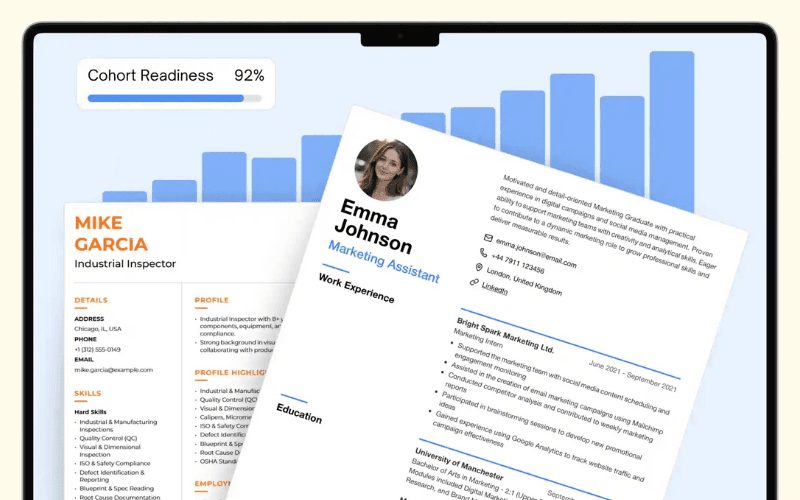
Career development platforms track learner progress and resume quality at the cohort level. Dashboards show which learners are on track, which resumes meet quality standards, and where interventions are needed. This data is available in real time, not after manual compilation.
What advisors do instead:
Advisors receive automated flags about learners who need attention. They can be proactive instead of reactive, reaching out before someone falls behind rather than after.
For program managers, this visibility makes reporting easier and decision-making more informed. You can see where your team's capacity is being consumed and whether it's aligned with learner needs.
Use Case 4: Consistent Feedback at Scale
One of the hardest problems in career services is consistency. When three advisors review the same resume, they often give different feedback. This isn't because anyone is wrong. It's because humans have different priorities and perspectives.
The problem:
Learners get confused when feedback varies by advisor. Program quality looks inconsistent to employers and funders. Advisors themselves are frustrated when their guidance conflicts with a colleague's.
How AI helps:
AI applies the same criteria to every resume. It doesn't have personal preferences or get tired at the end of a long day. The baseline feedback is consistent, regardless of who the learner happens to work with.
What advisors do instead:
Advisors focus on the areas where their individual expertise and judgment add value. The variation that remains is productive, the kind that comes from different coaching styles and areas of specialization, rather than arbitrary differences in basic quality checks.
Pro Tip
Define your quality standards before implementing AI tools. The platform should enforce your criteria, not impose its own. Document what "employer-ready" means for your program and configure the AI accordingly.
Use Case 5: Support for Outplacement and Career Transitions
Career services isn't just about new graduates. Many programs serve workers facing job loss, career changers, and people re-entering the workforce after gaps.
The problem:
These populations often need more support, not less. They may have outdated resumes, unfamiliarity with current hiring practices, or emotional barriers to job searching. Advisor capacity is limited.
How AI helps:
AI provides immediate, accessible support that learners can use on their own time. Someone who loses their job at 9pm doesn't have to wait for office hours to start updating their resume. The platform provides guidance and quality checks without requiring an appointment.
What advisors do instead:
Advisors focus on the emotional and strategic aspects of career transition. They help people process job loss, think through their options, and make decisions about next steps. This is the work that requires human connection.
For organizations offering outplacement services, AI-powered tools extend capacity without proportionally increasing cost.
What AI Doesn't Do Well (And Shouldn't Try)
Effective AI implementation requires honesty about limitations. Here's what AI in career services shouldn't be expected to handle:
- Complex career counseling: Deciding whether to change industries, go back to school, or take a pay cut for better work-life balance are not algorithm problems. These decisions require understanding of the learner's full context, values, and constraints.
- Emotional support: Job loss is hard. Career uncertainty is stressful. AI can be polite, but it can't provide genuine empathy. Advisors are essential for the human connection that sustains people through difficult transitions.
- Networking and relationship building: AI can't introduce a learner to a hiring manager or vouch for their character. The relational aspects of job searching remain fundamentally human.
- Navigating discrimination and bias: Learners facing age discrimination, disability barriers, or other forms of bias need advisors who understand these challenges and can help them navigate strategically. AI doesn't have the judgment for this work.
- Understanding unusual contexts: Someone who spent five years as a caregiver, worked informally in a family business, or has a career path that doesn't fit standard categories needs human guidance. AI works best with patterns. Advisors handle the exceptions.
The goal isn't to push AI into areas where it fails. It's to use AI where it excels, freeing human capacity for work that requires human skills.
Getting the Implementation Right
If you're considering AI tools for your career services operation, here's how to approach it:
- Start with your pain points: Where is your team spending time on tasks that could be automated? Where are you seeing inconsistency? Where do you lack visibility? Let these questions guide your tool selection.
- Involve advisors in the process: Advisors who feel threatened will resist adoption. Advisors who understand how the tool makes their work better will champion it. Include them in selection and configuration.
- Choose governed AI: Not all AI is created equal. Look for platforms that offer transparency about how the AI works, configurability for your context, and guardrails that prevent inappropriate outputs.
- Measure what matters: Track whether the implementation is achieving your goals. Are advisors spending less time on baseline reviews? Are learners progressing faster? Is quality more consistent? Use data to refine your approach.
- Maintain human oversight: AI should support decisions, not make them. Advisors should always have the ability to override, adjust, or supplement AI-generated guidance. The human stays in the loop.
Moving Forward
AI in career services isn't a threat to advisors. It's an opportunity to refocus their work on what matters most: helping people navigate career decisions with confidence.
The Yotru Platform is built on this philosophy. AI handles quality checks, content suggestions, and readiness insights. Advisors handle coaching, relationships, and the cases that require human judgment.
For organizations serving learners at scale, whether training providers, workforce programs, or outplacement services, this division of labor is what makes sustainable, high-quality career services possible.
About the Author

Team Yotru
Employability Systems
Team Yotru
Employability Systems
We build practical career tools for training providers and workforce programs, combining labor market insights with real employment outcomes. Follow us on LinkedIn.
Frequently Asked Questions
No. AI in career services handles baseline tasks like quality checks and formatting feedback. Advisors focus on coaching, relationship building, and complex cases that require human judgment. The goal is augmentation, not replacement.
Yotru Platform
Employer-Ready Resume Solutions Hub
- Career Development Platform— AI platform for compliant, employer-ready resumes.
- Employer Hiring Signals— Standardized resumes with clear pre-interview hiring signals
- Educator Resume Platform— Standardize learner resumes and track cohort readiness.
- Workforce Resume Builder— Employer-ready resumes for workforce clients with tracking.
- Outplacement Resume Support— Support transitions with standardized, employer-ready resumes.
- Recruitment Resume Signals— Role-aligned resumes plus readiness scores for recruiters.
Audience Context
This article is for career services leaders, educators, and nonprofit administrators evaluating AI tools. It provides a balanced perspective on practical use cases while acknowledging legitimate concerns about technology in career services.
Research Methodology
This article draws on publicly available research about AI in workforce development, observed patterns in career services operations, and general best practices for technology adoption in educational settings.
Editorial Standards
Yotru content prioritizes accuracy, neutrality, and practical guidance. This article is maintained by the Workforce Practice Group and reviewed regularly to reflect current technology capabilities and best practices.
Disclaimer
This article is for informational purposes only. AI capabilities and appropriate use vary by context. Evaluate tools and approaches based on your specific program requirements and learner population.
Related Resources
Platform Hub
- Career development platforms explained
- How to standardize resume quality across cohorts
- Why white-label career platforms matter
- When to move beyond a resume builder
AI and Career Development
- How AI resume tools can help and hurt your job application - Balanced perspective on AI in resume building
- AI resume tools and inclusive career development - Equity considerations for AI implementation
- Should you trust AI to write your resume? Here's what recruiters said on Reddit - Real-world perspectives on AI resumes
Career Services Operations
- How training providers can improve learner job outcomes with AI resume tools - Implementation guidance
- Gatsby benchmarks in practice for careers teams - Quality standards in career services
- Measuring guidance impact beyond job placement - Broader outcome measures
References
- Organisation for Economic Co-operation and Development. (2023). OECD employment outlook 2023: Artificial intelligence and the labour market. OECD. Retrieved January 29, 2026, from https://www.oecd.org/employment-outlook/2023/
- World Economic Forum. (2023). The future of jobs report 2023. World Economic Forum. Retrieved January 29, 2026, from https://www.weforum.org/publications/the-future-of-jobs-report-2023/
- U.S. Department of Labor. (2024). Artificial intelligence and worker well-being: Principles for developers and employers. U.S. Department of Labor. Retrieved January 29, 2026, from https://www.dol.gov/ (AI principles for worker well-being)
- National Association of Colleges and Employers. (2025, May 26). Using technology to amplify the impact of career services. NACE. Retrieved January 29, 2026, from https://www.naceweb.org/career-development/best-practices/using-technology-to-amplify-the-impact-of-career-services
- Khurumova, L. N. (2023). Online and computer-assisted career guidance. Frontiers in Psychology, 14, 1137718. https://doi.org/10.3389/fpsyg.2023.1137718
- OECD, & International Centre for Career Development and Public Policy. (2025). Artificial intelligence, occupations, and career guidance: Connecting the dots in the labour market. ICCDPP. Retrieved January 29, 2026, from https://www.iccdpp.org/artificial-intelligence-occupations-and-career-guidance-connecting-the-dots-in-the-labour-market-oecd/
- Careers & Enterprise Company. (2024, November 21). Employer standards for careers education: One year on. Careers & Enterprise Company. Retrieved January 29, 2026, from https://www.careersandenterprise.co.uk/evidence-and-reports/employer-standards-for-careers-education-one-year-on/
- Department for Education. (2025, June 25). LEO graduate and postgraduate outcomes: Tax year 2022–23. UK Government. Retrieved January 29, 2026, from https://explore-education-statistics.service.gov.uk/find-statistics/leo-graduate-and-postgraduate-outcomes/2022-23
- Prospects Luminate. (2024). What do graduates do? 2025/26. Prospects. Retrieved January 29, 2026, from https://luminate.prospects.ac.uk/what-do-graduates-do
- Asia Pacific Career Development Association. (2025, November 22). Australia: Country information and trends in career development. APCDA. Retrieved January 29, 2026, from https://asiapacificcda.org/australia-information/
- Catholic Schools New South Wales. (2025, June 5). 2024 national survey of Australian career development practitioners. Catholic Schools NSW. Retrieved January 29, 2026, from https://www.csnsw.catholic.edu.au/resources/national-survey-career-development-practitioners
- Higher Education Quality Council of Ontario. (2024). Navigating the transition from school to work: The impact of career development activities and services on graduate labour market outcomes. HEQCO. Retrieved January 29, 2026, from https://heqco.ca/wp-content/uploads/2024/10/School-to-work-report-FINAL.pdf
Maintained by: Labor Intelligence Group at Yotru
Review cycle: Monitored as market conditions evolve
Last updated: March 23, 2026
Questions or Need Support?
If you are working on employability programs, hiring strategy, career education, or workforce outcomes and want practical guidance, you are in the right place.
Yotru supports individuals and organizations navigating real hiring systems. That includes resumes and ATS screening, career readiness, program design, evidence collection, and alignment with employer expectations. We work across education, training, public sector, and industry to turn guidance into outcomes that actually hold up in practice.