Practice
5 min read
Why Young People Struggle to Get Hired (and What Employers Really Look For)
Synopsis
Students aren’t failing the job market because they lack skills, but because they struggle to translate them. Sandra Davis explains how language, behaviour, and structured thinking separate candidates who get noticed from those who don’t, and what employers actually look for beyond grades.
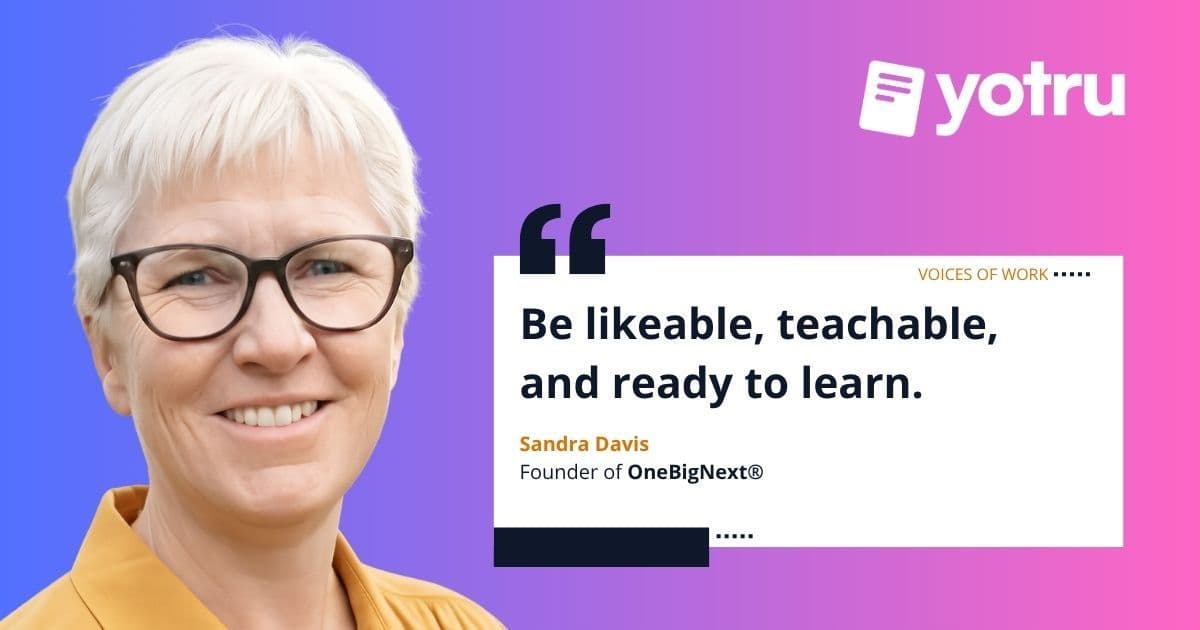
Sandra Davis, Founder of OneBigNext®, works at the intersection of education and employability, helping young people translate potential into real-world readiness. Her perspective is grounded in a simple but often overlooked reality: the problem is not capability, it’s alignment.
In a recent exchange, Sandra Davis shared several observations from her research and advisory work.
Language Creates a Gap
Sandra doesn’t blame a lack of intelligence or ability for the disconnect between education and employment. Instead, she explains it in this way:
“The gap between education and employment is - more than anything - one of language. Schools and colleges talk one language and teach one set of behaviours. Employers talk a different language and require a different set of behaviours.”
This mismatch is particularly noticeable when capable students struggle to present themselves effectively during hiring processes. According to Sandra, the problem is not that young people lack skills; rather, they often do not know how to express those skills in a way that resonates with employers.
“A key part of my role is helping young people to reframe their knowledge, skills, and experiences using language that employers understand, so that they can best present themselves to future employers.”
This reframing requires a shift in perspective. Students are trained to excel academically but are rarely taught to consider the employer’s perspective.
“When a young person gains a strong understanding of the employer’s perspective, they can then shape themselves and their offer into something that works for real employers in real workplaces.”
Beyond Grades: What Employers Actually Want
Davis is clear about the role of qualifications; they matter, but alone they are not enough. What follows this initial evaluation is where many candidates fall short. Employers seek indicators of behaviour rather than just achievements.
“Grades and qualifications are important to get your foot in the door, but to secure the role a young person will need to have strong core skills and experience. Core skills - such as leadership, teamwork, resilience, listening, and communication - are critical to employers. These skills can be developed and demonstrated by young people through co-curricular and community activities, plus volunteering and work experience.”
These are not abstract qualities. They are observable, and they must be demonstrated through action. For candidates who lack formal experience, Sandra emphasizes the importance of resourcefulness and the increasing significance of structured short-form learning.
“Making really strong use of micro-credentials - such as courses on Udemy and Coursera - is a great way to stand out to an employer and put yourself ahead of the rest of the field.”
Where Young Candidates Struggle Most
Even highly capable candidates often underperform during the hiring process. Sandra attributes this issue to a lack of exposure rather than a lack of ability. She points out:
“The education system does not typically teach young people how recruitment processes work, and how to succeed at each stage.”
These processes require a different kind of discipline, where clarity and restraint are more important than enthusiasm alone. One of the simplest yet most effective adjustments is to focus on delivering clear and succinct answers that naturally incorporate keywords relevant to the role.
“The biggest mindset shift we teach is how to deliver a clear and succinct answer which naturally integrates keywords relevant to the role. Giving young people the confidence to deliver a clear and relevant answer - and stop at the right point - is a game changer. Young people typically struggle with the concept that, in a faceless video interview, the time limit is a maximum, not a target to be achieved.”
Why Structure Changes Outcomes
Sandra emphasizes the importance of structured approaches to career preparation. This structure is not meant to impose rigidity, but rather to reduce uncertainty and improve focus.
“Structure is essential for young people navigating the education to employment gap because at OneBigNext® we are teaching young people a system that they can use repeatedly throughout their career.”
Without a clear structure, candidates often waste energy figuring out the application process rather than improving their performance within it.
“If a young person is approaching their job search in a structured way, following a repeatable framework, they can give all their attention to the detail of each role rather than wasting mental energy and focus on ‘how to’ questions.”
The concept of repeatability is key here. Hiring success is not just a one-time event; it is a skill set that can be learned and applied multiple times.
The Impact of AI
Sandra sees AI as a defining factor in the future of work, particularly for early-career talent. For young people, this creates a clear expectation.
“AI adoption will increasingly be a key deciding factor between companies that thrive and companies that fail. Consequently, strong AI literacy is a core skill that employers require, and an area where young people can potentially add significant value when they join the workforce.”
However, she is equally clear that technical familiarity is not enough. Human judgment remains central.
“It is essential to develop your AI literacy - whilst retaining a strong understanding of AI ethics - if you want to thrive in the modern workplace.”
What Schools and Young People can do now
For institutions, Davis sees a specific and immediate opportunity.
“There’s a gap between the high-quality careers education provided under the Gatsby framework (in the UK), and the practical employability support to bridge the gap from education to employment or entrepreneurship.”
Her recommendation is practical rather than theoretical.
“Seek specialist practical employability support from an external provider… [to] provide the practical support that young people need to navigate this key life transition.”
For individuals, the advice is even more direct.
“Build character to build employability skills”
These experiences shape both capability and direction.
“Getting involved in co-curricular activities either in school or outside school is the most important thing young people can do. Through these activities, [you] will develop the core skills that employers need… Alongside developing these skills… [you’ll] discover what’s important to you. You will find your niche: Your USP.”
And for those willing to go a step further:
“As a bonus, start a side hustle. You’ll learn loads and develop a huge range of skills and experience which will be fantastic as examples when you apply for a job.”
About Sandra Davis
Sandra Davis is a careers and employability specialist working with young people aged 13 to 25. She is the founder of OneBigNext® and is passionate about helping young people understand what employers are really looking for and how to intentionally build the skills and experiences that will set them apart.
Hint
This article is part of Yotru's Voices of Work series, highlighting leaders who are redefining how people learn, lead, and get hired. To get featured, please contact us.
About the Author

Hannah Verkler
Media Relations Lead
Hannah Verkler
Media Relations Lead
Hannah leads media relations and external communications at Yotru, helping share the company’s work with journalists, partners, and the workforce community.
Frequently Asked Questions
Soft skills are difficult to validate on resumes because the language used to describe them is often broad and subjective. Words like “adaptable” or “collaborative” can mean different things in different contexts. Without supporting examples, hiring teams cannot easily determine how those behaviors actually show up in real work situations.
Audience Context
This article is written for workforce leaders, educators, and hiring managers who regularly evaluate resumes and talent signals. It explores how soft skills are interpreted during early resume screening and why contextual evidence, such as outcomes and ownership, matters when assessing candidate readiness.
Research Methodology
The insights in this article are drawn from written responses provided by Christopher Pappas regarding how soft skills are interpreted during early resume review. The editorial synthesizes his observations into practical themes relevant to hiring teams and career development professionals.
Editorial Standards
Voices of Work articles are based on source-driven expert insights. Quotes in this piece are drawn directly from the expert’s written response. The editorial reframes those observations into a narrative format while maintaining fidelity to the expert’s language and intent.
Disclaimer
The perspectives shared reflect one experienced HR leader’s observations across client engagements. Hiring practices vary by industry, geography, and role type. Readers should interpret these insights within their own organizational and labor market context.
Related Readings
Voices of Work: Leadership and Hiring Perspectives
- How Hiring Volume Forced John Lentini to Rethink Resume Requirements — Rethinking resume screening at scale
- Career Transitions During Digital Restructuring in Schools — Guiding careers through change
- Mark Pearce on What Hiring Managers Will Look for in CVs in 2026 — What 2026 CVs must show
- Voices of Work: Alexandra Aileru on Identity Translation and Modern Career Fit — Translating non-linear careers
- Voices of Work: Why Qualified Candidates Fail Early Resume Screenings — Why resumes fail early screens
- Nicole Fougere on Trust, Tools, and the Future of Hiring — Trust, AI tools, future hiring
Platform and Solutions
- Yotru for Workforce Development — Tools for workforce organizations
- Yotru for Employers — Hiring and talent solutions
- Yotru for Outplacement — Supporting workforce transitions
- Yotru for Educators — Career services for education providers
People Strategy and Hiring
- Why Yotru Is Built for Real Hiring, Not Just Resume Writing — Systems built for real hiring outcomes
- Why HR Departments Are Using Yotru to Support Laid-Off Workers — Humane layoff support tools
- How Yotru Helps Regions Identify Upskilling and Retraining Opportunities — Regional workforce strategy
- What Is a Risk-Free Hiring Pilot Program — Testing hiring systems safely
Job Market and Interview Insights
- Why It Feels So Hard to Get a Job Right Now — Market pressures and constraints
- Why Interviews Feel Harder Than the Actual Job — Where process and work diverge
- Green Flags in Interviews — Signs of healthy hiring cultures
- What Hiring Managers Really Notice in the First 5 Minutes — Signals that matter early
References
- Deming, W. E. (2000). Out of the crisis. MIT Press.
https://mitpress.mit.edu/9780262541152/out-of-the-crisis - National Association of Colleges and Employers. (2023). Job outlook 2023: The attributes employers seek on resumes. National Association of Colleges and Employers.
https://www.naceweb.org/store/2023/job-outlook-2023/ - Organisation for Economic Co-operation and Development. (2019). OECD skills outlook 2019: Thriving in a digital world. OECD Publishing.
https://doi.org/10.1787/df80bc12-en - U.S. Bureau of Labor Statistics. (2023). Employment projections and occupational outlook. U.S. Department of Labor.
https://www.bls.gov/emp - World Economic Forum. (2023). The future of jobs report 2023. World Economic Forum.
https://www.weforum.org/publications/the-future-of-jobs-report-2023
Maintained by: Workforce Practice Group at Yotru
Review cycle: Regularly reviewed to reflect real-world practice
Last updated: March 30, 2026
Questions or Need Support?
If you are working on employability programs, hiring strategy, career education, or workforce outcomes and want practical guidance, you are in the right place.
Yotru supports individuals and organizations navigating real hiring systems. That includes resumes and ATS screening, career readiness, program design, evidence collection, and alignment with employer expectations. We work across education, training, public sector, and industry to turn guidance into outcomes that actually hold up in practice.