Practice
4 min read
Why Soft Skills Are Hard to Validate on Paper
Synopsis
Soft skills matter in hiring, but they are difficult to validate from a resume alone. Christopher Pappas explains why context and outcomes make the difference.
Soft skills appear on nearly every resume today, yet they remain one of the hardest aspects for hiring teams to interpret. Most candidates know that qualities like collaboration, adaptability, and communication are essential in the workplace.
However, simply including these traits on a resume does not necessarily make them credible.For recruiters and hiring managers reviewing hundreds of resumes, the challenge is less about whether soft skills are important and more about finding evidence that those skills are genuine. In practice, validating soft skills on resumes means identifying behaviors and outcomes that demonstrate how a candidate works with others, makes decisions, or navigates change.
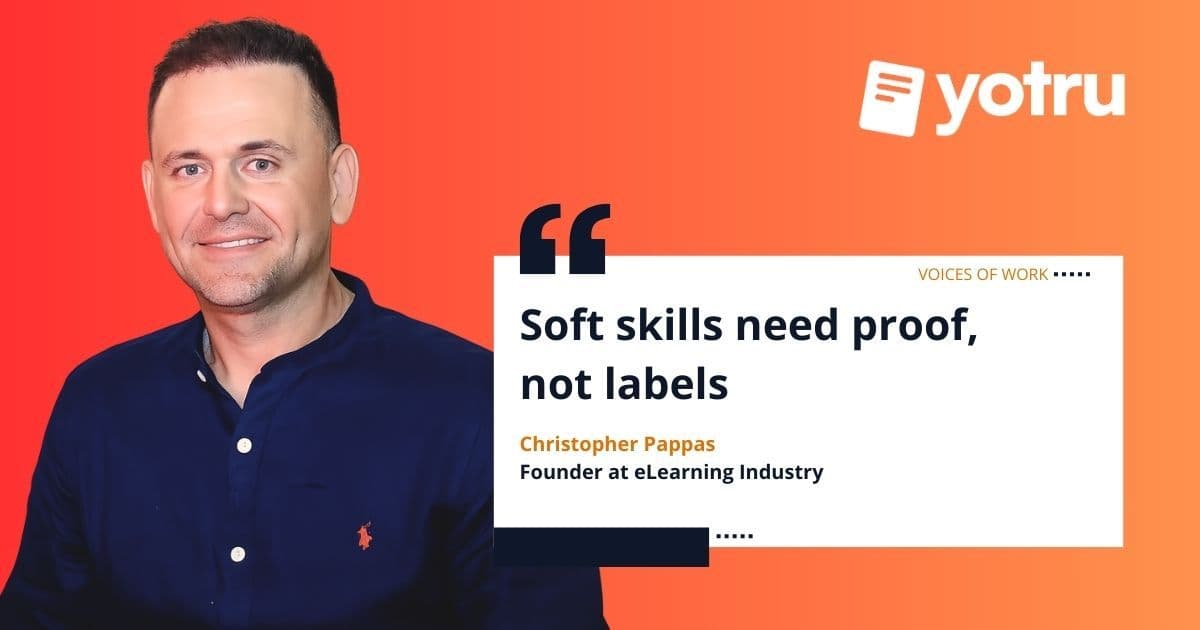
In a recent discussion, Christopher Pappas shared several insights from his research and advisory work. As the founder of eLearning Industry Inc., he has spent years observing how professionals present their experiences and how hiring audiences interpret these signals.
One pattern consistently emerges: the words on a page often do not convey the complete story.
When Soft Skills Become Risk Signals
While soft skills are generally intended to enhance a candidate's profile, they can sometimes have the opposite effect.According to Christopher, early resume screening is a time-sensitive process. Reviewers aren't evaluating a candidate's personality in depth; instead, they're looking for signals that help them quickly understand the candidate's role and impact.When certain soft skills appear without context, they can create ambiguity.
“During early review, soft skill claims can act as risk signals.”
For example, describing yourself as a “team player” could mean several things. It might signal someone who collaborates effectively across teams. But it might also raise the possibility that the candidate relies too heavily on group work without taking ownership of outcomes.
This ambiguity extends to other common descriptors as well.
“For example, ‘team player’ could mean a steady collaborator or someone avoiding ownership.”
From a hiring perspective, a resume alone cannot clarify this uncertainty. As a result, recruiters seek additional clues in the experience section to interpret what these claims really mean.
Why Context Matters More Than Labels
Many resumes list soft skills at the top or summarize them in profile sections. But hiring teams rarely rely on those sections to evaluate them.
Instead, reviewers look for evidence embedded in the work itself.
“Since we cannot fully assess behavior from a document alone, we look at the context provided in the following bullets.”
This means examining how candidates detail their responsibilities and achievements. Specific information about collaboration, ownership, and decision-making often reveals much more than labels for soft skills themselves.
For example, describing cross-functional work with product teams or coordinating deliverables across departments provides insight into how collaboration actually occurred. Mentioning decision authority, project cadence, or stakeholder influence can reveal the communication and leadership behaviors behind the work.
At Yotru, we observe similar trends when analyzing how hiring teams interpret resumes. Simply using soft skill language does not significantly impact screening decisions unless it is accompanied by concrete evidence of effectiveness and impact.
What Makes a Soft Skill Credible
If soft skill claims can create ambiguity, what actually strengthens them?
Christopher identifies three types of supporting signals that enhance the believability of these claims during the early stages of review.
“If the next points show clear ownership, measurable outcomes, and cross-functional work, the soft skill label gains credibility.”
First, clear ownership is one of the strongest indicators. When a resume highlights a candidate's responsibility for a project, initiative, or outcome, it suggests that the candidate was not just involved but had a significant influence on direction and results.
Second, measurable outcomes add another layer of credibility. When candidates describe how their work improved performance, efficiency, or adoption, it allows the reader to connect specific behaviors with tangible results.
Lastly, cross-functional work indicates collaboration in action. Rather than merely claiming teamwork, a resume that illustrates how the candidate navigated relationships among teams, departments, or stakeholders demonstrates practical collaboration skills.
Specificity Saves Reviewers Time
Recruiters and hiring managers often review resumes under significant time pressure. That reality shapes how they interpret soft skill claims.
Generic descriptions require interpretation. Specific descriptions reduce it.
“We respond best to specificity that saves us time.”
One practical way candidates can achieve this is by clarifying the context in which their work occurred. Christopher suggests highlighting details such as the audience influenced, the decision-driven nature, or the work's cadence.
“Mention the audience you influenced, the cadence you operated in, and the decision you drove.”
These details turn vague statements into descriptions of observable behavior. Instead of simply claiming to be adaptable or collaborative, a resume can illustrate the situations where those behaviors were significant.
Over time, this level of specificity helps hiring teams interpret a candidate's experience more quickly and with greater confidence.
About Christopher Pappas
Christopher Pappas is the Founder of eLearning Industry Inc, a publishing platform and community focused on learning and development professionals. Through his work with educators, HR leaders, and training organizations, he studies how professionals communicate expertise and how hiring audiences interpret signals of readiness and impact.
Hint
This article is part of Yotru's Voices of Work series, highlighting leaders who are redefining how people learn, lead, and get hired. To get featured, please contact us.
About the Author

Hannah Verkler
Media Relations Lead
Hannah Verkler
Media Relations Lead
Hannah leads media relations and external communications at Yotru, helping share the company’s work with journalists, partners, and the workforce community.
Frequently Asked Questions
Soft skills are difficult to validate on resumes because the language used to describe them is often broad and subjective. Words like “adaptable” or “collaborative” can mean different things in different contexts. Without supporting examples, hiring teams cannot easily determine how those behaviors actually show up in real work situations.
Audience Context
This article is written for workforce leaders, educators, and hiring managers who regularly evaluate resumes and talent signals. It explores how soft skills are interpreted during early resume screening and why contextual evidence, such as outcomes and ownership, matters when assessing candidate readiness.
Research Methodology
The insights in this article are drawn from written responses provided by Christopher Pappas regarding how soft skills are interpreted during early resume review. The editorial synthesizes his observations into practical themes relevant to hiring teams and career development professionals.
Editorial Standards
Voices of Work articles are based on source-driven expert insights. Quotes in this piece are drawn directly from the expert’s written response. The editorial reframes those observations into a narrative format while maintaining fidelity to the expert’s language and intent.
Disclaimer
The perspectives shared reflect one experienced HR leader’s observations across client engagements. Hiring practices vary by industry, geography, and role type. Readers should interpret these insights within their own organizational and labor market context.
Related Readings
Voices of Work: Leadership and Hiring Perspectives
- How Hiring Volume Forced John Lentini to Rethink Resume Requirements — Rethinking resume screening at scale
- Career Transitions During Digital Restructuring in Schools — Guiding careers through change
- Mark Pearce on What Hiring Managers Will Look for in CVs in 2026 — What 2026 CVs must show
- Voices of Work: Alexandra Aileru on Identity Translation and Modern Career Fit — Translating non-linear careers
- Voices of Work: Why Qualified Candidates Fail Early Resume Screenings — Why resumes fail early screens
- Nicole Fougere on Trust, Tools, and the Future of Hiring — Trust, AI tools, future hiring
Platform and Solutions
- Yotru for Workforce Development — Tools for workforce organizations
- Yotru for Employers — Hiring and talent solutions
- Yotru for Outplacement — Supporting workforce transitions
- Yotru for Educators — Career services for education providers
People Strategy and Hiring
- Why Yotru Is Built for Real Hiring, Not Just Resume Writing — Systems built for real hiring outcomes
- Why HR Departments Are Using Yotru to Support Laid-Off Workers — Humane layoff support tools
- How Yotru Helps Regions Identify Upskilling and Retraining Opportunities — Regional workforce strategy
- What Is a Risk-Free Hiring Pilot Program — Testing hiring systems safely
Job Market and Interview Insights
- Why It Feels So Hard to Get a Job Right Now — Market pressures and constraints
- Why Interviews Feel Harder Than the Actual Job — Where process and work diverge
- Green Flags in Interviews — Signs of healthy hiring cultures
- What Hiring Managers Really Notice in the First 5 Minutes — Signals that matter early
References
- Deming, W. E. (2000). Out of the crisis. MIT Press.
https://mitpress.mit.edu/9780262541152/out-of-the-crisis - National Association of Colleges and Employers. (2023). Job outlook 2023: The attributes employers seek on resumes. National Association of Colleges and Employers.
https://www.naceweb.org/store/2023/job-outlook-2023/ - Organisation for Economic Co-operation and Development. (2019). OECD skills outlook 2019: Thriving in a digital world. OECD Publishing.
https://doi.org/10.1787/df80bc12-en - U.S. Bureau of Labor Statistics. (2023). Employment projections and occupational outlook. U.S. Department of Labor.
https://www.bls.gov/emp - World Economic Forum. (2023). The future of jobs report 2023. World Economic Forum.
https://www.weforum.org/publications/the-future-of-jobs-report-2023
Maintained by: Workforce Practice Group at Yotru
Review cycle: Regularly reviewed to reflect real-world practice
Last updated: March 13, 2026
Questions or Need Support?
If you are working on employability programs, hiring strategy, career education, or workforce outcomes and want practical guidance, you are in the right place.
Yotru supports individuals and organizations navigating real hiring systems. That includes resumes and ATS screening, career readiness, program design, evidence collection, and alignment with employer expectations. We work across education, training, public sector, and industry to turn guidance into outcomes that actually hold up in practice.