

Practice
4 min read
What Employers Distrust Most on Resumes in 2026
Synopsis
A veteran HR leader explains what triggers resume skepticism today and why authenticity has become the real hiring filter.
Key Insight
Ten years ago, a polished resume signaled professionalism. Today, it can convey something entirely different.
As automation has transformed job applications and economic uncertainty has intensified competition, hiring leaders are no longer evaluating qualifications; they are assessing authenticity.
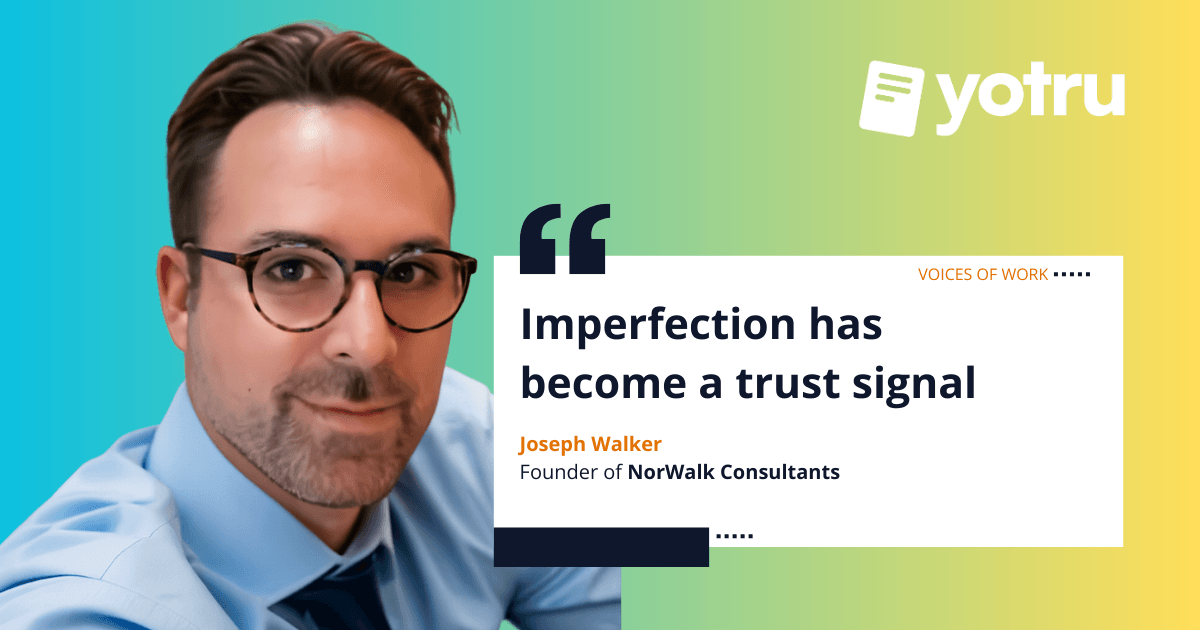
Joseph Walker (SHRM-SCP), the founder of NorWalk Consultants and a fractional HR consultant with over 20 years of experience in talent acquisition and workforce planning, has analyzed thousands of resumes. He noticed something different.
In a recent exchange, Joseph shared several observations from his research and advisory work.
“We have moved past simple skepticism about skill proficiency into an era where we are actively decoding authenticity.”
In practice, this skepticism means that employers are no longer asking “Can this person do the job?” first. They are asking, “Is this story real?”
The Rise of Title Inflation
One of the quickest ways to trigger skepticism is to assign senior titles that do not align with the organization's scale.
Joseph described a growing pattern of candidates listing “VP” or “Director” roles at companies with fewer than ten employees. While these titles may reflect genuine effort and responsibility in smaller organizations, hiring teams at larger companies scrutinize context.
Hiring teams now routinely check company headcount on LinkedIn. If a candidate claims to have been a “Director of Marketing” at a four-person agency, employers often assume that the level of responsibility was more akin to that of a coordinator or generalist.
When titles appear inflated, trust erodes across the entire resume. Employers begin to question not only the level of responsibility but also the depth of skills. This isn’t about penalizing experience in smaller companies; it’s about alignment. When titles and organizational structures do not match, skepticism arises.
The “Consultant” Gap Filler
Economic shifts since 2023 have resulted in noticeable gaps in many employment histories. Joseph has noticed a growing trend where candidates label extended unemployment as “Freelance Consultant.”
While consulting work is legitimate and often impressive, the distinction lies in its specificity.
“When a candidate lists ‘Consulting’ for a 12-month period but lists zero clients, projects, or tangible outcomes, it is a red flag.”
An authentic consultant details the problems they solved and the measurable results they achieved. A placeholder entry lists generic responsibilities, such as “advised on strategy.”
There is also a second layer of concern. Some hiring managers worry that candidates might continue their freelance work while employed full-time. That uncertainty introduces perceived risk.
The moment of breakdown typically happens during the screening process. When hiring teams probe for specifics and receive vague answers, skepticism can harden into disqualification.
Real consulting work can withstand scrutiny. Camouflaged, vague claims do not.
The “AI-Generated” Wall of Perfection
Perhaps the most counterintuitive shift Joseph describes involves the concept of polish itself.
“Ten years ago, a polished, error-free resume was the gold standard. Today, a resume that is too polished triggers the ‘Uncanny Valley’ effect.”
When resumes mirror job descriptions word-for-word, show perfectly aligned dates, and use consistently complex sentence structures, hiring leaders sometimes suspect automation rather than genuine authorship.
“I don’t think ‘What a great candidate.’ I think, ‘This is a bot.’”
Ironically, minor imperfections now signal humanity. A clearly explained career pivot feels more trustworthy than a document that checks every algorithmic box.
This does not mean that professionalism is no longer important. It means that authenticity must be evident to the reader. The document should sound like a person with lived experience, not a composite designed to fit through filters.
At Yotru, we see similar patterns across institutions, where screening-readiness must balance structure with individual clarity.
Fabricated Degrees and the Integrity Line
According to Joseph, the most damaging breach of trust in the hiring process is not simply inflated language; it is the presence of fabricated education. He has encountered candidates who list incomplete degrees or certifications to bypass applicant tracking filters, and this deception often extends to verbal interactions during screening.
The truth typically comes to light with a background check. When education is returned as “unverified” or “inconclusive,” job offers must be rescinded, resulting in significant time and resource losses.
Joseph’s response is direct.
“The issue isn’t just a lie on paper; it’s a reinforced deception in person.”
For employers, this is not just a qualification gap, but a fundamental integrity flaw. Once this trust is broken, it cannot be restored.
Authenticity as the New Hiring Filter
A central theme in Joseph’s insights is clear: trust has become the primary screening criterion. In today’s high-volume, automation-driven hiring environment, authenticity distinguishes candidates. Those who provide context, measurable outcomes, and honest career narratives stand out compared to those who aim for surface-level perfection.
Distrust in resumes is not merely a matter of cynicism; it’s about risk management. Joseph emphasizes that the hiring conversation has shifted from focusing solely on competence to prioritizing credibility first.
About Joseph Walker
Joseph Walker, SHRM-SCP, is the Founder of NorWalk Consultants and a Fractional HR Consultant with over 20 years of experience in talent acquisition and workforce planning. A former HR Director, he advises organizations on hiring strategy, workforce planning, and human capital leadership.
Hint
This article is part of Yotru's Voices of Work series, highlighting leaders who are redefining how people learn, lead, and get hired. To get featured, please contact us.
About the Author

Hannah Verkler
Media Relations Lead
Hannah Verkler
Media Relations Lead
Hannah leads media relations and external communications at Yotru, helping share the company’s work with journalists, partners, and the workforce community.
Frequently Asked Questions
Employers most commonly distrust inflated titles, vague consulting roles, overly polished AI-like language, and fabricated degrees. The core concern is authenticity. Hiring leaders are increasingly verifying organizational size, probing for specific outcomes, and cross-checking credentials to reduce risk.
Audience Context
This article is written for workforce leaders, hiring managers, and advanced job seekers navigating high-volume, automation-supported hiring environments. It reflects patterns observed in consulting engagements and HR advisory practice across small and mid-sized organizations.
Research Methodology
Insights are drawn directly from Joseph Walker’s professional observations as a Fractional HR Consultant and former HR Director, reviewing thousands of resumes. The article synthesizes his written responses and real-world advisory experience without adding external claims.
Editorial Standards
This Voices of Work piece is source-driven and narrative-based. Quotes are presented verbatim from the provided material. Analysis focuses on observable hiring behaviors and avoids speculation, endorsements, or product positioning.
Disclaimer
The perspectives shared reflect one experienced HR leader’s observations across client engagements. Hiring practices vary by industry, geography, and role type. Readers should interpret these insights within their own organizational and labor market context.
Related Readings
Voices of Work: Leadership and Hiring Perspectives
- How Hiring Volume Forced John Lentini to Rethink Resume Requirements — Rethinking resume screening at scale
- Career Transitions During Digital Restructuring in Schools — Guiding careers through change
- Mark Pearce on What Hiring Managers Will Look for in CVs in 2026 — What 2026 CVs must show
- Voices of Work: Alexandra Aileru on Identity Translation and Modern Career Fit — Translating non-linear careers
- Voices of Work: Why Qualified Candidates Fail Early Resume Screenings — Why resumes fail early screens
- Nicole Fougere on Trust, Tools, and the Future of Hiring — Trust, AI tools, future hiring
Platform and Solutions
- Yotru for Workforce Development — Tools for workforce organizations
- Yotru for Employers — Hiring and talent solutions
- Yotru for Outplacement — Supporting workforce transitions
- Yotru for Educators — Career services for education providers
People Strategy and Hiring
- Why Yotru Is Built for Real Hiring, Not Just Resume Writing — Systems built for real hiring outcomes
- Why HR Departments Are Using Yotru to Support Laid-Off Workers — Humane layoff support tools
- How Yotru Helps Regions Identify Upskilling and Retraining Opportunities — Regional workforce strategy
- What Is a Risk-Free Hiring Pilot Program — Testing hiring systems safely
Job Market and Interview Insights
- Why It Feels So Hard to Get a Job Right Now — Market pressures and constraints
- Why Interviews Feel Harder Than the Actual Job — Where process and work diverge
- Green Flags in Interviews — Signs of healthy hiring cultures
- What Hiring Managers Really Notice in the First 5 Minutes — Signals that matter early
References
- Washington, E. (2019, July 17). Uncovering bias: A new way to study hiring can help. Wharton School, University of Pennsylvania. https://knowledge.wharton.upenn.edu/article/uncovering-hiring-bias/
- Robinson, B. (2023, November 4). 70% of workers lie on resumes, new study shows. Forbes. https://www.forbes.com/sites/bryanrobinson/2023/11/05/70-of-workers-lie-on-resumes-new-study-shows/
- Durvasula, P. K., & Ly, T. (2022). Mitigating bias in recruitment: Attracting a diverse, dynamic workforce. Journal of Surgical Education, 79(4), 874–880. https://pmc.ncbi.nlm.nih.gov/articles/PMC9436705/
- Wilson, K., & Caliskan, A. (2025, August 21). Gender, race, and intersectional bias in AI resume screening via language model retrieval. Brookings Institution. https://www.brookings.edu/articles/gender-race-and-intersectional-bias-in-ai-resume-screening-via-language-model-retrieval/
- Kang, S. K., DeCelles, K. A., Tilcsik, A., & Jun, S. (2016). Whitened résumés: Race and self-presentation in the labor market. Administrative Science Quarterly, 61(3), 469–502. Summary at Harvard Business School Working Knowledge: https://www.library.hbs.edu/working-knowledge/minorities-who-whiten-job-resumes-get-more-interviews
Maintained by: Workforce Practice Group at Yotru
Review cycle: Regularly reviewed to reflect real-world practice
Last updated: February 27, 2026
Questions or Need Support?
If you are working on employability programs, hiring strategy, career education, or workforce outcomes and want practical guidance, you are in the right place.
Yotru supports individuals and organizations navigating real hiring systems. That includes resumes and ATS screening, career readiness, program design, evidence collection, and alignment with employer expectations. We work across education, training, public sector, and industry to turn guidance into outcomes that actually hold up in practice.