Practice
4 min read
What “Job-Ready” Actually Means for Early-Career Candidates
Synopsis
Job-ready isn’t about grades anymore. What actually gets early-career candidates hired is real-world experience, initiative, and proof you can deliver from day one.
Entering your first job search with only academic qualifications is no longer sufficient. Many students come to this realization too late, often after months of submitting applications with little to no response.
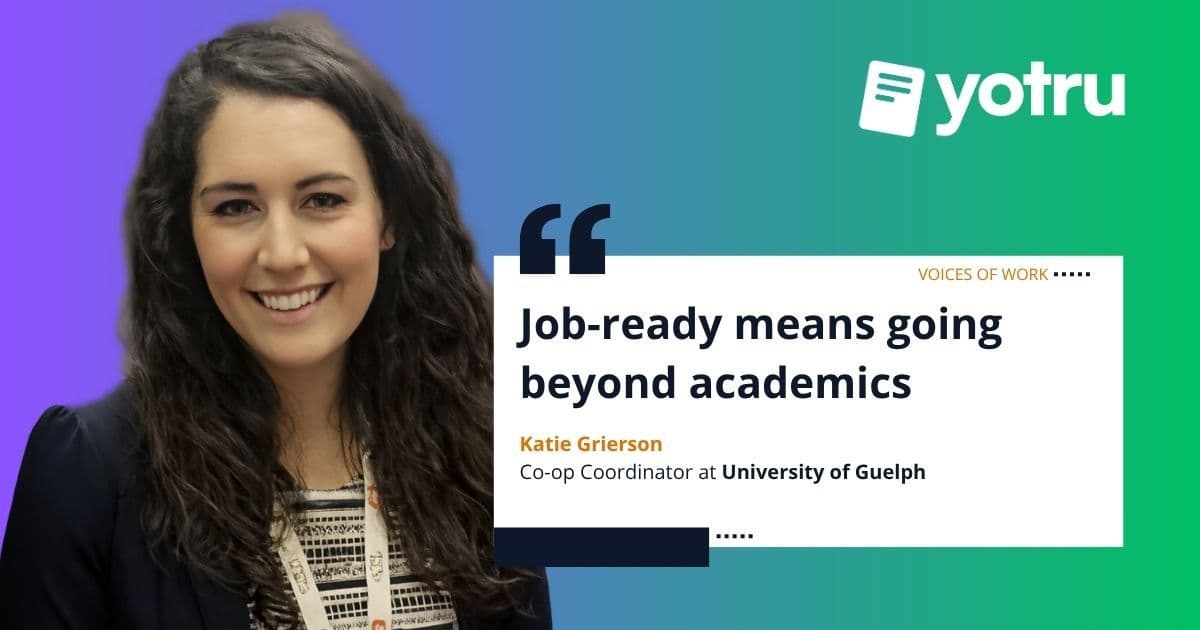
Katie Grierson, a Co-op Coordinator who works with computing students at the University of Guelph, frequently observes this pattern. She operates at the intersection of students and employers, assisting one group in preparing while helping the other make those connections. It is in this gap that most early-career frustrations arise.
In a recent discussion, Katie shared several insights from her advisory work. In practical terms, being "job-ready" means demonstrating that you can contribute effectively in a real work environment, not just excel in academic settings.
Job-Ready Starts Beyond the Classroom
Katie is direct about what makes the first co-op search difficult.
“Coming into that first work term search with a totally blank resume makes it immeasurably harder to be successful.”
The main issue at hand is not the candidates' capabilities but the lack of assessment signals. Employers struggle to gauge potential without reliable indicators.
Students who differentiate themselves often engage in activities beyond their coursework. This includes participating in hackathons, working on personal projects, volunteering, or being active in student organizations. While the specific activities may vary, what truly matters is what they signify: initiative, curiosity, and the ability to thrive outside structured academic environments.
This trend reflects a broader shift in hiring practices. At Yotru, we have observed that decisions increasingly rely on signals of practical capability and consistency rather than credentials alone.
The Real Gap Between Students and Employers
One of the more subtle challenges highlighted by Katie is misalignment. Students and employers often have different assumptions about the capabilities of early-career candidates. She describes this as a gap that “can go both ways.”
Some students tend to underestimate their value, while others may overestimate how their skills translate into actual workplace impact. However, the more consistent hiring signal is not related to technical depth.
“As an employer hire the person that seems keen, willing to learn, communicates well and that will fit well within the team and then you can teach them whatever they need to know to be successful.”
Many students often misallocate their efforts when it comes to developing skills. While technical skills are important, they seldom determine success at the entry level. Employers often prioritize potential for growth over qualifications alone.
Why Well-Rounded Experience Wins
When reviewing resumes from candidates with limited experience, employers tend to look for points of comparison. If all candidates appear similar, grades often become the primary filter to differentiate them.
However, Katie highlights a distinct preference for candidates who offer variation in their experiences.
“I think interviewing a student who has decent grades but has more well-rounded experience… would be who I’d pick over someone with straight A’s but nothing else on their resume.”
The distinction is not based on academic performance, but rather on observed behavior in less controlled environments.
A well-rounded background indicates adaptability, demonstrating that a candidate can manage uncertainty, communicate effectively with others, and solve problems independently without constant guidance. These traits minimize the risk for employers considering candidates with limited professional experience.
Where Applications Break Down
A common breaking point occurs during interviews. Many students assume that shorter answers are preferable, but this often limits an employer’s ability to evaluate their qualifications effectively.
Katie notices this clearly during mock interviews; candidates who give minimal responses leave interviewers with insufficient information to make an assessment. Even strong experiences may be overlooked if not explained well.
The root of the problem is not a lack of experience, but rather a lack of articulation. While structured approaches like the STAR method can be helpful, the more significant point is that interviewing is a skill that must be learned. Without practice, even capable candidates tend to underperform.
Why Relationship-Building Matters More Than Volume
One of the most significant points Katie emphasizes is where students should focus their efforts. Many students rely almost exclusively on submitting applications through formal systems. However, in a competitive job market where a single position can attract hundreds of applicants, this method often yields diminishing returns.
Her advice is to rebalance this approach. Instead of applying in isolation, students should dedicate time to building relationships. This includes reaching out to employers, attending networking events, and leveraging existing connections.
Katie points out that employers may consider candidates even if there is no formal job posting, especially when a student demonstrates initiative and genuine interest. This strategy is not about bypassing established systems; rather, it is about creating additional pathways into them.
At Yotru, similar patterns emerge across high-volume hiring environments, where proactive outreach and relationship signals often influence who gets reviewed more closely.
About Katie Grierson
Katie Grierson is a Co-op Coordinator for Computing students at the University of Guelph. She works directly with students as they navigate their first job searches and collaborates with employers on hiring and campus recruitment strategies. Her background includes roles in talent acquisition and people operations across multiple organizations, where she supported hiring for technical and business teams.
Hint
This article is part of Yotru's Voices of Work series, highlighting leaders who are redefining how people learn, lead, and get hired. To get featured, please contact us.
About the Author

Hannah Verkler
Media Relations Lead
Hannah Verkler
Media Relations Lead
Hannah leads media relations and external communications at Yotru, helping share the company’s work with journalists, partners, and the workforce community.
Frequently Asked Questions
It means demonstrating the ability to operate in a real work environment. This includes communication, initiative, and adaptability. Academic success alone is not enough. Employers look for signals that a candidate can apply their knowledge in less structured, team-based settings.
Audience Context
This article is designed for educators, workforce leaders, and early-career job seekers, particularly those involved in co-op and entry-level hiring. It reflects real hiring dynamics in technical student pipelines and focuses on practical signals employers use when evaluating candidates with limited experience.
Research Methodology
This piece is based on direct written responses and professional insights from a co-op coordinator working closely with computing students and employers. Observations are drawn from real advising conversations, mock interviews, and hiring feedback patterns.
Editorial Standards
All insights are grounded in provided source material and presented without exaggeration or unsupported claims. The article follows Yotru’s standard of clarity, neutrality, and practical relevance, ensuring guidance reflects real-world hiring behavior.
Disclaimer
This article reflects the perspective of one practitioner working in early-career hiring and student advising. Hiring practices vary by organization, role, and market conditions. Readers should interpret these insights as directional rather than universal rules.
Related Readings
Voices of Work: Leadership and Hiring Perspectives
- How Hiring Volume Forced John Lentini to Rethink Resume Requirements — Rethinking resume screening at scale
- Career Transitions During Digital Restructuring in Schools — Guiding careers through change
- Mark Pearce on What Hiring Managers Will Look for in CVs in 2026 — What 2026 CVs must show
- Voices of Work: Alexandra Aileru on Identity Translation and Modern Career Fit — Translating non-linear careers
- Voices of Work: Why Qualified Candidates Fail Early Resume Screenings — Why resumes fail early screens
- Nicole Fougere on Trust, Tools, and the Future of Hiring — Trust, AI tools, future hiring
Platform and Solutions
- Yotru for Workforce Development — Tools for workforce organizations
- Yotru for Employers — Hiring and talent solutions
- Yotru for Outplacement — Supporting workforce transitions
- Yotru for Educators — Career services for education providers
People Strategy and Hiring
- Why Yotru Is Built for Real Hiring, Not Just Resume Writing — Systems built for real hiring outcomes
- Why HR Departments Are Using Yotru to Support Laid-Off Workers — Humane layoff support tools
- How Yotru Helps Regions Identify Upskilling and Retraining Opportunities — Regional workforce strategy
- What Is a Risk-Free Hiring Pilot Program — Testing hiring systems safely
Job Market and Interview Insights
- Why It Feels So Hard to Get a Job Right Now — Market pressures and constraints
- Why Interviews Feel Harder Than the Actual Job — Where process and work diverge
- Green Flags in Interviews — Signs of healthy hiring cultures
- What Hiring Managers Really Notice in the First 5 Minutes — Signals that matter early
References
- National Association of Colleges and Employers. (2023). Career readiness defined. https://www.naceweb.org/career-readiness/competencies/career-readiness-defined
- U.S. Bureau of Labor Statistics. (2024). Employment projections and early career trends. https://www.bls.gov/emp/
- Organisation for Economic Co-operation and Development. (2022). Skills for jobs report. https://www.oecdskillsforjobsdatabase.org/data/S4J2022_results.pdf
- U.S. Department of Labor. (2023). Youth and young adult employment statistics. https://www.dol.gov/agencies/odep/categories/youth
Maintained by: Workforce Practice Group at Yotru
Review cycle: Regularly reviewed to reflect real-world practice
Last updated: April 13, 2026
Questions or Need Support?
If you are working on employability programs, hiring strategy, career education, or workforce outcomes and want practical guidance, you are in the right place.
Yotru supports individuals and organizations navigating real hiring systems. That includes resumes and ATS screening, career readiness, program design, evidence collection, and alignment with employer expectations. We work across education, training, public sector, and industry to turn guidance into outcomes that actually hold up in practice.