Voices of Work
3 min read
How to Prove Soft Skills to Employers Before the Interview
Synopsis
Soft skills aren’t proven by listing them. They’re demonstrated through behavior. One recruiting leader explains how candidates can show credibility early.
Key Insight
Most candidates already know they need to show soft skills. The problem is that listing them on a resume rarely works.
Employers review many applications, and they see the same words over and over. Attention to detail. Communication. Reliability. Over time, these claims lose meaning. So you have to reinforce them.
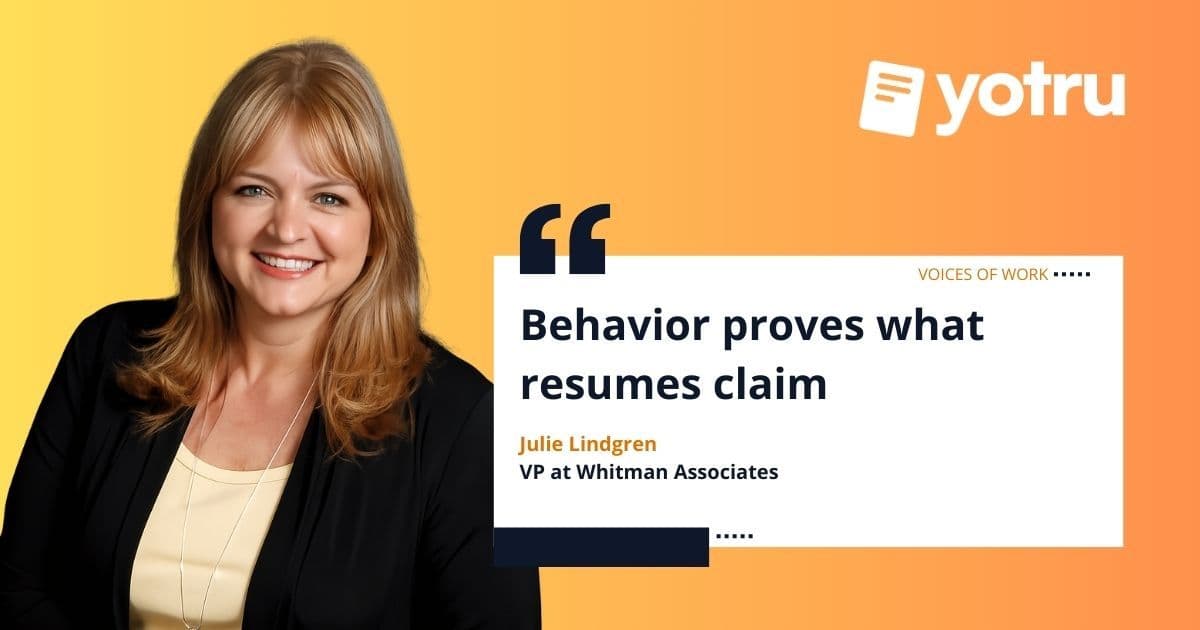
Julie Lindgren has spent more than two decades staffing and recruiting for Whitman Associates, working in environments where small differences between candidates can shape hiring decisions. In a recent exchange, Julie Lindgren shared several observations from their research and advisory work.
In practice, proving you have soft skills means demonstrating them through consistent behavior throughout the hiring process, not by listing them on a resume.
Start With the Application, Not the Interview
Many candidates think the best option is to list their skills now and prove themselves later. But the evaluation begins earlier than most expect, and making the wrong move can mean
For recruiters, the application itself is the first test of how someone works.
“Recruiters look for candidates who accurately follow the application process.”
This especially includes details that feel administrative in nature. Submitting materials correctly, following instructions exactly, and meeting deadlines without reminders are all great examples.
Following instructions correctly can signal more than compliance. They show how a candidate handles expectations, structure, and accountability.
At Yotru, we see similar patterns where structured hiring workflows surface behavioral signals well before interviews begin.
Treat Deadlines and Instructions as Evidence
One of the clearest ways to demonstrate soft skills is through how you manage your time and handle direction.
Deadlines are not just for scheduling. They are accurate indicators of reliability.
“Many times, there is a deadline for resume submissions, so a late resume demonstrates not only a lack of attention to detail, but also an inability to meet a deadline.”
From an employer’s perspective, missing a deadline is a signal of risk. It raises questions about a candidate’s consistency and ability to follow through.
The same applies to following the instructions. Skipping a step or submitting incomplete materials suggests a breakdown in attention or process awareness.
Use Communication to Show Professionalism
Soft skills are the most apparent in a candidate’s communication.
Email responsiveness, clarity, and tone all contribute to how a candidate is perceived. These are ongoing signals, so make sure to put effort in continuously.
“Punctuality when interviewing, or responsiveness when emailing or communicating by phone, are also indicators of professionalism and reliability.”
A delayed response or missed message may seem minor. But in a competitive hiring environment, it can shift how a candidate is evaluated relative to others who are more consistent.
Avoid the Small Mistakes That Undermine Credibility
Sometimes, candidates don’t fail because they lack ability. They fail because they lose credibility along the way through small, preventable errors.
Missing documents, incorrect submission channels, and incomplete applications are common issues and are often interpreted as signals of work habits.
“Every piece of the application process is an opportunity to learn about and evaluate the candidate.”
Each step is not just a task to complete or a requirement to meet. It is a moment where behavior is observed and interpreted.
Consistency across these moments builds trust. Inconsistency erodes it.
Shift From Claiming to Demonstrating
The most effective way to prove soft skills is to stop treating them as statements and start treating them as actions.
Instead of saying you are detail-oriented, show it through precise, complete submissions. Instead of claiming reliability, demonstrate it through timeliness and responsiveness.
This shift aligns how candidates present themselves with how employers actually evaluate them.
At Yotru, this reflects a broader move toward structured, observable signals in hiring, where behavior carries more weight than self-reported traits.
Soft skills still matter. But they are no longer judged by what you write. They are judged by what you do.
About Julie Lindgren
Julie Lindgren is Vice President of Sales and Marketing at Whitman Associates in Washington, D.C. With over 25 years of experience in staffing and recruiting, she has worked closely with employers and candidates across a wide range of industries, developing a deep understanding of how hiring decisions are made and how candidate behavior is evaluated throughout the process.
Pro Tip
This article is part of Yotru's Voices of Work series, highlighting leaders who are redefining how people learn, lead, and get hired. To get featured, please contact us.
About the Author

Hannah Verkler
Media Relations Lead
Hannah Verkler
Media Relations Lead
Hannah leads media relations and external communications at Yotru, helping share the company’s work with journalists, partners, and the workforce community.
Frequently Asked Questions
Candidates demonstrate soft skills through actions during the hiring process. This includes meeting deadlines, following instructions carefully, and communicating clearly. Employers rely more on observable behaviors than on self-reported claims when evaluating traits like reliability and professionalism.
Audience Context
This article is written for employers, workforce leaders, and job seekers navigating structured hiring environments where early-stage signals influence decisions. It reflects common evaluation patterns in staffing and recruiting workflows where process behavior is closely observed.
Research Methodology
This piece is based on direct input from a senior recruiting practitioner with over two decades of experience. Insights are drawn from real-world hiring observations, focusing on how candidate behavior is evaluated during application and early-stage screening.
Editorial Standards
This article follows Yotru’s standard for evidence-informed, practitioner-led insights. All claims are grounded in provided source material, with no fabrication of data or scenarios. The focus remains on observable hiring behavior and real-world applicability.
Disclaimer
This content reflects the perspective and experience of one recruiting professional. Hiring practices may vary by organization, role, and industry. Readers should interpret these insights as directional guidance rather than universal rules.
Yotru Insights
Resume Building & Optimization
- How to Build a Professional Resume in Microsoft Word – Create ATS-friendly resumes using widely available tools
- Make Your Resume ATS-Friendly in 5 Minutes – Quick formatting adjustments that improve screening outcomes
Skills & Career Development
- Interview Preparation Tips: How to Prepare and Impress Employers – Comprehensive guidance on interview readiness beyond background settings
- What Really Matters in Job Interviews: Practical Advice That Actually Works – Evidence-based interview strategies
Yotru Tools & Templates
- Yotru Resume Builder – AI-assisted resume creation with ATS optimization
- Interview Preparation Platform – Practice tools and guidance for virtual and in-person interviews
References
- National Association of Colleges and Employers. (2024). Competencies for a career-ready workforce. NACE. https://www.naceweb.org/career-readiness/competencies
- Organisation for Economic Co-operation and Development. (2023). OECD skills outlook 2023: Skills for a resilient green and digital transition. OECD Publishing. https://doi.org/10.1787/df859811-en
- World Economic Forum. (2023). The future of jobs report 2023. World Economic Forum. https://www.weforum.org/publications/the-future-of-jobs-report-2023
- Robert Half. (2025, April). Labor market update: What employers and job seekers need to know. Robert Half Talent Solutions. https://www.roberthalf.com/us/en/insights/research/april-2025-labor-market-update-for-employers-and-job-seekers
Maintained by: Labor Intelligence Group at Yotru
Review cycle: Reviewed regularly to reflect market changes
Last updated: March 22, 2026
Questions or Need Support?
If you are working on employability programs, hiring strategy, career education, or workforce outcomes and want practical guidance, you are in the right place.
Yotru supports individuals and organizations navigating real hiring systems. That includes resumes and ATS screening, career readiness, program design, evidence collection, and alignment with employer expectations. We work across education, training, public sector, and industry to turn guidance into outcomes that actually hold up in practice.