Employability
2 min read
Should You Use a Photo on Your Resume? A Comprehensive Guide
Synopsis
Discover when including a photo on your resume is advisable, the risks involved, regional norms, and safer alternatives to enhance your job application effectively.
Introduction
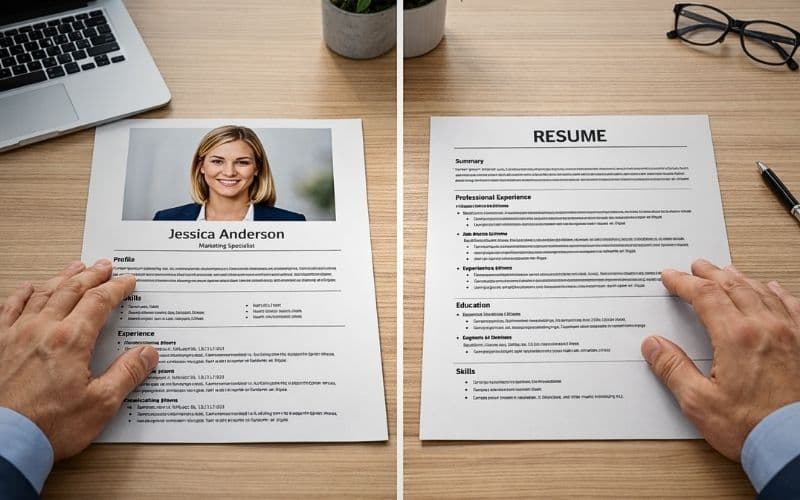
The question of whether to include a photo on resume documents does not have a single global answer. Advice from friends or generic templates often ignores how anti-discrimination rules, applicant tracking systems, and regional norms have changed. This guide explains when a resume photo is risky, when it can be acceptable, and what to do instead if you are unsure.
Key Insight
Before adding a photo on resume, ask yourself: “Will this help me get fairly assessed, or does it only introduce bias and formatting risk?”
Why Photos Are Discouraged in Many Countries
In Canada, the United States, and the UK, major career services and HR organizations generally advise against adding a photo on resume documents.[file:3] Human rights guidance stresses that employers should avoid decisions based on protected characteristics like age, race, gender, or disability, and a visible photo can complicate this.
- Increases risk of appearance-based bias
- Adds data employers should not use
- Can make resumes look non-standard in ATS
Because many employers want to show they are making fair, compliant decisions, seeing a photo may create more problems than benefits. A clean, text-focused layout is usually safer for first screening in these markets.
Where a Resume Photo Can Be More Normal
Norms differ across regions and industries. In some countries, including a photo on resume or CV is common and sometimes expected, particularly for local roles.
| Regional photo norms | ||
|---|---|---|
| Region/context | Photo on resume norm | Typical approach |
| Canada / US / UK | Generally discouraged | No photo |
| Parts of Europe | More common on CVs | Optional photo |
| Some ME / APAC roles | Often expected on CV | Formal headshot |
Even where photos are common, candidates are encouraged to follow employer guidance and choose neutral, professional images. Research on discrimination suggests that visible demographic information can influence outcomes, so careful judgment is still important.
Better Alternatives to Putting a Photo on Resume
If you decide not to use a photo on resume, you can still show your professional presence in ways that do not interfere with screening. A strong strategy is to pair a clean resume with an up-to-date professional profile.
- Use LinkedIn or portfolio for photos
- Keep resume text-only for ATS
- Add a clear, easy-to-type profile URL
This approach lets employers see your headshot once they are intentionally reviewing your broader profile, rather than during blind or semi-blind resume screening. It also keeps your resume file simpler for automated parsing and quick scans.
Important
If a job posting or online application explicitly asks for a headshot, follow the instructions. Otherwise, a text-only resume plus a complete online profile is usually safer than adding a photo on resume documents by default.
How to Decide for Your Situation
Because norms differ, the “right” choice depends on where you are applying and what kind of role it is. Treat the photo on resume decision as one part of a broader strategy to reduce bias and present your skills clearly.
- 1Confirm the country’s common practice
- 2Check the posting for explicit guidance
- 3Look at credible local resume examples
- 4Default to no photo if unsure
- 5Use a professional headshot online
For international roles or remote positions spanning multiple regions, a no-photo resume is usually the safest compromise. Employers who need a headshot later can request one separately or see it on your professional profile.[file:3]
Additional Considerations for Creative and Public-Facing Roles
In creative, entertainment, or client-facing fields, a photo on resume or portfolio headshot might be explicitly requested.
When Photos May Be Appropriate
- Acting or modeling portfolios
- Public relations and media roles
- Marketing and branding positions
In these cases, a polished, professional image complements your application.
Best Practices
- Use high-quality, recent photos
- Avoid distracting backgrounds or filters
- Keep consistent style across all materials
Even then, maintain a photo-free resume version for other applications.
Impact of Photos on Applicant Tracking Systems (ATS)
Most ATS software focuses on parsing text content. Including a photo can sometimes disrupt parsing algorithms or result in formatting issues.
Important
A simple, well-structured resume without images is generally more reliable for automated screening and reduces the risk of technical errors.
Summary and Recommendations
- Photos are discouraged in Canada, US, UK due to anti-discrimination concerns.
- European and some ME/APAC regions may expect photos; always research local norms.
- Use professional online profiles for photos rather than embedding in resumes.
- Follow explicit job posting instructions.
- For creative roles, carefully consider if a photo is beneficial.
About the Author

Team Yotru
Employability Systems
Team Yotru
Employability Systems
We build practical career tools for training providers and workforce programs, combining labor market insights with real employment outcomes. Follow us on LinkedIn.
Frequently Asked Questions
Common questions about using photos on resumes
In Canada and the United States, career and HR guidance generally recommends not including a photo on resume documents. This reduces the risk of appearance‑based bias and helps employers focus on your skills and experience. A better approach is a clean, text‑only resume plus a professional headshot on LinkedIn or another profile.
Related Resources
Additional resources to explore
Resume Writing Tips
- How to Make Your Resume ATS-Friendly— Learn best practices for creating resumes that pass applicant tracking system filters effectively.
About This Article
This article provides job seekers with an in-depth understanding of when and how to use photos on resumes, considering regional norms, anti-discrimination policies, and ATS compatibility.
Audience Context
This article is designed for job seekers navigating resume preparation across different regions and industries. It addresses practical decision-making around including photos on resumes, considering legal, technological, and cultural factors that affect hiring processes and fairness.
Editorial Standards
Content follows rigorous editorial standards emphasizing neutrality, evidence-based guidance, and alignment with current hiring practices. The article avoids exaggerated claims or anecdotal advice and is regularly updated to reflect evolving employment landscapes and anti-discrimination regulations.
Methodology
The guidance is synthesized from analysis of human rights frameworks, ATS system behaviors, and regional hiring customs. It incorporates academic research, government reports, and HR industry insights to provide repeatable, practical recommendations for diverse job markets.
Disclaimer
This article is for informational purposes only and does not constitute legal advice or guarantee hiring success. Resume and hiring practices vary by employer, jurisdiction, and role. Readers should consult local regulations and professional career advisors as needed.
Yotru Resume Examples
- Emergency Medical Technician (EMT-B) / Las Vegas / NV / USA – https://yotru.com/resume/B6AHKFH0 – Entry-level EMT-B focused on patient assessment, BLS, and safe ambulance transport for first-response roles.
- Emergency Medical Technician (EMT-B) / Orlando / FL / USA – https://yotru.com/resume/OFIZATHW – Experienced EMT-B with interfacility and 911 support background, emphasizing patient monitoring and documentation in high-pressure environments
- Administrative Assistant / Toronto / ON / Canada – https://yotru.com/resume/4N27OGLP – Administrative professional supporting office operations, scheduling, and customer-facing communication in busy environments.
- Full-Stack Developer / Toronto / ON / Canada – https://yotru.com/resume/E6ALLHP8 – Full-stack developer skilled in modern web technologies, building end-to-end applications and maintaining production-ready codebases.
- Machine Learning Engineer / Calgary / Alberta / Canada – https://yotru.com/resume/GBHY5F95 – ML engineer with applied AI and cloud expertise, deploying scalable machine learning solutions for real-world use cases.
References
- Equal Employment Opportunity Commission. (n.d.). Prohibited employment policies/practices. https://www.eeoc.gov/prohibited-employment-policiespractices
- Ontario Human Rights Commission. (n.d.). Human rights at work. https://www.ohrc.on.ca/en/human-rights-work
- Equality and Human Rights Commission. (n.d.). Pre-employment questions. https://www.equalityhumanrights.com
- LinkedIn. (n.d.). Photo guidelines for your LinkedIn profile. https://www.linkedin.com/help/linkedin
- Hausdorf, P. A., & Shannon, H. (2008). Recruiters’ decisions in resume screening: Screening cues, social bias, and applicant tracking systems. Journal of Employment Counseling, 45(1), 18–30.
Maintained by: Yotru Career Research and Development Team
Review cycle: Reviewed regularly to reflect market changes
Last updated: January 6, 2026
Questions or Need Support?
If you are working on employability programs, hiring strategy, career education, or workforce outcomes and want practical guidance, you are in the right place.
Yotru supports individuals and organizations navigating real hiring systems. That includes resumes and ATS screening, career readiness, program design, evidence collection, and alignment with employer expectations. We work across education, training, public sector, and industry to turn guidance into outcomes that actually hold up in practice.