
Employability
8 min read
Kickresume vs ChatGPT: What's the Difference for Resume Building?
Synopsis
Kickresume and ChatGPT both use AI, but they solve different parts of the resume process. One builds structured, design-ready resumes, the other generates flexible content. Here’s how to choose without hurting clarity or credibility.
For job seekers comparing AI resume tools: A clear comparison of Kickresume and ChatGPT, explaining how design-first and text-first approaches affect clarity, credibility, and hiring outcomes.
AI has made resume writing faster than ever, but speed does not automatically translate into better outcomes. Two tools job seekers often compare are Kickresume and ChatGPT. While both can help generate resume content, they approach the problem from very different angles and solve different parts of the job-search process.
Understanding those differences matters if your goal is not just to create a good-looking resume, but to get interviews.
What Kickresume Is Designed to Do
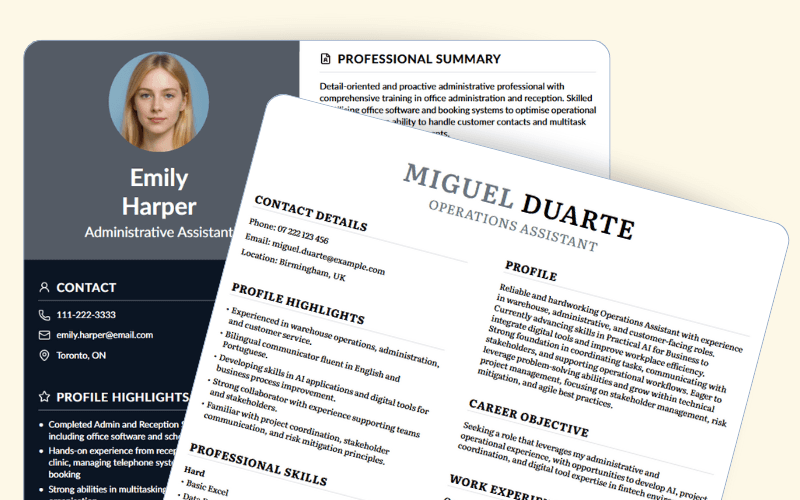
Kickresume is a template-first resume builder with a strong focus on design and layout. Its primary value lies in helping job seekers quickly create visually polished resumes using predefined formats.
Kickresume typically supports:
- Professionally designed resume templates with clean, modern aesthetics
- Structured sections for work experience, education, and skills
- AI-assisted bullet point suggestions for describing responsibilities
- Easy export to PDF and other downloadable formats
- Cover letter templates that match resume design
- Resume examples from real professionals across industries
For job seekers who care about presentation and want something that looks modern and clean without design expertise, Kickresume is approachable and easy to use. The platform removes the friction of formatting decisions by providing pre-built layouts that look professional out of the box.
Kickresume's Strengths
Quick visual polish: Users can create attractive-looking resumes in minutes without wrestling with Word formatting or design software.
Template variety: Different styles accommodate various industries and personal preferences, from conservative finance layouts to creative agency formats.
Integrated approach: Resume and cover letter templates match aesthetically, creating visual consistency across application materials.
Resume examples: Seeing how other professionals in your field structured their resumes provides helpful guidance.
Kickresume's Limitations
The limitation is depth. Because Kickresume is template-driven, it often emphasizes how a resume looks more than how a career story flows. The AI assists with wording individual bullets, but it does not deeply guide users through:
- Career narrative coherence: Ensuring all sections tell a consistent professional story
- Role alignment: Tailoring content specifically to target job requirements
- Career progression logic: Demonstrating clear growth and skill development over time
- Industry-specific terminology: Using language that resonates with hiring managers in your field
- Achievement quantification: Moving beyond duties to demonstrate measurable impact
Additionally, template-first approaches can create formatting issues with applicant tracking systems (ATS) when templates prioritize visual appeal over parsing compatibility. Some Kickresume designs use multi-column layouts, graphics, or unconventional section headers that confuse automated screening systems.
What ChatGPT Is Designed to Do
ChatGPT is a general-purpose language model. It is not built specifically for resumes, but many job seekers use it because it can generate text quickly and flexibly.
ChatGPT can:
- Rewrite resume bullets in different tones (professional, concise, achievement-focused)
- Translate experience into job-specific language matching job descriptions
- Brainstorm achievements, skills, and professional summary content
- Adapt content across industries and seniority levels
- Generate multiple versions of the same information for comparison
- Help overcome writer's block when describing accomplishments
Its flexibility is its strength. It is also its risk.
ChatGPT's Strengths
Maximum flexibility: Users can prompt ChatGPT in countless ways to explore different approaches to presenting the same experience.
Quick iteration: Generate multiple versions of resume sections rapidly for comparison and refinement.
Language assistance: Helps users articulate accomplishments they know they achieved but struggle to describe effectively.
Industry adaptation: Can adjust language and framing for different target roles or career pivots.
ChatGPT's Limitations
Without strong prompts and careful review, ChatGPT can:
- Produce generic or repetitive language: The same overused phrases ("spearheaded," "leveraged," "dynamic professional") appear across millions of AI-generated resumes
- Introduce soft exaggeration: Inflating responsibilities or achievements beyond what actually occurred
- Invent metrics or responsibilities: Creating plausible-sounding but fabricated details when users don't provide specific information
- Create content that sounds polished but lacks credibility: Professional-sounding language that doesn't withstand interview scrutiny
- Generate inconsistent narratives: When creating sections separately, they may not connect into coherent career progression
- Miss industry-specific nuances: Generic language that doesn't demonstrate true familiarity with field-specific terminology
ChatGPT does not understand what is true about your career unless the user actively controls it. It generates plausible text based on patterns in training data, not accurate descriptions based on your actual experience.
This creates real consequences. Hiring managers increasingly recognize ChatGPT's telltale patterns, and resumes that can't be defended in interviews damage candidate credibility permanently.
Design-First vs Text-First Approaches
At a high level, the difference between Kickresume and ChatGPT comes down to design-first versus text-first resume building.
Kickresume's Design-First Philosophy:
- Prioritizes visual presentation as the primary differentiator
- Offers structure through templates that guide section placement
- Is easy to use with minimal setup for users without design skills
- May sacrifice narrative depth for layout when templates constrain content
- Assumes professional appearance directly correlates with hiring success
ChatGPT's Text-First Philosophy:
- Prioritizes language generation and content creation
- Offers maximum flexibility with no structural constraints
- Requires strong user judgment to evaluate output quality and accuracy
- Leaves structure and formatting entirely to the user after text generation
- Assumes users can distinguish between impressive-sounding and credible content
Both approaches can work in specific contexts, but neither fully solves the resume problem on its own.
Where Job Seekers Get Stuck
Many job seekers run into trouble when they rely too heavily on one approach without understanding its limitations.
The Kickresume Trap:
Some users end up with resumes that look professionally designed but:
- Lack clarity about actual qualifications and accomplishments
- Don't align with specific job requirements because templates aren't role-specific
- Show poor differentiation from other candidates using identical templates
- Contain generic AI-generated bullets that sound professional but say little
- Fail to tell a coherent career story beyond listing jobs chronologically
The ChatGPT Trap:
Others end up with resumes that sound impressive but:
- Feel generic to experienced recruiters who've seen the same AI patterns repeatedly
- Cannot be confidently defended in interviews when asked to elaborate on exaggerated claims
- Lack proper formatting structure that guides recruiter attention effectively
- Contain subtle accuracy issues that undermine credibility when verified
- Miss ATS optimization because ChatGPT doesn't understand applicant tracking systems
In both cases, the issue is not AI itself. It is the lack of structure, guidance, and guardrails that ensure resumes are both professionally presented AND accurately represent real experience.
Real-World Comparison Scenarios
Scenario 1: Recent Graduate with Limited Experience
Kickresume approach: Template helps structure limited experience professionally. However, AI suggestions may encourage listing duties rather than demonstrating impact.
ChatGPT approach: Can help articulate transferable skills from academic projects and internships. However, may generate inflated descriptions of minor responsibilities.
Better approach: Structured platform that guides highlighting relevant coursework, projects, and early experience accurately without over-inflating accomplishments.
Scenario 2: Mid-Career Professional Changing Industries
Kickresume approach: Templates don't adapt well to career transitions. Design focus doesn't help translate skills to new industry language.
ChatGPT approach: Flexibility helps explore different ways to frame experience. However, generic industry transitions often lack strategic positioning needed for career pivots.
Better approach: Purpose-built tools that help identify transferable skills and reframe experience specifically for target industries.
Scenario 3: Senior Executive
Kickresume approach: Templates often feel too junior for executive-level positioning. Design emphasis may appear inappropriate for C-suite roles.
ChatGPT approach: Can articulate complex achievements but requires significant expertise to ensure strategic positioning and credibility.
Better approach: Platforms designed to handle complex career narratives with appropriate seniority positioning and industry knowledge.
Scenario 4: Technical Professional
Kickresume approach: Templates may not accommodate technical portfolios, certifications, or specialized skills effectively.
ChatGPT approach: Can help describe technical projects but often uses generic language that doesn't demonstrate actual technical depth.
Better approach: Systems that integrate technical skills, certifications, and project descriptions with appropriate industry terminology.
The ATS Compatibility Question
A critical factor often overlooked in design-first vs text-first comparisons: applicant tracking system compatibility.
How Kickresume Handles ATS:
- Template design sometimes prioritizes visual appeal over parsing compatibility
- Multi-column layouts can confuse ATS parsing algorithms
- Custom section headers may not be recognized by screening software
- Graphics and design elements often cause parsing failures
- Some templates work fine; others create significant ATS issues
How ChatGPT Handles ATS:
- Doesn't handle formatting at all—users must address this separately
- Generated text often lacks keywords needed for ATS scoring
- No built-in guidance on section headers or structure
- Users must independently research and implement ATS best practices
- Requires additional tools or knowledge to create ATS-compatible documents
Research consistently shows that approximately 75% of resumes never reach human reviewers due to ATS filtering. Both Kickresume and ChatGPT leave job seekers vulnerable to this filtering in different ways—one through design choices, the other through lack of structure.
The Missing Middle: Structure With Judgment
This is where a more balanced approach matters.
Yotru is built as a career development platform, not just a resume generator. It combines structured resume design with guided AI prompts that focus on career narrative, accuracy, and recruiter alignment.
Instead of choosing between templates or open-ended text generation, Yotru helps users:
- Build a coherent career story from start to finish that connects experience logically
- Produce ATS-ready, job-ready documents by default without sacrificing professionalism
- Avoid exaggeration or hallucinated achievements through structured prompting and validation
- Generate resumes, cover letters, and interview prep in one flow with consistent messaging
- Match industry expectations without requiring users to research formatting norms
- Ensure credibility through guardrails that prevent common AI-generated content issues
The goal is not just to make resumes faster, but safer and more effective in real hiring systems.
How Yotru Addresses Both Gaps:
vs Kickresume:
- Maintains professional appearance while prioritizing content quality over visual flair
- Ensures ATS compatibility without making users choose between design and functionality
- Guides narrative development rather than just providing template structure
- Adapts to different industries and career levels strategically, not just aesthetically
vs ChatGPT:
- Provides structure and formatting from the start, not as an afterthought
- Includes credibility guardrails that prevent exaggeration and fabrication
- Maintains consistency across all application materials automatically
- Understands ATS requirements and hiring system expectations
Choosing the Right Tool
Choose Kickresume if:
- Visual presentation is your primary concern
- You're targeting smaller companies with minimal ATS screening
- You have strong career narrative skills and just need formatting help
- You're willing to manually verify ATS compatibility
Use ChatGPT if:
- You need help articulating accomplishments but will handle structure separately
- You have expertise to critically evaluate AI output for accuracy
- You're comfortable researching and implementing ATS best practices yourself
- You're using it as a brainstorming tool, not a complete solution
Consider Yotru when:
- You want an integrated solution that handles both content and structure
- ATS compatibility matters for your target employers
- You value accuracy and credibility as much as speed
- You want confidence your materials meet professional standards
- You need aligned resume, cover letter, and interview preparation
What matters most is not which tool you choose, but whether it helps you present your real experience clearly and credibly. Employers are increasingly skilled at spotting generic or inflated resumes, whether they come from templated AI suggestions or open-ended language models.
AI should support judgment, not replace it.
Ready to build a resume that balances professional design with authentic career storytelling? Start with Yotru.
About the Author

Team Yotru
Employability Systems
Team Yotru
Employability Systems
We build practical career tools for training providers and workforce programs, combining labor market insights with real employment outcomes. Follow us on LinkedIn.
Frequently Asked Questions
Kickresume is a structured resume builder with templates and AI writing, while ChatGPT is a flexible tool that generates text but requires manual formatting and review.
Audience Context
For job seekers who want to use AI without creating generic or inaccurate resumes, this post explains the trade-off between structured career tools and flexible drafting tools. It helps readers choose the right approach for accuracy, clarity, and confidence in real hiring systems.
Disclaimer
This article is for general career guidance only and does not guarantee hiring outcomes or replace professional advice. Brands mentioned are independent products and trademarks of their respective owners. Any comparison here is for informational purposes only and does not imply partnership, endorsement, or affiliation.
Further Insights
- Teal vs ChatGPT for Job Seekers — Tracker tool vs general AI
- Kickresume vs ChatGPT for Resumes — Design-first vs text generation
- Rezi vs ChatGPT for Resume Building — ATS builder vs open AI
- Enhancv vs ChatGPT for Resumes — Visual builder vs raw AI
- Is Jobscan Better Than ChatGPT? — Keyword tool vs AI writing
- AI Resume Builder vs ChatGPT — Structured AI vs open AI
- How to Use ChatGPT for Resumes — Prompts, limits, and better tools
- Can ChatGPT Resumes Get You Rejected? — AI risk in real hiring
- ChatGPT as a Resume Builder — What it does and doesn't do
References
- Clifford, C. (2024, March 18). The No. 1 ChatGPT mistake job seekers make: Having AI write your resume. CNBC Make It. https://www.cnbc.com/2024/03/18/dont-use-chatgpt-to-write-your-resume.html
- Dastin, J., & Bass, D. (2024, March). OpenAI GPT sorts resume names with racial bias, test shows. Bloomberg. https://www.bloomberg.com/graphics/2024-openai-gpt-hiring-racial-discrimination/
- Willo. (2025). Hiring trends report 2026: AI is accelerating the decline of the resume as employers demand more authentic signals of talent. TechR Series. https://techrseries.com/artificial-intelligence/hiring-trends-report-2026-study-finds-ai-is-accelerating-the-decline-of-the-resume-as-employers-demand-more-authentic-signals-of-talent/
- Gartner. (2025, July 31). Gartner survey shows just 26% of job applicants trust AI will fairly evaluate them. Gartner Newsroom. https://www.gartner.com/en/newsroom/press-releases/2025-07-31-gartner-survey-shows-just-26-percent-of-job-applicants-trust-ai-will-fairly-evaluate-them
- SHRM. (2025). Recruitment is broken: Automation and algorithms can't fix it. Society for Human Resource Management. https://www.shrm.org/topics-tools/news/hr-trends/recruitment-is-broken
Maintained by: Employability & Skills Group at Yotru
Review cycle: Updated regularly
Last updated: March 23, 2026
Questions or Need Support?
If you are working on employability programs, hiring strategy, career education, or workforce outcomes and want practical guidance, you are in the right place.
Yotru supports individuals and organizations navigating real hiring systems. That includes resumes and ATS screening, career readiness, program design, evidence collection, and alignment with employer expectations. We work across education, training, public sector, and industry to turn guidance into outcomes that actually hold up in practice.