

Campaign Inspiration
How to Generate Leads With Postcards: A Step-by-Step Guide
Postcards generate leads when a short list of the right recipients gets one clear offer, a way to respond that you can track, and a fast follow-up. Here is the full process, from choosing the audience to improving the next wave.
Chinedu Okafor · Content & Editorial Lead
· 7 min read
On this page22 sectionsClose
- How postcard lead generation works
- Step 1: Choose an audience you can name
- Step 2: Give people one reason to respond
- Step 3: Write the card for one reader
- Step 4: Design for a few seconds of attention
- Step 5: Mail in planned waves
- Step 6: Track every response
- Step 7: Follow up fast and personally
- Step 8: Improve the next wave
- Where postcard lead generation works well
- Common mistakes
- When postcards are the wrong tool
- How Yotru helps
- Frequently asked questions
- Do postcards still generate leads?
- How many postcards should I send to generate leads?
- What should a lead generation postcard offer?
- How do I know which postcards produced leads?
- Should I follow up after sending a postcard?
- Are postcards better for B2B or B2C lead generation?
- How long does a postcard campaign take to produce leads?
- References
To generate leads with postcards, mail a short, well-chosen list of people a card with one clear offer and one easy, trackable way to respond, then follow up with everyone who responds while their interest is fresh. The card starts the conversation. Your list, your offer and your follow-up decide whether it turns into a lead.
This guide walks through the whole process in the order you would run it: choosing who gets a card, deciding what to offer, writing and designing the card, mailing it, tracking responses, following up and improving the next round. Each step links to a deeper guide if you want more detail.
How postcard lead generation works
A postcard campaign is a small system. If one part is weak, the others can't make up for it. A great design sent to the wrong people produces nothing, and a strong list with no follow-up leaves interested people waiting.
| Step | The decision | What good looks like |
|---|---|---|
| 1. Audience | Who gets a card | A list where you can explain why each name is on it |
| 2. Offer | Why they should respond | One specific, low-effort next step |
| 3. Message | What the card says | Short copy written for one type of reader |
| 4. Design | How it looks | Readable in a few seconds, with the offer easy to find |
| 5. Mailing | When and how often | Planned waves with room for follow-up |
| 6. Tracking | How you see responses | A unique QR code or link per recipient |
| 7. Follow-up | What happens next | A call or email soon after a response |
| 8. Improvement | What you change | One tested change per wave |
Step 1: Choose an audience you can name
The audience is the biggest lever in any postcard campaign. A card costs real money per piece, so it pays to mail fewer, better-chosen people rather than everyone in an area. Most lead generation campaigns start from one of three lists:
- New prospects: companies or people who match your best customers but don't know you yet. How to build a targeted mailing list covers how to find and check them.
- Past customers: people who bought before and went quiet. They already trust you, which often makes them the easiest leads to win. See how to win back old customers with postcards.
- Warm contacts who stalled: quote requests that never closed, old CRM leads, event contacts who never replied.
For business-to-business campaigns, also decide who at each company should receive the card. A card to the person who feels the problem, and sometimes a second card to the person who approves the budget, usually works better than a card addressed to the company in general.
Step 2: Give people one reason to respond
A postcard without an offer is an advertisement. A postcard with a specific, easy next step is a lead generator. The offer should be useful on its own and small enough to say yes to without a long decision.
| Business | Weak offer | Stronger offer |
|---|---|---|
| Commercial cleaning | Quality cleaning services | A free walkthrough and written quote for your office this month |
| B2B software | Learn more about our platform | A 15-minute review of how your team handles [problem] today |
| Accounting firm | Trusted accountants | A year-end checklist for owner-managed companies, plus a free review call |
| Caterer | Delicious food for any event | A tasting box for your office before you book the holiday lunch |
If you have a real deadline, such as limited onboarding spots or a booking cut-off before a busy season, put it on the card. Never invent urgency. Readers notice, and it costs trust you will need on the follow-up call.
Step 3: Write the card for one reader
Good postcard copy is short and specific. A practical structure:
- A greeting with the person's name or company.
- A headline about their situation, not your company.
- One or two lines explaining the offer.
- A clear call to action next to the QR code.
- A sign-off from a real person who will follow up.
Personalization helps when it shows you know who they are: their company name, city, industry or a relevant change at their business. For more examples, read what a B2B postcard should say and our personalized direct mail examples.
Step 4: Design for a few seconds of attention
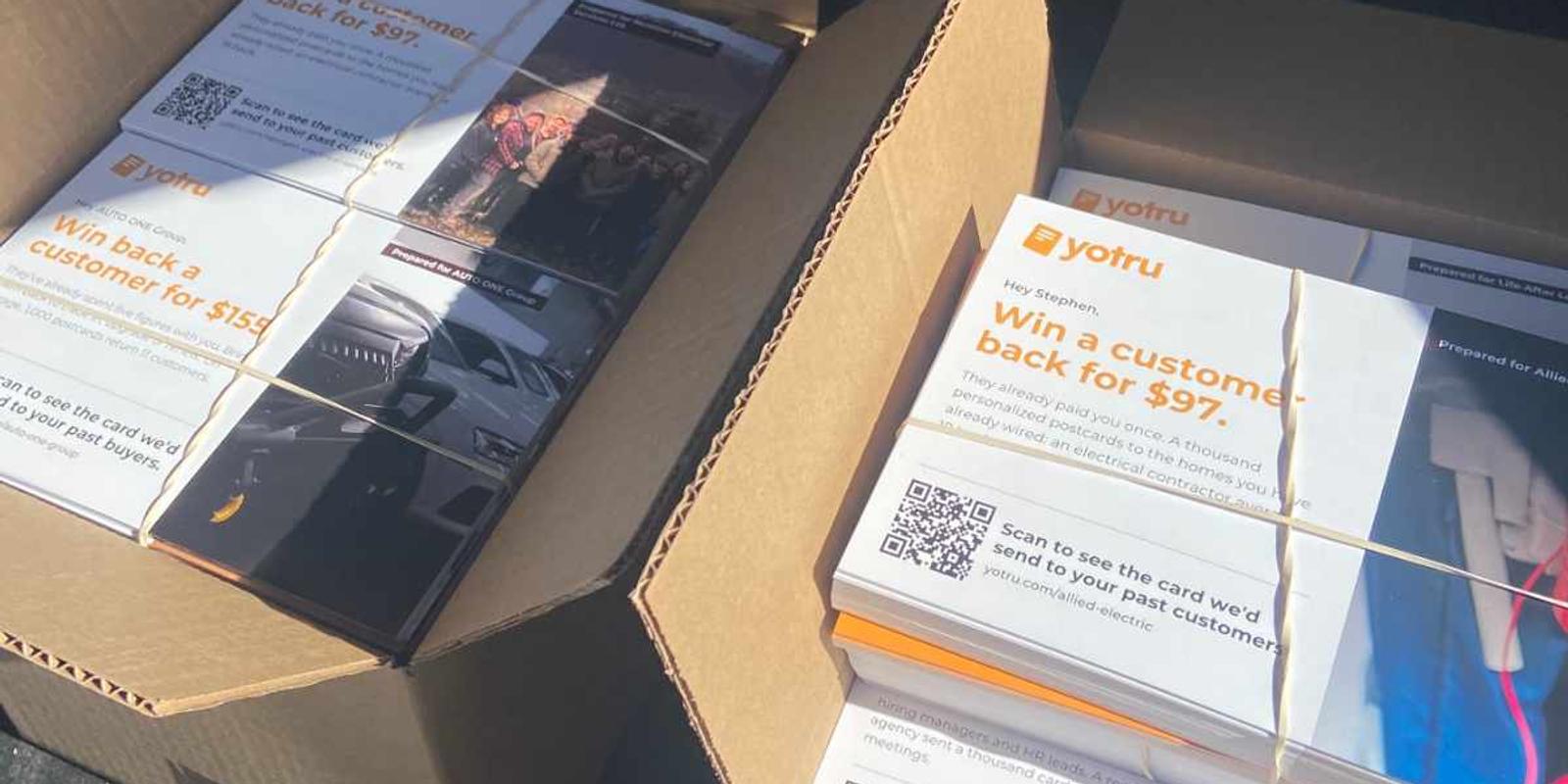
Most people decide quickly whether a card is worth reading. Use one strong image, a large headline, plenty of space and an obvious QR code. Choose a design style that fits the job: an introduction for cold prospects, an offer card when you have something concrete, a personal note for a small warm list, or a proof card when you have nearby results to show. The four postcard designs explains when to use each.
Size matters less than relevance, but a larger card gives you room for a photo and a clear offer. For most cold outreach, a 6" × 9" card is a sensible default; see what postcard size is best for direct mail.
Step 5: Mail in planned waves
One card is rarely a fair test, because most recipients won't be ready to buy on the day it arrives. Plan two to five cards per contact, a few weeks apart, with each card adding something new: proof, a different angle or a real deadline. How often to send B2B postcards includes a sample schedule.
Step 6: Track every response
If you can't see who responded, you can't follow up and you can't tell whether the campaign worked. A unique QR code for each recipient, linked to its own landing page, tells you exactly who scanned and when. A generic phone number or a single QR code for everyone only tells you that someone responded.
Keep the difference between a scan, a lead and a sale clear from the start. A scan shows interest. A lead is someone who fits and wants a next step. A sale is revenue. How to track leads and sales from postcards shows how to record each stage.
Step 7: Follow up fast and personally
Most of the value of a postcard campaign is created in the follow-up. Call or email anyone who scans, ideally the same day. For everyone else, a short email or call about a week after the expected delivery can mention the card and repeat the offer. Keep the follow-up from the same person who signed the card.
For business sales, how to book more B2B sales meetings with direct mail covers sequencing cards, email and calls. You can also use our follow-up email templates.
Step 8: Improve the next wave
Read the results by stage and change one thing at a time:
- Almost nobody scans: the list or the offer is the problem. Tighten the audience or make the offer more specific.
- People scan but don't book: the landing page asks for too much, or follow-up came too late.
- Meetings happen but don't close: the list may include companies that don't truly fit. Revisit your ideal customer profile.
Also compare cost per qualified lead and cost per meeting with your other channels. How much a postcard marketing campaign costs shows the calculation.
Where postcard lead generation works well
Postcards tend to make sense when each new customer is worth enough to justify a few dollars per contact, and when you can identify the right recipients in advance. Common examples:
- B2B companies targeting named accounts: see booking B2B sales meetings with direct mail.
- Service businesses winning back past clients: see customer win-back postcards.
- Local businesses selling to nearby offices, such as caterers: see getting more corporate catering bookings with postcards.
- Exhibitors who want booth visits and pre-booked meetings: see using postcards before a trade show.
Common mistakes
- Mailing too broadly. A large, loosely matched list raises cost without raising qualified responses.
- No offer, or three offers. One clear next step beats a list of services.
- No tracking. Without unique codes, you can't tell who responded or what worked.
- No follow-up plan. Interested people go cold if nobody calls.
- Judging on one wave. Give the campaign enough touches to reach people when their timing is right.
When postcards are the wrong tool
Postcards are usually a poor fit for very low-priced products, for audiences you can't identify by name or business, and for offers that need an immediate answer. If a new customer is worth less than the cost of reaching a handful of prospects, digital channels may be the better start. When you should not use direct mail goes into more detail.
How Yotru helps
Yotru runs postcard campaigns for businesses in Canada and the United States. We can build the recipient list for you or work from your own, create designs from your website, personalize each card, print and mail it, and give every recipient a unique QR code and landing page. You get an alert when someone scans, and you can review the recipients before paying. The follow-up stays with your team, because that's where leads turn into customers.
Frequently asked questions
Do postcards still generate leads?
Yes, when they go to a well-chosen audience with a clear offer, a trackable way to respond and a quick follow-up. Results depend far more on the list and offer than on the card itself.
How many postcards should I send to generate leads?
Start with a list you can follow up properly, often 100 to 500 recipients for a first test, and plan two to five cards per contact. Scale once you know what a qualified lead costs.
What should a lead generation postcard offer?
One specific, low-effort next step that is useful on its own, such as a free review, a quote, a checklist, a tasting or a short call.
How do I know which postcards produced leads?
Give each recipient a unique QR code or URL. Each scan is tied to one person, so you can see who responded and record what happened next in your CRM.
Should I follow up after sending a postcard?
Yes. Contact anyone who scans quickly, and reach out to everyone else about a week after the expected delivery, referring to the card.
Are postcards better for B2B or B2C lead generation?
Both can work. They fit best where each customer is valuable and the recipients can be identified in advance, such as named business accounts, past customers or nearby offices.
How long does a postcard campaign take to produce leads?
Responses usually start once cards arrive. With Yotru, mailing typically starts two to three days after the order is finalized and delivery usually takes about a week, sometimes two to three weeks.
References
Chinedu Okafor
Content & Editorial Lead
Chinedu Okafor is a freelance editorial and content lead at Yotru, covering direct mail marketing, personalized postcards, and how businesses use physical mail to reach customers and drive sales.
Keep reading
Insights & Trends
How to Build a Targeted Mailing List for a Postcard Campaign
A targeted mailing list starts with a clear customer profile, then adds the right companies, the right people and verified postal addresses. Here is the step-by-step process, the columns to include and how to cut wasted mail.
Chinedu Okafor
6 min read

Campaign Inspiration
How to Book More B2B Sales Meetings With Direct Mail
Direct mail books meetings when it reaches the right people at named accounts, offers a meeting worth taking, and is timed with email and phone follow-up. Here is the sequence, with sample scripts and the numbers to track.
Erol Branovic
6 min read

Insights & Trends
How to Track Leads and Sales From Postcards: From Scan to Closed Deal
A scan is not a lead, and a lead is not a sale. Here is how to set up unique QR codes, landing pages, UTM tags and CRM stages so you can follow every postcard from scan to closed deal and credit the campaign fairly.
Erol Branovic
6 min read
Work with Yotru
Turn your next postcard into a trackable lead source
Yotru builds or checks your list, personalizes every card, gives each recipient a unique QR code and landing page, and alerts you when someone scans. You review the recipients before you pay.