

Insights & Trends
How to Track Leads and Sales From Postcards: From Scan to Closed Deal
A scan is not a lead, and a lead is not a sale. Here is how to set up unique QR codes, landing pages, UTM tags and CRM stages so you can follow every postcard from scan to closed deal and credit the campaign fairly.
Erol Branovic · Marketing Specialist
· 6 min read

On this page19 sectionsClose
- Scan, lead, opportunity, sale: define them first
- Step 1: Give every recipient a unique code
- Step 2: Turn the scan into a response
- Step 3: Tag links so analytics recognize the campaign
- Step 4: Capture responses that don't come through the QR code
- Step 5: Record every stage in your CRM
- Step 6: Decide how you'll credit the campaign
- Step 7: Report the full funnel
- Common tracking mistakes
- How Yotru helps
- Frequently asked questions
- How do you track leads from a postcard?
- Is a QR code scan a lead?
- How do I attribute sales to a direct mail campaign?
- Should I use UTM parameters on postcard QR codes?
- How do I track people who call instead of scanning?
- How long should I wait before judging a postcard campaign?
- What metrics should I report for a postcard campaign?
- References
To track leads and sales from postcards, give every recipient a unique QR code that opens their own landing page, tag those links so your analytics recognize the campaign, record each response in your CRM against the person who was mailed, and move them through clear stages: scan, lead, opportunity and sale. Also capture people who respond by phone or email, and credit the campaign within a fixed time window.
Most postcard reporting stops at scans. This guide shows how to follow the trail all the way to revenue. It's part of our guide to generating leads with postcards; for the QR setup itself, see QR codes for direct mail.
Scan, lead, opportunity, sale: define them first
Teams often argue about whether a campaign worked because they're counting different things. Agree on definitions before the first card goes out:
| Stage | What it means | Example |
|---|---|---|
| Scan or visit | Someone opened the landing page | The office manager scanned the card |
| Response | They took an action: form, call, reply, booking | She asked for a quote |
| Qualified lead | They fit your criteria and want a next step | Right size, right area, budget this quarter |
| Opportunity | A real deal is in progress | Proposal sent |
| Sale | They paid or signed | Contract signed for a year of service |
A scan shows curiosity, not intent. Someone may scan out of interest in the design and never respond. That's why scan counts alone make a campaign look better or worse than it really is.
Step 1: Give every recipient a unique code
A single QR code printed on every card tells you that someone responded. A unique QR code per recipient tells you who. That difference is what lets sales follow up with the right person and lets you connect revenue back to a specific card. Static QR codes vs unique QR codes explains the trade-off.
Step 2: Turn the scan into a response
The landing page is where a scan becomes a lead. Keep it short and focused:
- Greet the person or company by name and repeat the offer from the card.
- Offer one main action: book a time, request a quote or claim the offer.
- Ask only for what you don't already know. You already have their name and company.
- Show a phone number and the name of the person who signed the card.
If many people scan but few respond, the landing page is usually the problem: too much text, too many choices or a form that's too long.
Step 3: Tag links so analytics recognize the campaign
If the QR code or a printed web address leads to your own website, add UTM parameters so your analytics tool attributes the visit to the postcard rather than to direct traffic. Use a consistent naming convention, for example:
| Parameter | Example value |
|---|---|
| utm_source | postcard |
| utm_medium | direct-mail |
| utm_campaign | 2026-11-office-catering-wave1 |
| utm_content | the segment or card version, for example dental-groups |
Never put personal information such as names or email addresses in URL parameters. Use an anonymous recipient ID instead, and match it to the person inside your own systems.
Step 4: Capture responses that don't come through the QR code
Plenty of people read a card and then call, email or search for your website instead of scanning. If you ignore them, you undercount the campaign. Ways to catch them:
- Use a phone number or email address on the card that isn't used anywhere else.
- Include a short offer code that people mention when they call.
- Ask new inquiries how they heard about you, and add "postcard" as an option.
- Match new leads and customers against the mailing list by company name and address.
Step 5: Record every stage in your CRM
Add a few fields to each contact or company record so you can report on the campaign later:
- Campaign name and wave
- Date mailed
- Date scanned, if any
- Response type: scan, call, email, form or meeting
- Lead status, and later the opportunity and deal value
Most CRMs already have a campaign or source field and a lead-status field; use them rather than creating many custom ones. If your team scores leads, add a point value for a postcard scan the same way you would for other engagement. When a scan alert comes in, the person who follows up should log the outcome straight away. When sales should follow up after a postcard scan covers timing.
Step 6: Decide how you'll credit the campaign
Agree on attribution rules before results come in, so nobody adjusts them afterwards:
- Direct: the person scanned their code or used the card's phone number or offer code.
- Influenced: the person was mailed and became a lead through another channel within a set window, often 60 to 90 days.
- Incremental: the difference in results between a mailed group and a small, randomly chosen group that wasn't mailed. This is the most honest measure, and worth doing on larger campaigns.
Report direct and influenced results separately, so the numbers stay credible. How to attribute leads to direct mail goes deeper.
Step 7: Report the full funnel
A simple report per campaign and per wave is enough. Show counts at each stage and the conversion between them:
| Stage | Count | What it tells you |
|---|---|---|
| Mailed | Your number | The base for every rate |
| Scanned | Your number | Whether the list and card earned attention |
| Responded | Your number | Whether the offer and landing page worked |
| Qualified leads | Your number | Whether the list matched your ideal customer |
| Opportunities | Your number | Whether follow-up and fit were strong |
| Sales and revenue | Your number | Whether the campaign paid off |
Pair the funnel with cost per stage, as shown in how much a postcard marketing campaign costs. B2B deals can take months to close, so revisit the report after one sales cycle rather than judging it in the first two weeks.
Common tracking mistakes
- Reporting scans as leads. It inflates results and erodes trust in the numbers.
- One QR code for everyone. You can't follow up with anonymous scans.
- Ignoring phone and email responses. They are often the warmest leads.
- No attribution window. Without one, either every later sale gets credited or none does.
- Judging too early. Leads from a card can take a full sales cycle to become revenue.
How Yotru helps
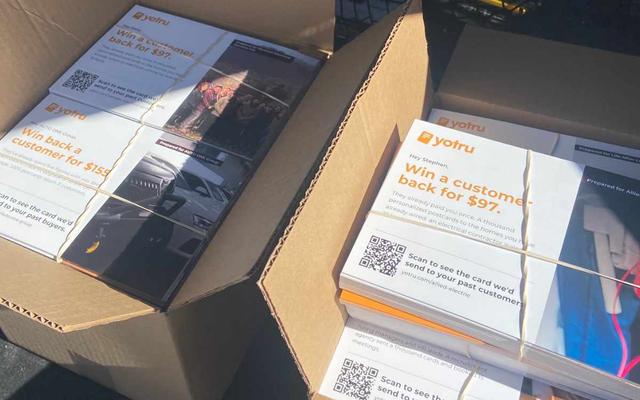
Every Yotru postcard has a unique QR code and its own landing page, so each scan is tied to one recipient. You get an alert when someone scans, and you can see which recipients engaged. Your team follows up and records the result. See what happens when someone scans a Yotru postcard.
Frequently asked questions
How do you track leads from a postcard?
Give each recipient a unique QR code or URL, send it to a landing page with one clear action, and record each response in your CRM against the person who was mailed.
Is a QR code scan a lead?
No. A scan shows interest. It becomes a lead when the person takes an action, such as booking or requesting a quote, and fits your criteria.
How do I attribute sales to a direct mail campaign?
Count direct responses through the card's code, number or offer, plus influenced sales from mailed contacts within a set window. A small unmailed holdout group shows the true incremental effect.
Should I use UTM parameters on postcard QR codes?
Yes, if the code leads to your website. UTM tags let your analytics credit the visit to the postcard. Don't put personal data in the URL.
How do I track people who call instead of scanning?
Use a phone number or offer code that only appears on the card, ask new inquiries how they heard about you, and match new leads against your mailing list.
How long should I wait before judging a postcard campaign?
Look at scans and responses within a few weeks of delivery, but judge revenue after at least one normal sales cycle.
What metrics should I report for a postcard campaign?
Mailed, scanned, responded, qualified leads, opportunities and sales, with the conversion rate and cost at each stage.
References
Erol Branovic
Marketing Specialist
Erol Branovic is a sales-focused marketing professional at Yotru, covering B2B messaging, sales outreach, and how businesses communicate their value to decision-makers through direct mail and personalized campaigns.
Keep reading
Campaign Inspiration
How to Generate Leads With Postcards: A Step-by-Step Guide
Postcards generate leads when a short list of the right recipients gets one clear offer, a way to respond that you can track, and a fast follow-up. Here is the full process, from choosing the audience to improving the next wave.
Chinedu Okafor
7 min read

Insights & Trends
How Much Does a Postcard Marketing Campaign Cost? Pricing, Budgets and Cost per Lead
What a postcard campaign really costs: the per-card price, the lines people forget to budget for, worked examples, and how to calculate cost per response, qualified lead and booked meeting so you can judge whether it pays.
Jenna Gallo
5 min read
Insights & Trends
QR Codes for Direct Mail: Setup, Tracking and Landing Page Examples
How to set up QR codes on a postcard so every scan is tracked to a person and lands on a page worth scanning for. Setup steps, UTM tags and landing page examples.
Erol Branovic
4 min read
Work with Yotru
Know exactly who responded to your postcards
Every Yotru postcard carries its own QR code and landing page, and you get an alert the moment someone scans, so your team can follow up and record the result.