
Employability
15 min read
Software Developer Resume Guide: The Complete Template for Every Career Stage (2026)
Synopsis
Your software developer resume needs to prove you can build things that work. This guide gives you one core template you can adapt whether you're a new grad, career changer, or experienced developer updating your stack—with specific examples for each situation.
Your software developer resume needs to prove you can build things that work. Whether you're a new grad with projects but no job history, a career changer bringing transferable skills, or a mid-career developer updating your stack, this guide gives you one core template you can adapt to your situation.
The software developer resume that gets interviews does three things: it shows your technical stack clearly, demonstrates you've shipped real work, and makes it easy for both humans and applicant tracking systems to find what they need. This guide covers all of it.
The Core Software Developer Resume Template
This structure works for junior developers, mid-level engineers, and senior technologists. Every section below can be adjusted based on your situation, which we cover in detail after the template.
Contact Information
Place this at the top. Include your full name, city and region (no full address needed), phone number, professional email, LinkedIn URL, and GitHub or portfolio link.
Example:
Maya Chen
Toronto, ON | (416) 555-0147 | maya.chen@email.com
linkedin.com/in/mayachen | github.com/mayachen
Professional Summary
Two to three sentences that position you for the role. State your experience level, core technical strengths, and what you're looking for. This is where you match yourself to the job.
Example for mid-level developer:
Full-stack developer with 3 years of experience building scalable web applications using React, Node.js, and PostgreSQL. Shipped production features serving 50K+ daily users at a fintech startup. Looking to bring my experience with real-time data systems to a product-focused engineering team.
Technical Skills
Organize by category so recruiters and ATS can scan quickly. Put your strongest, most relevant skills first.
Example:
Languages: JavaScript, TypeScript, Python, SQL
Frontend: React, Next.js, Tailwind CSS
Backend: Node.js, Express, Django, REST APIs, GraphQL
Data: PostgreSQL, MongoDB, Redis
Infrastructure: AWS (EC2, S3, Lambda), Docker, GitHub Actions
Tools: Git, Jira, Figma, Postman
Projects or Technical Projects
For developers with limited work experience, this section carries most of the weight. For experienced developers, include 1-2 notable projects that demonstrate skills not shown in your work history.
Each project entry should name the project, link to code or demo if available, and include 2-4 bullet points describing what you built, what technologies you used, and what the outcome was.
Example:
Real-Time Expense Tracker | github.com/mayachen/expense-tracker
- Built full-stack application with React frontend and Node.js/Express backend handling 1000+ daily transactions
- Implemented WebSocket connections for real-time sync across devices with sub-100ms latency
- Designed PostgreSQL schema with optimized queries reducing dashboard load time by 60%
- Deployed on AWS with Docker containers and automated CI/CD pipeline via GitHub Actions
Work Experience
List positions in reverse chronological order. For each role, include job title, company name, location, and dates. Below that, write 3-5 bullet points that describe what you built, what technologies you used, and what the measurable outcome was.
Example:
Software Developer | Acme Financial, Toronto, ON | Jun 2023 – Present
- Built and maintain REST APIs serving 200+ endpoints for mobile banking application used by 80,000 customers
- Reduced API response times by 40% by implementing Redis caching layer and query optimization
- Led migration from monolithic architecture to microservices, improving deployment frequency from weekly to daily
- Mentored 2 junior developers through code reviews and pair programming sessions
Education
For recent graduates, this section comes before work experience. For experienced developers, it goes after. Include degree, institution, location, and graduation date. Add relevant coursework, GPA, or honors only if they strengthen your candidacy.
Example:
Bachelor of Science in Computer Science
University of British Columbia, Vancouver, BC | May 2023
Relevant Coursework: Distributed Systems, Machine Learning, Software Engineering, Database Systems
Additional Sections (Optional)
Include these when they add value: certifications (AWS, Google Cloud, relevant technical certs), publications or conference talks, open source contributions, hackathon wins, or leadership in technical communities.
If You Have No Professional Software Experience
When you're applying for your first software developer role, your projects become your experience section. The goal is to demonstrate you can build real software, not just complete coursework.
What to Change in the Template
Move your Technical Projects section above Work Experience, or rename it to "Relevant Experience." Rename Work Experience to "Other Experience" if you have non-tech jobs to include. Your education section should come near the top since it's recent and relevant.
How to Write Project Bullets That Sound Professional
The mistake most new developers make is describing projects like assignments. Employers want to see that you can ship working software.
Weak bullet: Completed capstone project for software engineering class using React and Node.js
Strong bullet: Built full-stack task management application with React frontend and Node.js backend, implementing JWT authentication and PostgreSQL database serving 50+ test users
The difference: specific technologies, concrete implementation details, and evidence that real users interacted with your work.
What Counts as a Valid Project
Academic projects work if they involved significant technical complexity. Personal projects demonstrate initiative. Open source contributions show you can work with existing codebases. Bootcamp projects are valid if they go beyond the basic curriculum.
Strong projects to include: capstone or thesis work with technical depth, personal applications you actually use or deployed, contributions to open source projects (even documentation or bug fixes count), freelance or contract work of any size, hackathon projects especially with awards.
Example Summary for No Experience
Recent computer science graduate with hands-on experience building full-stack web applications using React, Python, and PostgreSQL. Completed 4 production-quality projects including a deployed e-commerce platform and an open source contribution to a developer tool. Eager to apply strong fundamentals in algorithms and system design to a collaborative engineering team.
If You Only Change Three Things
First, rename your sections to emphasize technical work: use "Technical Projects" and "Relevant Experience" instead of academic-sounding headers. Second, add quantifiable details to every project bullet: number of users, performance metrics, lines of code, deployment details. Third, include links to live demos or GitHub repos for every project you mention.

If You're Early-Career (0-3 Years Experience)
You have some professional experience but haven't hit mid-level yet. Your resume needs to show progression and measurable impact without overclaiming seniority.
What to Change in the Template
Keep everything on one page. Lead with your most impressive role even if it was an internship. Move education below work experience. Include 1-2 strong projects only if they demonstrate skills not shown in your job history.
How to Show Progression
Employers hiring early-career developers want to see growth trajectory. If you went from intern to junior developer, or from junior to software developer, make that visible in your job titles and responsibilities.
Example showing progression:
Software Developer | TechCorp, Ottawa, ON | Jan 2024 – Present
- Promoted from Junior Developer after 8 months based on successful delivery of payment processing feature
- Own end-to-end development of customer dashboard used by 15,000 active users
- Reduced bug backlog by 35% through implementation of automated testing suite
Junior Software Developer | TechCorp, Ottawa, ON | May 2023 – Jan 2024
- Built and maintained React components for customer-facing web application
- Participated in Agile ceremonies and contributed to sprint planning
What Metrics to Include
Early-career developers often struggle to quantify impact. Look for these numbers: performance improvements (latency, load time, throughput), reliability metrics (uptime, error rates, test coverage), user metrics (active users, daily transactions, customer satisfaction), efficiency gains (deployment frequency, time saved, tickets resolved), and scope indicators (endpoints built, features shipped, team size).
Example Summary for Early-Career
Software developer with 2 years of experience building production web applications at a B2B SaaS company. Shipped 12 customer-facing features using React and Node.js, including a real-time notification system handling 50K daily events. Looking to deepen backend expertise on a team building distributed systems.
If You Only Change Three Things
First, consolidate your education to two lines maximum and move it below your work experience. Second, add at least one quantified metric to every job bullet. Third, remove or minimize projects section unless the projects demonstrate skills your work history doesn't show.
If You're Mid-Career and Updating Your Skills
You have significant experience but your tech stack shows its age. Maybe you've been working in enterprise systems for a decade and want to move to modern cloud-native development. Your resume needs to show that your fundamentals are strong and your recent learning is current.
What to Change in the Template
Add a "Recent Technical Projects" or "Recent Upskilling" section above your work experience. This showcases your current capabilities before employers see older technologies in your job history. Compress very old roles (10+ years ago) into a brief "Earlier Career" section.
How to Position Older Technologies as Strengths
Long experience with older systems means you understand fundamentals that many newer developers lack: debugging complex systems, performance optimization at scale, working with legacy constraints, and understanding why certain architectures exist.
Example positioning older experience:
Senior Developer | Enterprise Systems Inc., Calgary, AB | 2015 – 2022
- Architected and maintained distributed transaction processing system handling $2M+ daily volume
- Led performance optimization initiative reducing batch processing time from 4 hours to 45 minutes
- Mentored team of 6 developers across 3 time zones on code quality and system design principles
Notice: no specific mention of COBOL, Java 6, or on-premise servers, but the skills demonstrated (distributed systems, performance optimization, technical leadership) translate directly to modern roles.
How to Show Recent Learning
Create a dedicated section for recent skill acquisition. Include personal projects, certifications, courses, or contributions that demonstrate current technical capabilities.
Example Recent Technical Projects section:
Recent Technical Projects
Cloud Migration POC | Personal Project | 2024
- Redesigned legacy inventory application using AWS Lambda, API Gateway, and DynamoDB
- Implemented infrastructure-as-code with Terraform and CI/CD with GitHub Actions
- Achieved 99.9% uptime with 70% cost reduction compared to on-premise hosting
Certifications: AWS Solutions Architect Associate (2024), Kubernetes Administrator (2024)
How to Handle the "Earlier Career" Section
Roles from more than 10-12 years ago can be compressed into a single block. This prevents your resume from running too long and keeps the focus on relevant experience.
Example:
Earlier Career (2008-2014)
Progressive technical roles at IBM and Deloitte including systems analyst and developer positions. Built foundation in enterprise architecture, database design, and large-scale system maintenance.
Example Summary for Mid-Career Retooling
Senior developer with 12 years building enterprise systems, now focused on cloud-native architecture and modern DevOps practices. Recent projects include AWS serverless migrations and Kubernetes deployments. Bringing deep experience in system design, performance optimization, and technical leadership to teams building scalable cloud infrastructure.
If You Only Change Three Things
First, add a "Recent Technical Projects" section above your work history showing current skills. Second, rewrite older job bullets to emphasize transferable skills (system design, debugging, architecture) rather than specific outdated technologies. Third, compress roles older than 10 years into an "Earlier Career" summary block.
If You're Changing Careers Into Software Development
You're coming from another field: maybe finance, healthcare, marketing, teaching, or something else entirely. Your resume needs to bridge your past experience to your new direction while establishing technical credibility.
What to Change in the Template
Use a hybrid structure. Your summary must explicitly name both your previous field and your transition. Create separate sections for "Software Development Experience" (projects, bootcamp work, contributions) and "Previous Professional Experience" (your career history).
How to Write the Career Transition Summary
Be direct about your transition. Hiring managers will figure it out anyway; owning it positions the transition as intentional rather than desperate.
Example:
Former marketing manager transitioning to software development after completing intensive full-stack bootcamp. Built 5 production-quality web applications using React, Python, and PostgreSQL. Bringing 6 years of experience in stakeholder management, data analysis, and cross-functional collaboration to a product engineering role.
What Transferable Skills to Highlight
Different backgrounds offer different advantages. Finance brings analytical rigor and attention to detail. Healthcare brings experience with compliance and sensitive data. Teaching brings communication skills and patience for debugging. Marketing brings user empathy and product thinking.
Map your previous experience to technical relevance:
From finance: SQL experience from reporting, analytical thinking, working with large datasets, attention to accuracy, regulatory compliance awareness
From healthcare: Working with sensitive data, understanding compliance requirements, process documentation, cross-functional collaboration, high-stakes decision-making
From teaching: Breaking down complex concepts, debugging (students' confusion = code errors), patience with iterative improvement, documentation skills, mentoring
From marketing: User research and empathy, A/B testing mindset, analytics and data interpretation, working with product teams, understanding business metrics
How to Structure the Experience Sections
Your technical experience comes first, even though your professional experience is longer.
Example Software Development Experience section:
Software Development Projects
E-Commerce Platform | Full-Stack Bootcamp Capstone | 2024
- Built complete shopping platform with React frontend, Node.js backend, and PostgreSQL database
- Implemented Stripe payment processing, user authentication, and admin dashboard
- Deployed on AWS with 99.5% uptime over 3-month testing period
Open Source Contribution | React Documentation | 2024
- Contributed 3 merged pull requests improving code examples in official React documentation
- Participated in issue triage and community discussions
Example Previous Professional Experience section:
Previous Professional Experience
Marketing Manager | Consumer Goods Corp, Vancouver, BC | 2018 – 2024
- Led data analysis initiatives using SQL and Python to measure campaign effectiveness
- Managed cross-functional projects with engineering and product teams
- Built automated reporting dashboards reducing weekly reporting time by 5 hours
Establishing Technical Credibility
Career changers often worry about being seen as "not technical enough." Build credibility through: bootcamp completion or relevant coursework, certifications (AWS, Google Cloud, etc.), public GitHub profile with consistent commits, deployed projects that people can actually use, and open source contributions of any size.
Example Summary for Career Changers
Healthcare data analyst transitioning to software development. Completed 6-month intensive program in full-stack web development while working full-time. Built 4 production applications using JavaScript, React, and Python including a HIPAA-compliant patient scheduling system. Bringing 5 years of experience working with sensitive data, cross-functional healthcare teams, and complex compliance requirements.
If You Only Change Three Things
First, write an explicit career transition summary that names your previous field and explains your move. Second, create a dedicated "Software Development" section above your previous work history. Third, rewrite 2-3 bullets from your previous career to emphasize technical or analytical work you did.
If You're an International Student or Recent Immigrant
You may have strong technical credentials from another country, but North American employers might not recognize your school, your previous employers, or your degree title. Your resume needs to translate your background into terms local hiring managers understand.
What to Change in the Template
Add brief context wherever North American employers might be confused. This means parenthetical explanations for degree titles, one-line descriptions for non-famous employers, and normalized formatting that matches local conventions.
How to Normalize Degree Names
Different countries use different degree titles. Use parenthetical equivalents to clarify.
Examples:
Bachelor of Technology in Computer Science (Equivalent to North American BSc in Computer Science)
Indian Institute of Technology Delhi, India | May 2023
Diplom-Informatiker (Equivalent to Master's in Computer Science)
Technical University of Munich, Germany | Oct 2022
Licenciatura en Ciencias de la Computación (Equivalent to Bachelor's in Computer Science)
Universidad Nacional Autónoma de México, Mexico City | Jul 2023
How to Describe Non-Famous Employers
Companies that are well-known in your home country may be unknown in North America. Add a brief description to provide context.
Examples:
Software Engineer | Infosys (Global IT services company, 300K+ employees) | Bangalore, India | 2021 – 2023
Backend Developer | Mercado Libre (Largest e-commerce platform in Latin America) | Buenos Aires, Argentina | 2020 – 2022
Full-Stack Developer | Flipkart (India's leading e-commerce company, owned by Walmart) | Hyderabad, India | 2022 – 2024
Resume Format Conventions to Follow
North American software developer resumes should: be one page for under 5 years experience (two pages acceptable for senior roles), have no photo, include no date of birth or age, include no marital status or nationality, list only city and region for location (no full address), and use standard section headings in English.
Addressing Work Authorization
If relevant, include a brief note about your work authorization status. Place it either in your contact section or at the end of your summary.
Examples:
Authorized to work in Canada via Post-Graduation Work Permit (PGWP) valid through 2027
Eligible for OPT; seeking H-1B sponsorship for long-term employment
Canadian Permanent Resident
Authorized to work in the United States without sponsorship
Example Summary for International Background
Full-stack developer with 3 years of experience building enterprise web applications at leading Indian tech companies. Expertise in React, Java, and AWS with proven ability to deliver production features for applications serving 500K+ users. Recently relocated to Toronto; authorized to work in Canada via PGWP through 2027.
If You Only Change Three Things
First, add parenthetical equivalents for your degree titles. Second, add one-line descriptions for any employer that North American hiring managers might not recognize. Third, include your work authorization status clearly if it's a strength or if employers are likely to ask.
If You're Applying for Remote Roles
Remote software developer positions have specific requirements that in-office roles don't. Your resume needs to demonstrate you can work effectively without physical oversight.
What to Change in the Template
Add evidence of remote work capabilities throughout your resume. This includes async communication experience, distributed team collaboration, and self-management skills.
What Remote-Specific Skills to Highlight
Remote hiring managers look for: experience with async communication tools (Slack, Notion, Linear, etc.), written communication skills, self-direction and time management, experience across time zones, documentation practices, and video-first collaboration experience.
How to Show Remote Work Evidence
In your work experience bullets:
- Collaborated with distributed team across 4 time zones using async standups and documented decision-making
- Maintained detailed technical documentation enabling seamless knowledge transfer across remote team
- Led remote onboarding process for 3 new developers including pair programming and recorded walkthroughs
In your skills section:
Collaboration: Slack, Notion, Linear, Loom, Figma, GitHub Projects, async communication
In your summary:
...3 years of experience working remotely with distributed teams across North America and Europe. Strong async communication skills with emphasis on documentation and written clarity.
Addressing Time Zones
If you're targeting remote roles in different time zones, mention your flexibility or overlap availability.
Examples:
Located in Vancouver (PST) with flexibility for EST overlap hours
Based in London; experienced working with US teams with 4-hour daily overlap
Available for synchronous collaboration during North American business hours
If You Only Change Three Things
First, add async communication tools to your skills section. Second, include at least one bullet per role mentioning distributed team collaboration or documentation practices. Third, mention your time zone and overlap availability in your contact section or summary.
Specialization: How to Tune the Template for Different Tracks
The same core template can be adjusted by reordering sections and emphasizing different skills depending on whether you're targeting backend, frontend, data, or DevOps roles.
For Backend-Heavy Roles
Lead your skills section with languages and backend frameworks. Emphasize databases, APIs, and infrastructure. In your project and experience bullets, focus on: API design and scalability, database optimization and query performance, system architecture decisions, and performance metrics (latency, throughput, reliability).
Example backend-focused bullets:
- Designed REST API architecture serving 50K daily requests with p99 latency under 100ms
- Optimized PostgreSQL queries reducing dashboard load time from 3 seconds to 400ms
- Implemented Redis caching layer achieving 85% cache hit rate and 60% reduction in database load
For Frontend-Heavy Roles
Lead your skills section with frontend frameworks and UI technologies. Emphasize user experience, accessibility, and performance. In your project and experience bullets, focus on: component architecture and reusability, performance optimization (Core Web Vitals, bundle size), accessibility implementation, and user-facing features with measurable improvements.
Example frontend-focused bullets:
- Built component library with 40+ reusable React components used across 3 product teams
- Improved Lighthouse performance score from 62 to 94 through code splitting and image optimization
- Implemented WCAG 2.1 AA accessibility standards achieving compliance for enterprise client requirements
For Data/ML Roles
Lead your skills section with Python, SQL, and data tools. Include ML frameworks and cloud ML services. In your project and experience bullets, focus on: data pipeline architecture, model performance metrics, scale of data handled, and business impact of analyses.
Example data-focused bullets:
- Built ETL pipeline processing 2TB daily data from 15 source systems using Apache Airflow and Spark
- Developed recommendation model improving click-through rate by 23% (validated via A/B test, p<0.01)
- Created executive dashboards in Looker used by C-suite for weekly business reviews
For DevOps/Platform Roles
Lead your skills section with cloud platforms, IaC tools, and CI/CD systems. Emphasize automation and reliability. In your project and experience bullets, focus on: infrastructure automation and scale, deployment frequency and reliability, cost optimization, and incident response improvements.
Example DevOps-focused bullets:
- Managed Kubernetes cluster running 200+ microservices with 99.95% uptime
- Implemented infrastructure-as-code with Terraform reducing environment provisioning from 2 days to 15 minutes
- Built CI/CD pipeline in GitHub Actions enabling team to deploy to production 50+ times per week
Formatting Your Software Developer Resume for ATS
Applicant tracking systems parse your resume before humans see it. Making your resume ATS-compatible isn't about tricks—it's about making your information easy to extract.
Formatting Rules That Work
Use standard section headings that ATS systems recognize: "Work Experience" or "Experience" (not "Where I've Made Impact"), "Education" (not "Academic Journey"), "Skills" or "Technical Skills" (not "My Toolbox"), and "Projects" or "Technical Projects" (not "Things I've Built").
Use a single-column layout. Avoid tables, text boxes, and graphics. Use standard fonts (Arial, Calibri, Helvetica). Save as PDF unless the application specifically requests .docx.
Keywords From Job Postings
ATS systems often score resumes based on keyword matches. Read the job posting carefully and include relevant terms naturally in your skills section and experience bullets.
If the job posting mentions "React, TypeScript, and GraphQL," make sure those exact terms appear in your resume if you have that experience. Don't stuff keywords; include them where they accurately describe your work.
What Not to Do
Don't use images or icons for your skills (ATS can't read them). Don't use headers or footers for important information. Don't use creative fonts or styling that might not parse correctly. Don't assume the ATS will understand abbreviations—use both "JavaScript" and "JS" if you have room.
Build Your Software Developer Resume
A strong software developer resume tells your technical story clearly. It shows what you can build, what technologies you use, and what results you've delivered. Whether you're a new graduate, career changer, or experienced developer updating your skills, the fundamentals are the same: clear structure, specific technologies, and measurable outcomes.
Yotru's resume builder helps you create ATS-optimized software developer resumes that highlight your technical strengths. Start with our core template and customize for your specific situation.
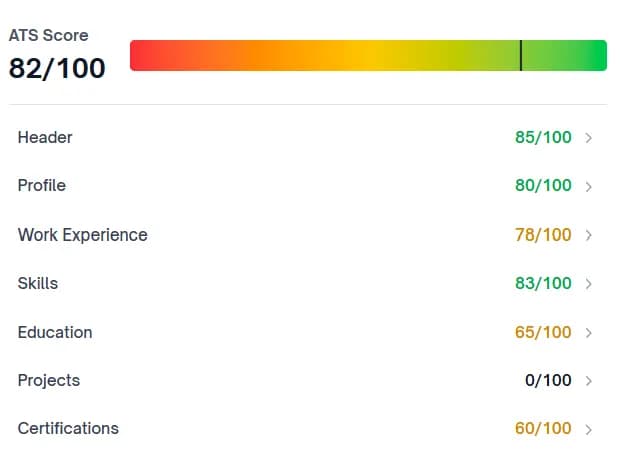
ATS-Optimized resumes That Meet Employer Standards
Our AI-powered scoring system helps organizations assess and standardize resume quality at scale. ATS-compliant templates support consistent formatting, keyword alignment, and interview readiness across cohorts.
About the Author

Team Yotru
Employability Systems
Team Yotru
Employability Systems
We build practical career tools for training providers and workforce programs, combining labor market insights with real employment outcomes. Follow us on LinkedIn.
Frequently Asked Questions
Most junior and mid-level software developers should keep their resume to one page; senior engineers with 10+ years of experience can use up to two pages if they fill the space with relevant, impact-focused content.
Audience Context
This guide is for people applying to software developer and software engineer roles at different career stages, including new graduates, early‑career developers, mid‑career engineers updating their stack, career changers moving into software, and international candidates adapting their experience for North American employers. It supports both individual job seekers and educators, workforce programs, and organizations that help people prepare for technical roles.
Research Methodology
Guidance in this article is based on analysis of recent software developer and software engineer job postings, recruiter advice for technical roles, and common applicant tracking system (ATS) formatting requirements. It is informed by labour‑market and occupational data from government sources, industry job‑market reports, and practical feedback from resume reviews in real hiring processes for developer positions.
Editorial Standards
Yotru content aims to be practical, neutral, and evidence‑informed. Claims are grounded in observable hiring patterns and reputable sources rather than insider tips or guaranteed outcomes. Examples use realistic but fictional scenarios to illustrate how software developers at different stages can present their skills, and no proprietary employer information is used.
Disclaimer
This article is for informational and educational purposes only and does not guarantee interviews, job offers, or specific outcomes. It is not legal, immigration, or financial advice. Hiring practices and technical requirements vary by employer, role, and region, so readers should adapt this guidance to their local context and the specific jobs they are targeting.
Related Resources
Resume Building & Optimization
- How to Build a Resume with No Work Experience: Step-by-Step Guide
- Make Your Resume ATS-Friendly in 5 Minutes: 2025 Guide
- 7 Traits All Great Resumes Possess
Skills & Career Development
- Interview Preparation Tips: How to Prepare and Impress Employers
- Skills in Resume for Freshers: What to Include and How to Present Them
- How to Get an Entry-Level Job in Today's Competitive Market
Market & Career Planning
- Why It Feels So Hard to Get a Job Right Now
- How Fresh Graduates Can Land a Good First Job
- What to Bring to a Job Interview
Yotru Tools & Development
References
- Tech Interview Handbook. (2018). Practical guide to writing FAANG-ready software engineer resumes. https://www.techinterviewhandbook.org/resume/
- Stack Overflow Blog. (2020, November 24). How to write an effective developer resume: Advice from a hiring manager. https://stackoverflow.blog/2020/11/25/how-to-write-an-effective-developer-resume-advice-from-a-hiring-manager/
- Indeed Editorial Team. (2025, June 30). How to create a developer resume (with tips and example). Indeed Career Guide. https://ca.indeed.com/career-advice/resumes-cover-letters/developer-resume
- Writerz. (2025, November 24). The developer’s guide to resume writing: How to write a software engineer resume that passes ATS. DEV Community. https://dev.to/writerz/the-developers-guide-to-resume-writing-how-to-write-a-software-engineer-resume-that-passes-ats-34in
- TieTalent. (2025, February 27). Making your resume ATS-friendly in 2025: What you need to know. https://tietalent.com/en/blog/148/making-your-resume-ats-friendly-in-2024-what-you-need-to-know
- U.S. Bureau of Labor Statistics. (2024). Software developers, quality assurance analysts, and testers: Occupational outlook handbook. https://www.bls.gov/ooh/computer-and-information-technology/software-developers.htm
- MEV. (2026, January 7). Software engineer job market: August 2025. https://mev.com/blog/software-engineer-job-market-august-2025
- Aura. (2025, July 22). 2025 software engineer job market: Hiring trends & skills in demand. https://blog.getaura.ai/software-engineering-job-trends
- iGotanOffer. (2024, December 8). 11 software engineer resume examples (Google, Amazon, Meta). https://igotanoffer.com/blogs/tech/software-engineer-resume-examples
Maintained by: Employability & Skills Group at Yotru
Review cycle: Reviewed regularly to reflect market changes
Last updated: January 22, 2026
Questions or Need Support?
If you are working on employability programs, hiring strategy, career education, or workforce outcomes and want practical guidance, you are in the right place.
Yotru supports individuals and organizations navigating real hiring systems. That includes resumes and ATS screening, career readiness, program design, evidence collection, and alignment with employer expectations. We work across education, training, public sector, and industry to turn guidance into outcomes that actually hold up in practice.